The Devereux Family
– 3 min read


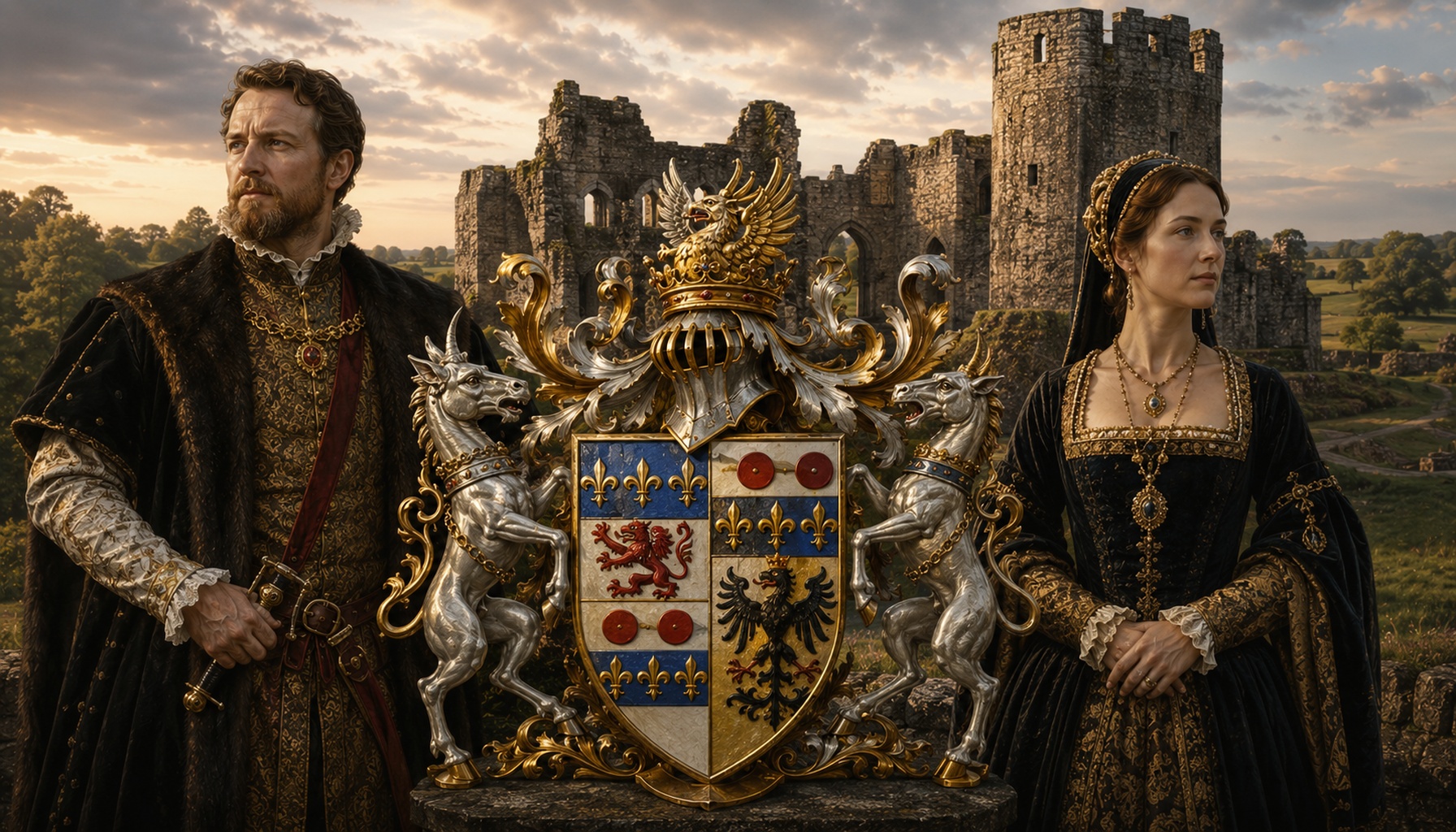
The Devereux family was one of the great Anglo-Norman noble lineages to make a lasting mark on England and the Welsh borderlands. Their name is traditionally linked to Evreux in Normandy, a reminder of the world created by the Norman Conquest, when military followers, land grants, and royal patronage could turn a continental family into an English power. In haplogroup terms, the primary family line is tagged here with R1b1a1b1a1a2c1a1e, a branch associated more broadly with western European paternal ancestry.
Once established in England, the Devereuxs built influence in the Welsh Marches, Herefordshire, Essex, and beyond, rising in exactly the way many successful Norman-descended houses did: through war, service, marriage, and proximity to the crown. Walter de Evereux, associated with 1066, stands at the family's early horizon, while figures such as Sir John Devereux, who died in 1393, show the house fully embedded in the political and military life of later medieval England. Over time the family accumulated baronial rank, viscountcies, and eventually the earldom of Essex, becoming bound up with frontier conflict, court ambition, Tudor faction, and the sort of high-stakes noble politics that so often ended in either dazzling success or disaster.
One of the most evocative places linked with the Devereux story is Chartley Castle in Staffordshire. The site began as a motte-and-bailey castle and later developed into a fortified manor with substantial medieval earthworks and ruined masonry, reflecting the long evolution of aristocratic residences from hard military strongholds into lordly power-centres. Chartley became associated with the Devereux family through noble inheritance and title history, and it sits in a landscape that still conveys the feel of medieval lordship: enclosure, control, display, and strategic placement. The ruins are known for their striking gatehouse remains and for the broad surviving outline of the castle complex, which makes it easier than at many sites to picture the scale of noble life once lived there. The castle is a scheduled historic site, and the ruins and surrounding area can still be visited, which makes it a particularly good anchor for anyone trying to connect the family name to a real and very physical landscape.
Read more about the Stafford Family
For readers interested in deeper ancestry, the Devereux family is tagged with the paternal haplogroup R1b1a1b1a1a2c1a1e. That does not mean every historical Devereux line can be genetically reduced to a single neat story, nor does it allow us to claim direct descent from ancient individuals. What it does offer is a fascinating web of related or linked ancient DNA samples across Britain and western Europe. Among them are multiple Celtic Durotriges burials from Duropolis at Winterborne Kingston such as WBK12, WBK20, WBK29, WBK41, WBK05, WBK30, WBK43, WBK06, WBK08, WBK18, and WBK191; Iron Age and Celtic Briton samples from East Kent, Oxfordshire, Somerset, Wiltshire, Hampshire, Yorkshire, Cornwall, Wales, and Scotland; and later individuals from Roman, Saxon, early medieval, and medieval contexts including Las Gobas in northern Spain, Sint-Truiden in Belgium, Hinxton and Eastry in England, Kilteasheen in Ireland, and Hedeby in southern Jutland. Taken together, these linked samples sketch a broad Atlantic and northwestern European background stretching from Bronze Age Britain to medieval frontier societies, which is exactly the kind of long, layered ancestry one might expect behind an Anglo-Norman noble house that rooted itself so firmly in Britain.
If the Devereux story speaks to you, with its Norman beginnings, marcher warfare, courtly ambition, and long trail through English history, you can take the next step yourself. Upload your DNA to MyTrueAncestry and see whether you match the Devereux family group or any of the related ancient DNA samples linked to haplogroup R1b1a1b1a1a2c1a1e.






Comments