The de Aubigny Family

– 3 min read


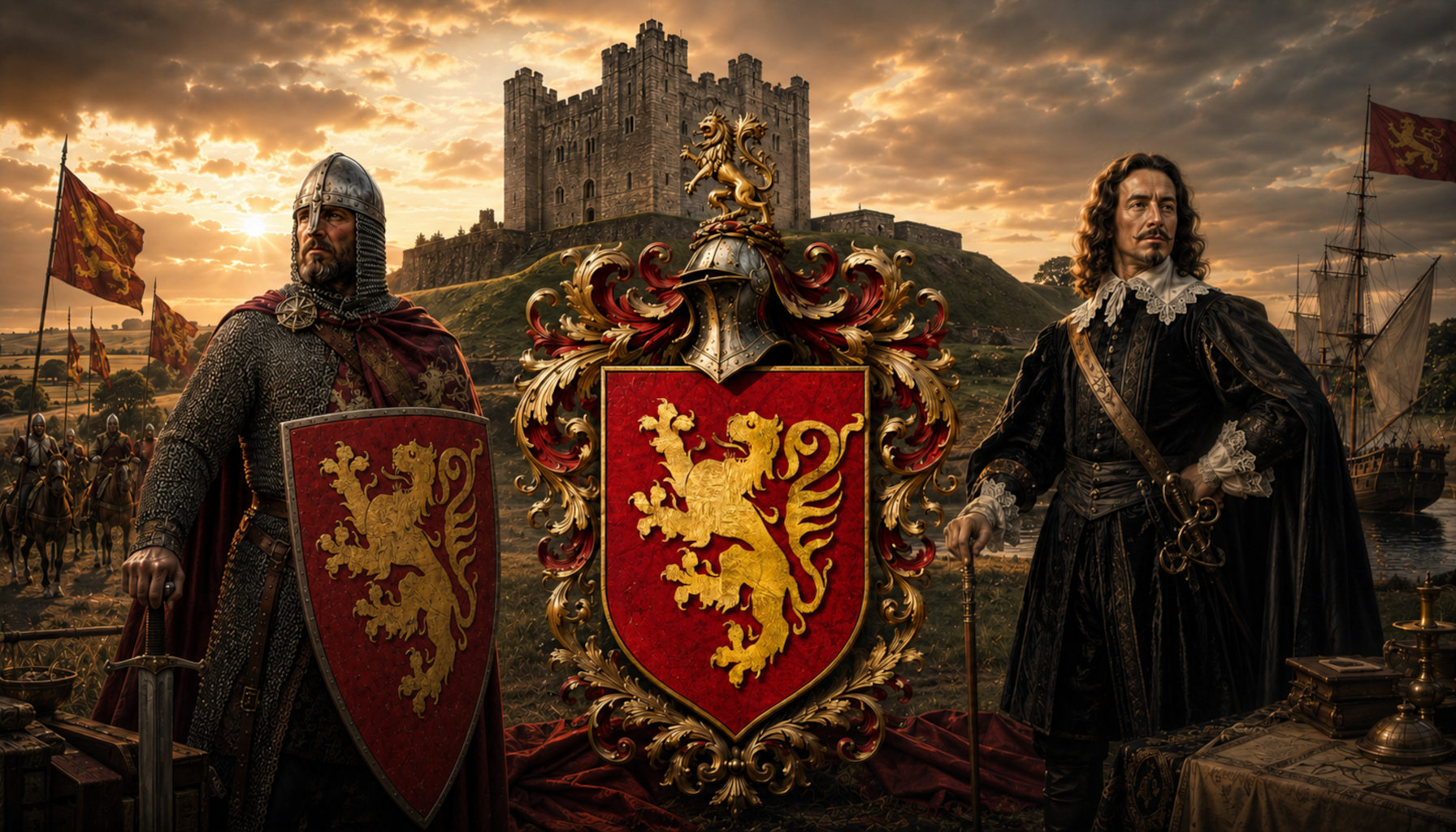
The de Aubigny, or d'Aubigny, family were one of the great Norman and Anglo-Norman noble houses, their name taken from Aubigny in Normandy and here linked with the haplogroup R1b1a1b1a1a1c2b2a1b1a4a1a1a. They belong to that formidable generation of post-Conquest aristocrats who crossed the Channel not simply as adventurers, but as builders of a new ruling class. In England they rose by the classic Norman methods: loyal service to kings, ambitious marriage alliances, strategic landholding, and the raising of castles that were as much statements of power as they were military works.
The family story is especially vivid in the 12th century. Nigel de Albini, who died in 1129, stands among the important early figures in the line, and from this wider family world emerged William d'Aubigny, 1st Earl of Arundel, the best-known of them all. His marriage to Adeliza of Louvain, the widow of King Henry I, vaulted him into the first rank of English magnates. That match mattered enormously: it tied the family not only to wealth and patronage, but to the royal aura itself. From there the de Aubignys became associated with some of the most striking symbols of Norman lordship, above all Castle Rising in Norfolk, that extraordinary keep which still seems to announce, in stone, that the Normans had arrived to stay. Their heraldry, a red shield with a gold lion rampant, fits the family rather well: bold, unmistakable, and designed to be seen.
Explore the House of de Warenne
The family's deepest geographical anchor lies in Normandy, in the place now known as Saint-Martin-d'Aubigny, today part of the commune of Saint-Martin-d'Aubigny in the Manche department of northwestern France. This is the Cotentin world, a landscape of fields, lanes, parish churches, and old settlement patterns that would have been entirely familiar to the lesser and greater nobles who supplied Normandy's military and political energy in the 11th century. A place like Aubigny was not just a dot on a map that happened to give a surname. It was the root of identity, the territorial label that told others where a family belonged, what local influence it possessed, and which network of loyalties it inhabited. In the ducal age of Normandy, these local lordships mattered enormously, and families such as the d'Aubignys carried those place-names with them into England, where they became part of the new Anglo-Norman elite. And yes, the area can still be visited today, which is one of the pleasures of Norman family history: the landscape that produced these names has not vanished into abstraction, but remains physically there for anyone curious enough to go and look.
Read more about the House of de Harcourt
From a DNA perspective, the de Aubigny family is here tagged with the paternal haplogroup R1b1a1b1a1a1c2b2a1b1a4a1a1a. As ever with medieval noble houses, one has to be careful: linked ancient samples are not the family itself unless there is direct evidence. But they do help sketch the wider genetic landscape in which such lineages moved. Related or linked examples for this branch include SDN003 from a Medieval Western Slav settler at Steuden in Sachsen-Anhalt, ADN002 from a Saxon grave at Hannover-Anderten in Lower Saxony, VK469 from Viking Age Kopparsvik on Gotland, and VK133 from Viking Age Galgedil on Funen in Denmark. That is an intriguing spread across medieval German, Saxon, Slavic, and Scandinavian contexts. It does not prove descent from the d'Aubignys, of course, but it does place this haplogroup within the broad northern European world that shaped Normandy itself: a zone of migration, warfare, settlement, and elite formation stretching from the North Sea to the Baltic and into the Frankish and Anglo-Norman realms.
Explore the Royal House of Stewart
If the de Aubigny story catches your imagination, that is really the point of bringing history and DNA together. A family like this sits at the crossroads of Norman conquest, aristocratic marriage, castle culture, and the long traffic of people between Normandy, England, France, and even later Scottish and French noble worlds. Upload your DNA to MyTrueAncestry to see whether you match the de Aubigny family profile or any of the related ancient DNA samples linked to this haplogroup.



Comments