The Carvajal Family

– 2 min read


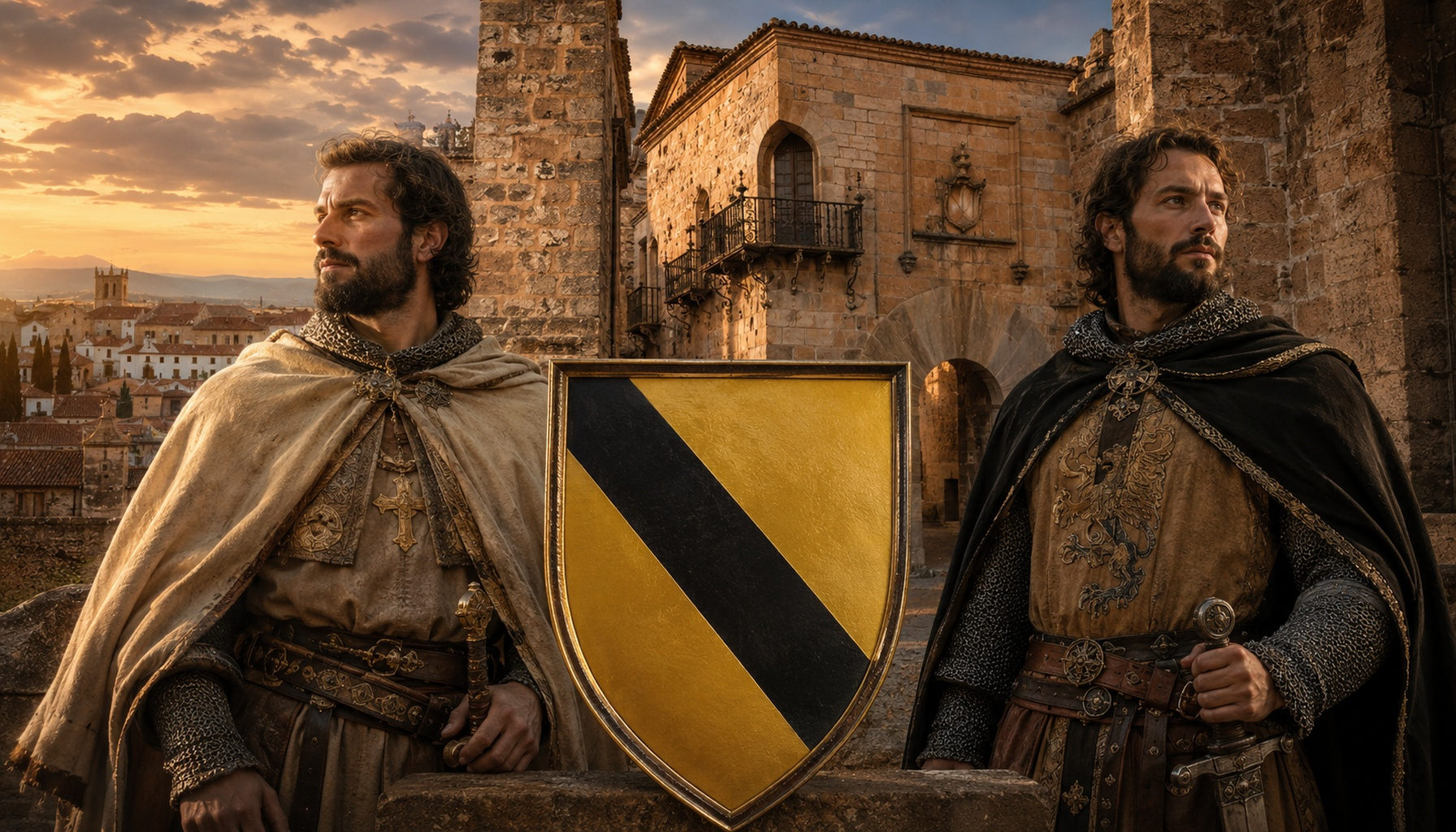
The Carvajal family was one of the historic noble lineages of Iberia, rooted above all in Spain but also connected to Portugal and the wider aristocratic world of the peninsula. In broad historical terms, House Carvajal belongs to that recognisably Iberian pattern of noble development: a family established through land, royal service, military duty, public office, church patronage, marriage alliances, and the careful preservation of lineage and heraldic identity. The primary family haplogroup linked here is I2a1a2a1a1a, a paternal line with a much deeper European story behind it.
Like many old Iberian houses, the Carvajals emerged in a world shaped by shifting frontiers, crown politics, and local power. Medieval and early modern Spain was not a single neat stage but a patchwork of kingdoms, jurisdictions, and ambitions, and noble families prospered by being useful as much as ancient. The Carvajal name appears in several regional branches, especially associated with Extremadura, and it carried weight through continuity of reputation as much as through any one dramatic origin tale. Among the best-known members are Luis de Carvajal y de la Cueva, born in 1539, a prominent colonial administrator in New Spain, and Luis de Carvajal the Younger, born in 1567, whose life and death became bound up with the tragic history of crypto-Jewish persecution under the Inquisition.
Read more about the House of Ayala
A particularly vivid anchor for the family is the Palacio de Carvajal in Caceres, in Extremadura, a region that produced a remarkable concentration of noble houses and fortified urban residences. The palace stands in the old monumental quarter of the city and is generally dated to the 15th century, though like so many aristocratic buildings it carries later alterations as well. It is built around the language of late medieval lordship: strong masonry, a tower, a noble facade, and the sense that domestic life and status display were never entirely separate from defense. Tradition also holds that parts of the building were rebuilt after damage from an earthquake. Today it remains one of the notable historic buildings of Caceres and, yes, it can still be visited, as it functions within the citys heritage landscape and tourist information network. It is exactly the kind of place that makes noble history feel tangible: not just a surname in a genealogy, but stone, courtyard, tower, and urban memory.
From a DNA perspective, the Carvajal familys featured paternal tag is I2a1a2a1a1a. That does not mean we can claim direct descent from prehistoric individuals, but it does place the family within a wider web of related ancient paternal lines found across Europe. Linked or related examples include Early Neolithic Denmark Borremose sample CGG106742, Neolithic Germany Esperstedt sample I0172, the Ancient Gotlander Battle Axe individual Ajvide52X, Distillery Cave in Oban, Argyll and Bute, Scotland sample I3133, and several Neolithic Irish individuals such as PB443 from County Clare, CH448 from Ireland, and ARD2 from Ardcrony, Tipperary. What is striking here is the breadth of the map: Scandinavia, Germany, Scotland, and Ireland all preserving branches connected to the same deeper paternal story. For a later Iberian noble family like the Carvajals, that is not a pedigree chart but a reminder that aristocratic identities sit on top of very old European population histories.
Read more about the Genetic History of Portugal
If you carry the Carvajal name, have Iberian roots, or simply want to see whether your own DNA connects with the Carvajal family story or with related ancient I2a1a2a1a1a-linked samples, you can upload your DNA to MyTrueAncestry and explore the deeper past behind your family history.
Comments