Roman Auxiliary Warrior of Kemathen
– 5 min read


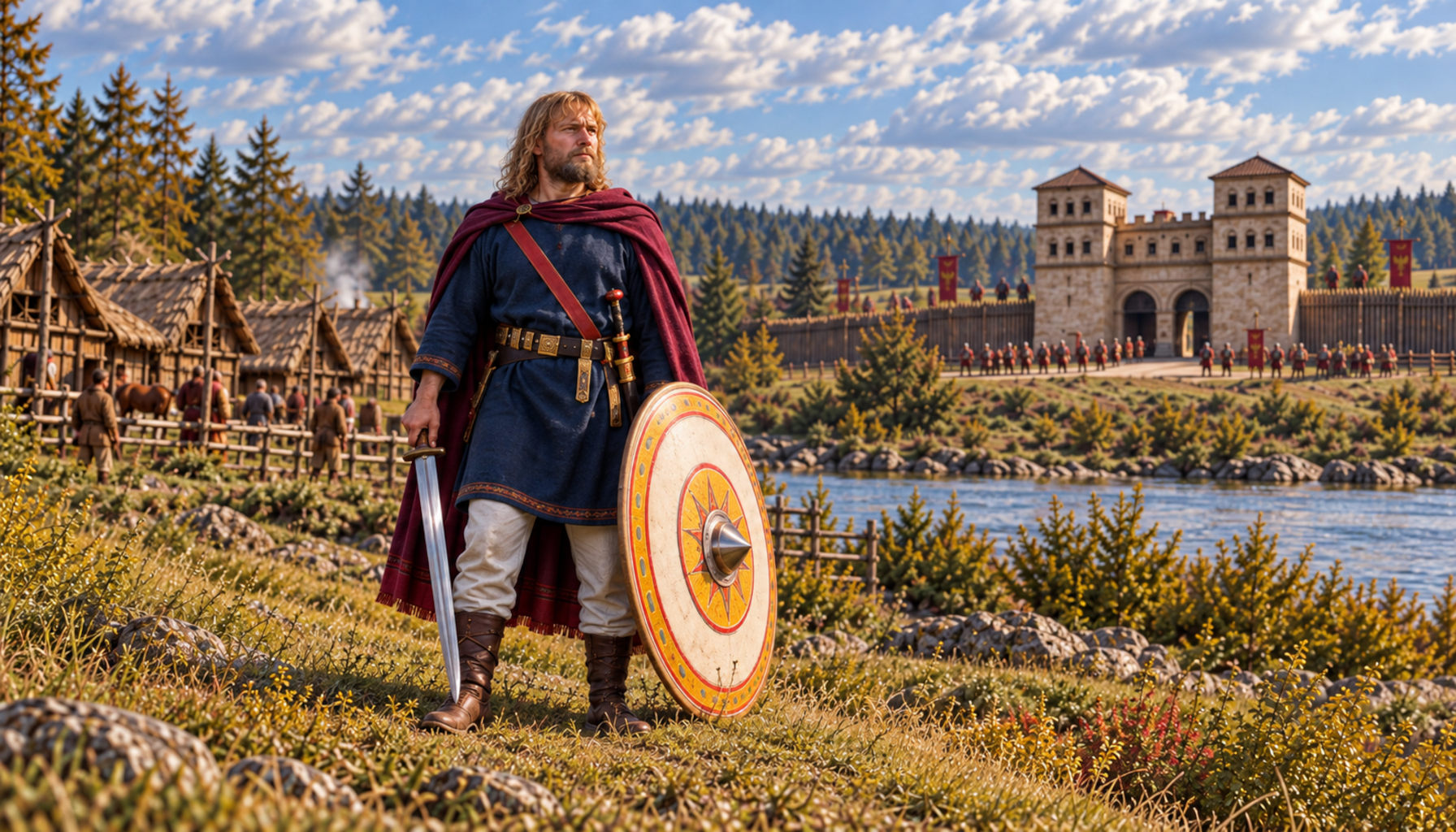
The Roman Auxiliary Warrior of Kemathen was buried around 425 AD, at the very moment when Roman power on the upper Danube was fraying and local strongmen, war leaders, and military entrepreneurs were stepping into the gap. He lay near Kemathen in present-day Bavaria, about 25 kilometers north of the old Roman frontier, and although we do not know his personal name, his grave makes plain that he was no ordinary man. This is the individual represented in ancient-DNA research as sample Kem1.
What makes him historically important is not simply that he was armed, or even richly buried, but that everything about his grave sits at the intersection of two worlds. Here was a man buried according to Germanic elite custom, yet equipped with unmistakably Roman military objects. In other words, he belonged to that fascinating late antique frontier society where “Roman” and “barbarian” were less clean categories than older textbooks liked to pretend.
By the early fifth century, the Roman Empire in the West was under intense pressure. Armies were short of men, frontiers were unstable, and imperial authority depended heavily on negotiated power with federate groups, auxiliaries, and local commanders. In that setting, a Germanic warrior could serve Rome, profit from Roman military structures, and still remain embedded in non-Roman burial traditions and local kin-based society. The Kemathen warrior seems to fit exactly that world.
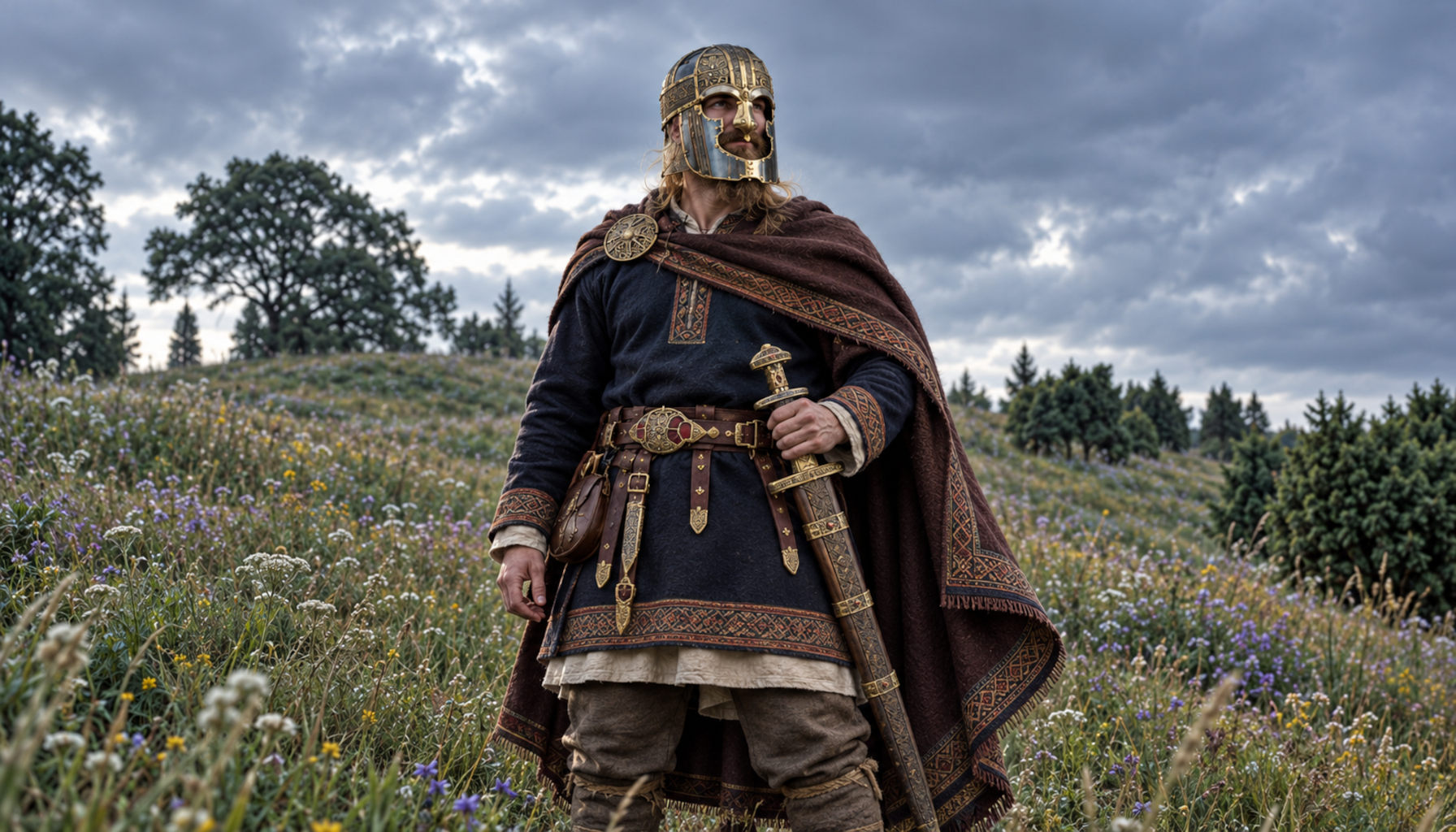
He was about 30 years old when he died and was buried alone in an elaborate wooden chamber grave, probably beneath a visible mound beside a contemporary settlement. The burial goods are a small historical drama in themselves: a long iron sword, shield, silver-wire ring, brooch, comb, knife, glass beaker, ceramic vessels, and a food offering. Most striking of all was a broad Roman military belt with bronze fittings, made in northeastern Gaul and later repaired or modified in Raetia. His sword, too, has been linked to Roman workshop traditions. The effect is vivid. This was someone who moved in the military orbit of the late Roman state, whether as an auxiliary warrior, mercenary, or frontier leader, while being commemorated in a manner that signaled Germanic elite identity and local status.
The biological sample associated with this individual is described as Late Roman Germanic Auxiliary Elite Warrior Kemathen Germany, dated to about 425 AD. The identification here is secure in the archaeological sense: the DNA comes from the remains of the man buried in the Kemathen chamber grave. What is not secure, because the evidence does not provide it, is his personal name or any exact unit, tribe, or rank. So we can confidently speak of the man in the grave and the social role suggested by his equipment, but not of a named historical figure.
That distinction matters. Archaeology gives us the burial setting, the grave construction, and the objects laid with him. Those objects strongly support the interpretation of a man tied to the Roman military world. Yet they do not pin him neatly to a single ethnic label, and nor should they. Late antiquity on the Danube was full of hybrid identities, shifting loyalties, and people who were Roman in service, Germanic in custom, and local in political ambition all at once.
The broader research context, including the study published in Nature at https://www.nature.com/articles/s41586-026-10437-3, is valuable precisely because it places burials like Kem1 into a wider genomic and archaeological landscape. Rather than isolating one dramatic grave, such work helps show how frontier communities were composed, connected, and transformed during the end of Roman rule in central Europe.
The Kemathen warrior’s Y-DNA haplogroup was I1 and his mtDNA haplogroup was H2a2a. These two markers tell us about two very narrow lines of ancestry. Y-DNA follows the direct paternal line, from father to father to father. mtDNA follows the direct maternal line, from mother to child, tracing the mother’s mother’s mother line back through time.
Haplogroup I1 is a paternal lineage with a well-known history in northern Europe and later in many Germanic-associated contexts. That does not mean I1 “proves” that this man was of any single tribe or people. It simply places his direct father-line within a lineage that appears in a range of ancient European individuals, including some connected with Germanic, Scandinavian, and post-Roman settings. In Kemathen’s case, the Y-line is interesting because it fits comfortably within the broader northern and central European genetic world one might expect on the late Roman frontier, without turning that expectation into a simplistic ethnic verdict.
His maternal lineage, H2a2a, is a branch of the wider haplogroup H family, one of the major maternal lineages in West Eurasia. Again, this is not an ethnic badge. It tells us only about one maternal thread in his ancestry, not the sum of who he was. Still, taken together, I1 and H2a2a add biological texture to the picture drawn by the archaeology: a man from the frontier world of late antiquity whose ancestry belonged to the mixed and mobile populations of Europe rather than to some tidy, bounded “Roman” or “barbarian” box.
There is also a useful ancient-DNA angle to his I1 lineage. Related I1-linked samples appear across an impressively wide chronological and geographic range, from Roman-era England and post-imperial Italy to Pannonia, Wielbark-associated Gothic contexts in Poland, Scandinavian Bronze Age burials, Anglo-Saxon England, Longobard-period Hungary, and Viking Age Scandinavia. Sample Kem1 belongs to that bigger story. The lineage turns up not in one isolated people, but across centuries of migration, military mobility, and regional continuity. That is exactly why Kem1 is so interesting: he stands at one of the hinge moments where those networks met the failing Roman frontier.
The H2a2a comparison is much narrower in the supplied material. The directly relevant H2a2a-linked sample available here is Kem1 himself. Even that is useful, though, because it reminds us that maternal lines are often less visible in historical storytelling than swords and belts. His mtDNA result anchors one small maternal thread within the same frontier biography, even if it does not by itself reveal where his mother or maternal ancestors lived.
The Kemathen warrior’s DNA is historically valuable because it helps anchor a very familiar late Roman story in an actual body. Historians have long known that the empire’s frontiers were staffed, defended, and sometimes dominated by men of mixed background serving in Roman military systems. Kem1 gives us a concrete example: not a literary stereotype, but a real man buried with Roman military gear and local elite display. His genetic lineages support the picture of a frontier figure embedded in wider European population networks.
But there are limits. His haplogroups do not tell us his language, his legal status, his unit, or whether he thought of himself as Roman, Germanic, both, or neither. Nor do they show that modern people with I1 or H2a2a are his close relatives or descendants. Ancient DNA is powerful, but it works best when read alongside grave goods, burial rite, place, and period. In Kemathen, that combined reading is what makes the man so compelling.
MyTrueAncestry lets you compare your DNA with ancient populations and archaeological samples from worlds like the late Roman frontier. You can explore whether your genetic profile shows connections to the populations, lineages, and deep history that shaped communities such as Kemathen’s warrior society.
Comments