Ludwig van Beethoven
– 5 min read


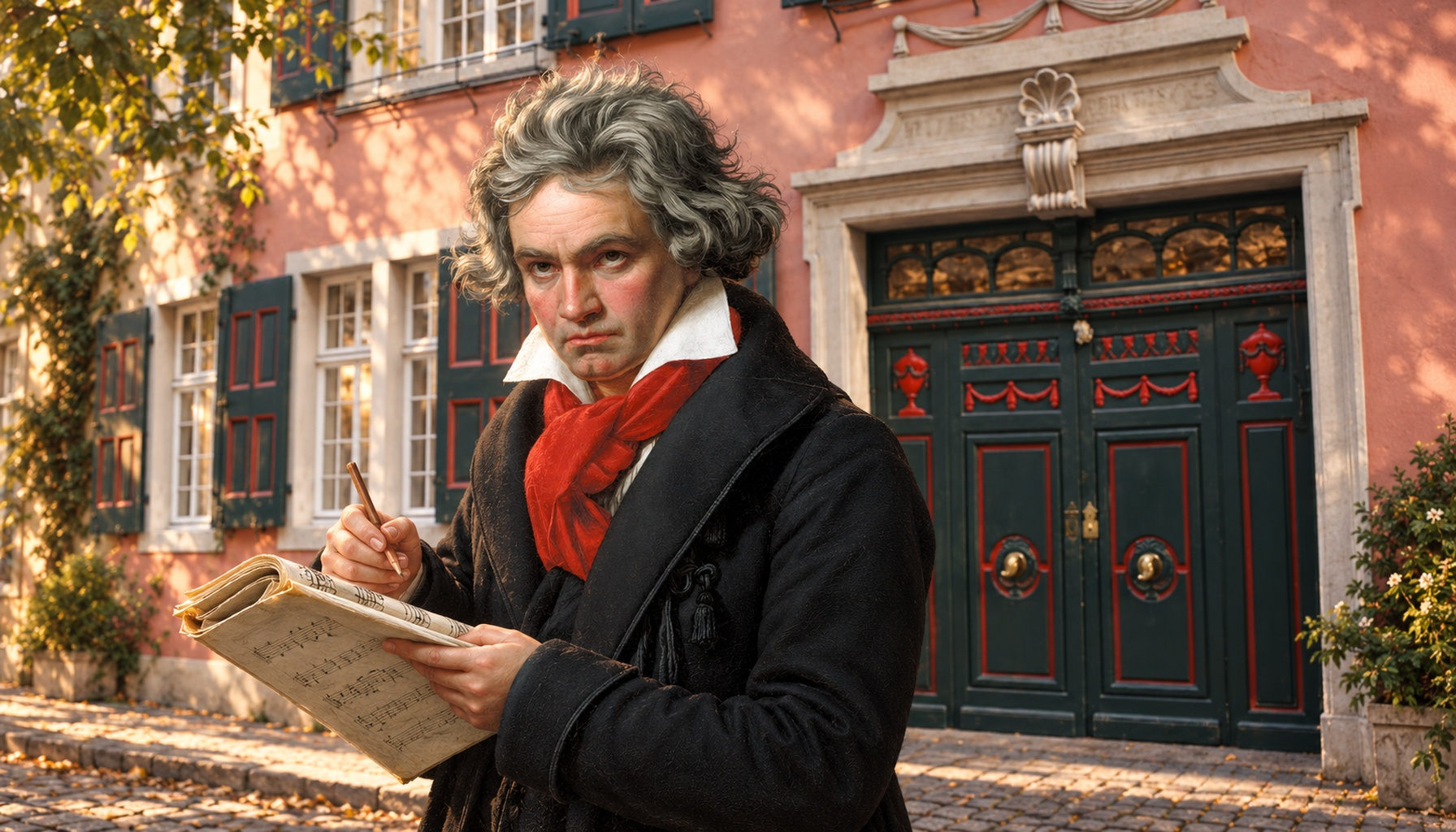
Ludwig van Beethoven was born in Bonn in 1770 and died in Vienna in 1827, and few lives are so thoroughly embedded in the history of Europe’s age of upheaval. He began in the late world of courts, patrons, and princely chapels, then lived through the French Revolution, the Napoleonic Wars, and the political reshaping of the German-speaking lands and the Habsburg world. If Haydn and Mozart represent the high Classical style, Beethoven is the figure who pushed it toward something larger, more personal, and more disruptive.
He was a German composer and pianist whose music transformed the Classical tradition and profoundly influenced the development of Western music. Born in Bonn and later based in Vienna, he produced symphonies, concertos, piano sonatas, string quartets, and sacred music of extraordinary ambition even as progressive hearing loss eventually left him profoundly deaf. That bare outline is familiar; what is newly fascinating is that Beethoven himself wanted the causes of his illnesses investigated after death. In that sense, the genome recovered from authenticated hair locks is not a modern intrusion into his story, but almost an answer to one of his own last requests.
Beethoven grew up in Bonn under the Electorate of Cologne, where his father Johann van Beethoven worked as a musician. His grandfather, also named Ludwig van Beethoven, had been a respected kapellmeister, and the family’s musical ambitions were serious, if not always happy. The young Beethoven was trained rigorously and sometimes harshly, and by his early twenties he had moved to Vienna, the capital that mattered for ambitious composers. There he entered a city that still lived in the shadow of Mozart and Haydn but was also becoming the great laboratory of European music.
Vienna in Beethoven’s lifetime was not a calm museum of culture. It was a city of aristocratic salons, censorship, war scares, and political anxiety. Napoleon’s armies marched across Europe; imperial power was tested repeatedly; and the Congress of Vienna in 1814–1815 turned the city into the diplomatic center of Europe. Beethoven’s career crossed that whole landscape. He depended on noble patrons such as Archduke Rudolf, Prince Lobkowitz, and Prince Kinsky, yet his public image came to embody artistic independence. The Eroica, the Fifth Symphony, the late piano sonatas, the Missa solemnis, and the Ninth Symphony all belong to a world in which the artist was no longer merely a servant of courtly taste, but a cultural authority in his own right.
And then there is the central personal drama: deafness. By his late twenties Beethoven had begun to lose his hearing, a cruel affliction for a composer and performer. The Heiligenstadt Testament of 1802 remains one of the most arresting documents in cultural history: not because it solves anything, but because it lets us hear him confronting despair, pride, rage, and vocation all at once. He never married, his domestic life was often turbulent, and his later years were marked by chronic illness and the bitter legal struggle over the guardianship of his nephew Karl. So the modern DNA work matters not because it reduces Beethoven to a diagnosis, but because it illuminates the bodily troubles that ran alongside one of the best documented artistic lives in history.
The sample associated here is listed as Ludwig van Beethoven Wiener Zentralfriedhof, with an approximate date of 1827 AD. In practice, the most important recent genetic study did not depend on digging up Beethoven’s skeleton from Vienna’s burial ground, but on sequencing DNA from authenticated locks of hair attributed to him. That distinction matters. Hair with reliable historical attribution is a biological sample from the historical individual, but it is not the same thing as directly sampling bone from a grave.
The identification in this case is strongly supported rather than casually assumed. Researchers tested several locks said to be Beethoven’s and found that some famous relics were not authentic, while others were genetically consistent with one another and suitable for analysis. That is exactly the sort of careful sorting historians and archaeogeneticists must do with celebrated remains and relics. A famous label on a keepsake box is not enough. The value of the 2023 study lay partly in showing that authentication comes first, interpretation second.
The results, widely discussed in reports including the Smithsonian summary, pointed toward a genetic predisposition to liver disease and evidence of hepatitis B infection in the months before Beethoven’s death. They did not provide a definitive genetic explanation for his deafness. That is a useful reminder that even a well-preserved genome cannot answer every historical question we would like to ask.
Read about DNA from Linked Artifacts
The reported Y-DNA haplogroup for Beethoven is I1a2b1c. Y-DNA tracks the direct paternal line, from father to son to son across many generations. It does not describe all of a person’s ancestry, still less their nationality or cultural identity. Beethoven was culturally German and historically a figure of Bonn and Vienna because of language, upbringing, training, patrons, and place, not because of a haplogroup label. Still, the Y lineage is interesting as one narrow thread of paternal descent, and broader branches of haplogroup I1 are historically associated with parts of northern and central Europe.
His mitochondrial DNA haplogroup is reported as H1b1+16. mtDNA traces the direct maternal line: mother to child, then through daughters onward. Like Y-DNA, it captures only one ancestral pathway among many. Beethoven’s mtDNA therefore tells us about a single maternal lineage, not the entirety of his family background. In historical genomics, these lineage markers are best treated as identifiers of deep ancestry lines, not as verdicts on ethnicity or personality.
What the wider genome added was more concrete than the haplogroups alone. Researchers found evidence consistent with elevated genetic risk factors for liver disease, and they also identified hepatitis B infection near the end of his life. Those findings fit intriguingly with long-standing descriptions of his illnesses and with accounts of the final decline that ended in 1827. By contrast, the study did not find a straightforward genetic cause for his deafness, which remains one of the great unsolved medical questions in music history.
For the paternal line, the most directly relevant I1a2b1c-linked sample available here is the Beethoven-associated sample itself, Ludwig van Beethoven Wiener Zentralfriedhof (lvb). That may sound almost tautological, but in a case like this it is useful: the ancient-DNA interest lies less in building a grand prehistoric tale around Beethoven’s Y lineage than in placing a securely studied modern-historical individual into the same lineage framework used for archaeological populations. It lets readers compare one famous nineteenth-century person with deeper paternal lineages found across older European datasets, while remembering that shared haplogroups usually point to distant common ancestry, not close kinship.
For the maternal line, the same is true of Ludwig van Beethoven Wiener Zentralfriedhof (lvb) under mtDNA H1b1+16. At present, the historically important point is not that Beethoven’s maternal lineage reveals some dramatic secret, but that it gives us one more authenticated thread in the reconstruction of his biology. mtDNA can help with sample consistency and lineage assignment, yet by itself it cannot tell us why Beethoven composed as he did, why he lost his hearing, or how he experienced the world around him.
Beethoven is a splendid case study in what historical genomics can and cannot do. It can test the authenticity of famous biological relics. It can reveal medically relevant clues, such as liver disease risk and infection. It can assign paternal and maternal lineages. But it cannot turn a genome into a complete biography, and it cannot solve every mystery simply because the subject is famous. The real fascination is that Beethoven’s life is already so richly documented in letters, conversation books, legal papers, musical manuscripts, and eyewitness accounts. DNA enters that archive as one more piece of evidence: powerful, but partial.
Discover Ancient DNA and Archaeogenetics
With MyTrueAncestry, you can compare your DNA with ancient populations and archaeological samples from the wider historical worlds that shaped people like Beethoven, from central European lineages to deeper prehistoric connections. It is a way to explore genetic history, not to claim direct descent from a famous composer.






Comments