House La Zouche

– 2 min read



House La Zouche was a notable Anglo-Norman noble family whose rise belongs squarely to the hard-edged world created after the Norman Conquest: a world of mounted service, royal patronage, land grants, inheritance disputes, lordship, and careful marriage strategy. Their name points back to continental roots in the Norman-Angevin sphere, from which families like this crossed into England and turned knightly status into hereditary power. In haplogroup terms, the primary family line here is linked with R1b1a1b1a1a2b3c, a branch found across a long sweep of western and central European history.
The La Zouches became prominent not because medieval nobility was ever static, but because it was always active. Men of this house served kings, held estates, fought, litigated, married well, and built up baronial standing over generations. Figures such as Alan de la Zouche (1136-1190), Roger la Zouche (1175-1238), and Alan la Zouche (1205-1270) show the family at work across the 12th and 13th centuries, moving within the political life of the realm. Their story is, in miniature, the story of many successful Anglo-Norman families: continental origin, English land, feudal obligations, heraldic identity, and a determined effort to remain visible among the governing class.
Read more about the House of de Clare
The family’s best-known English anchor is Ashby de la Zouch in Leicestershire, later crowned by the great ruin of Ashby de la Zouch Castle. The site became associated with the La Zouche lords in the medieval period, and the place-name itself preserves that connection with unusual clarity. The castle seen today is largely the grand later medieval fortress-house developed by the Hastings family, but its deeper significance lies in the continuity of noble occupation at Ashby and in the way such places embodied aristocratic life: residence, defense, estate administration, display, hospitality, and local authority all rolled into one. Its surviving towers, curtain walls, and long broken but still impressive masonry make the point rather well that medieval lordship was never just an abstract title; it was built into landscape, stone, and memory. Better still, the castle survives as a historic monument and can still be visited today.
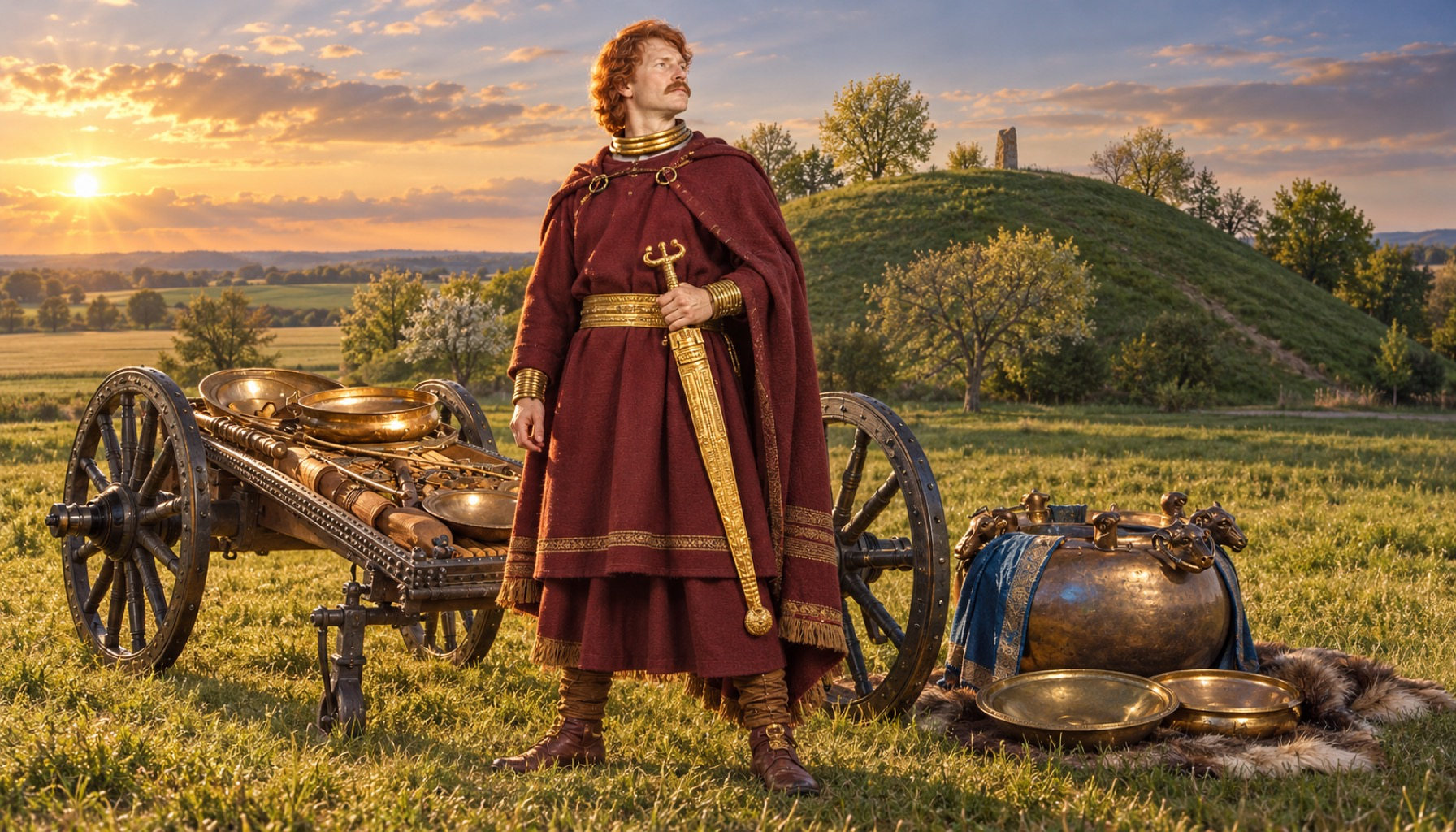
The La Zouche family’s tagged paternal line, R1b1a1b1a1a2b3c, belongs to a wider European genetic story rather than to one provable single medieval pedigree. That is an important distinction. We should not claim direct descent from ancient individuals merely because they share a linked branch. What we can say is that related or linked samples with this haplogroup appear across an arrestingly broad historical map: Medieval Northern Spain at Las Gobas, including ldo066, ldo037, ldo048, and ldo062; Iron Age and Roman Britain, including Durotriges samples WBK36, WBK39, and WBK35, and Roman Era Fenstanton sample FEN008; elite Celtic burials in Germany such as APG001, APG003, and LWB001; Gallo-Roman France at Metz Lunette Sablon; migration-period and Longobard-era Pannonia; late medieval England at Clopton in Cambridgeshire; Carolingian and medieval Belgium at Sint-Truiden; and even deeper Bronze Age horizons in central Europe and Iberia. In other words, this is a lineage with a long archaeological shadow across the same western European world from which the Anglo-Norman nobility ultimately emerged and into which it inserted itself.
If House La Zouche catches your imagination, the next step is wonderfully simple: test the history in your own DNA. Upload your results to MyTrueAncestry and see whether you match House La Zouche, the haplogroup R1b1a1b1a1a2b3c, or any of the related ancient samples linked to this wider medieval and pre-medieval European story.



Comments