House de Tancarville
– 3 min read


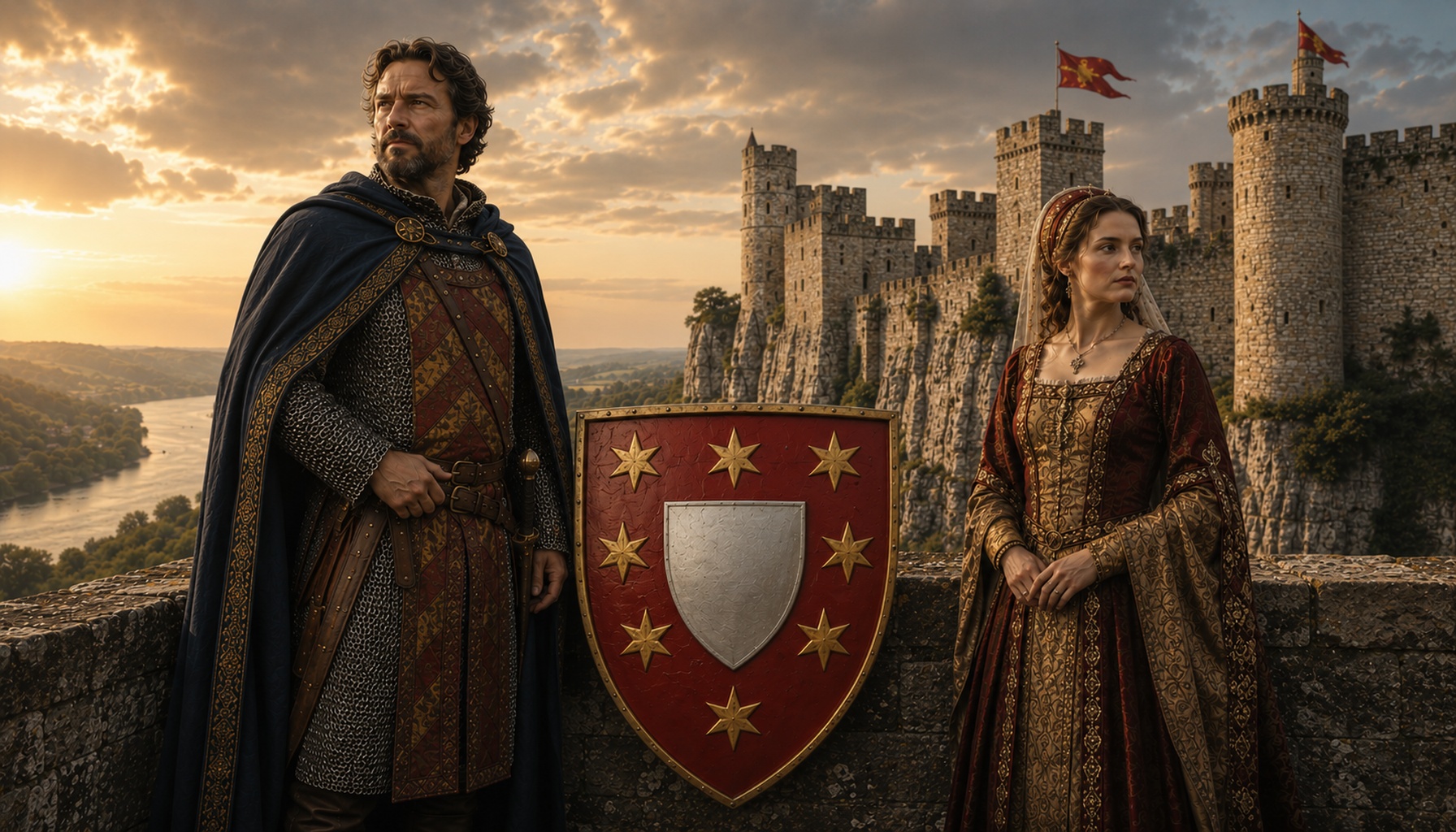
The House de Tancarville was one of the notable noble families of medieval Normandy, rooted in the lordship and castle of Tancarville near the Seine, and closely tied to the hereditary chamberlainship of Normandy. In haplogroup terms, the primary family association here is tagged to R1b1a1b1a1a2a, a lineage with a long and wide history across western Europe. The Tancarvilles belong to that recognisably Norman world of castle lords, office holders, and aristocratic servants of ducal power: men whose authority came not just from owning land, but from standing close to the machinery of rule itself.
Their origins are best understood in the landscape that made them. Tancarville stood in the Seine valley, one of the great arteries of Normandy, where fortification, river control, and ducal politics all went together. This was not an idle countryside of picturesque ruins; it was a strategic zone in a duchy built by war, lordship, and administrative innovation. Families like the Tancarvilles rose because Normandy rewarded disciplined service. The hereditary chamberlainship gave them prestige at the ducal court, while their castle lordship anchored them in the feudal world of military obligation, alliance, and local dominance. Figures such as Raoul de Tancarville (1030-1080) belong to the family's formative great age, while the later title history brings in names like Ford Grey, 1st Earl of Tancarville (1655-1701), and Charles Bennet, 6th Earl of Tancarville (1810-1899), showing how the name survived and was repurposed in later aristocratic culture far beyond its original Norman setting.
Explore the House of de Harcourt
One especially interesting later location anchor for the Tancarville title story is Chillingham Castle in Northumberland. Although the medieval Norman family itself sprang from Normandy, the later earldom of Tancarville became entangled with the British aristocratic world, and Chillingham offers a vivid architectural stage for that later history. The castle is famous for its long and layered past, with origins as a monastery site before becoming a fortified manor and then a full castle near the Anglo-Scottish border. That border setting mattered enormously: this was a frontier landscape, and Chillingham developed the heavy defensive character one would expect from a place exposed to centuries of tension and raiding. The building today is known for its battlements, towers, substantial medieval fabric, later domestic remodelling, and a reputation for richly furnished historic interiors. It remains one of those places where aristocratic residence and military architecture still sit visibly on top of one another. Better still, it can still be visited, which means the family story is not trapped in parchment and pedigree but can still be encountered in stone, rooms, and landscape.
Read more about the House of Grey
For the DNA side of the story, the R1b1a1b1a1a2a tag links the House de Tancarville to a very broad archaeological horizon rather than to any single proved ancestor. That is an important distinction. We are not claiming direct descent from named ancient individuals, only pointing to related or linked ancient DNA samples carrying branches associated with this wider paternal profile. Among them are medieval individuals from northern Spain at Las Gobas such as ldo066, ldo037, ldo046, ldo048, ldo040, and ldo062; elite Celtic burials in Germany including Magdalenenberg MBG013, Asperg-Grafenbuehl APG001 and APG003, Ludwigsburg Roemerhuegel LWB001, and Hochdorf HOC001; Roman and later British examples such as NWC009 from Eddington, FEN008 from Fenstanton, ARB003 from the Arbury wooden coffin burial, DUX003 from Duxford, and several Durotriges samples from Winterborne Kingston including WBK103, WBK106, WBK17, WBK36, WBK192, WBK10, WBK105, and WBK23. There are also linked examples stretching back into Bronze Age France and central Europe, and forward into early medieval and medieval contexts across England, Belgium, Germany, Hungary, Italy, Scotland, and Iberia. In other words, the haplogroup sits comfortably in the old western European genetic landscape from which Norman aristocratic lineages later emerged.
If the House de Tancarville catches your imagination, that is probably because it brings together so many classic strands of medieval history at once: Norman castles, river lordship, ducal office, Anglo-Norman connections, and the long afterlife of noble titles. Uploading your DNA can help you see whether you match the House de Tancarville profile or any of the related R1b1a1b1a1a2a-linked ancient DNA samples that illuminate the deeper population history behind families like this.

Comments