Haplogroup R1b1a1b1a1a2c1a5c3b1a1a

– 5 min read


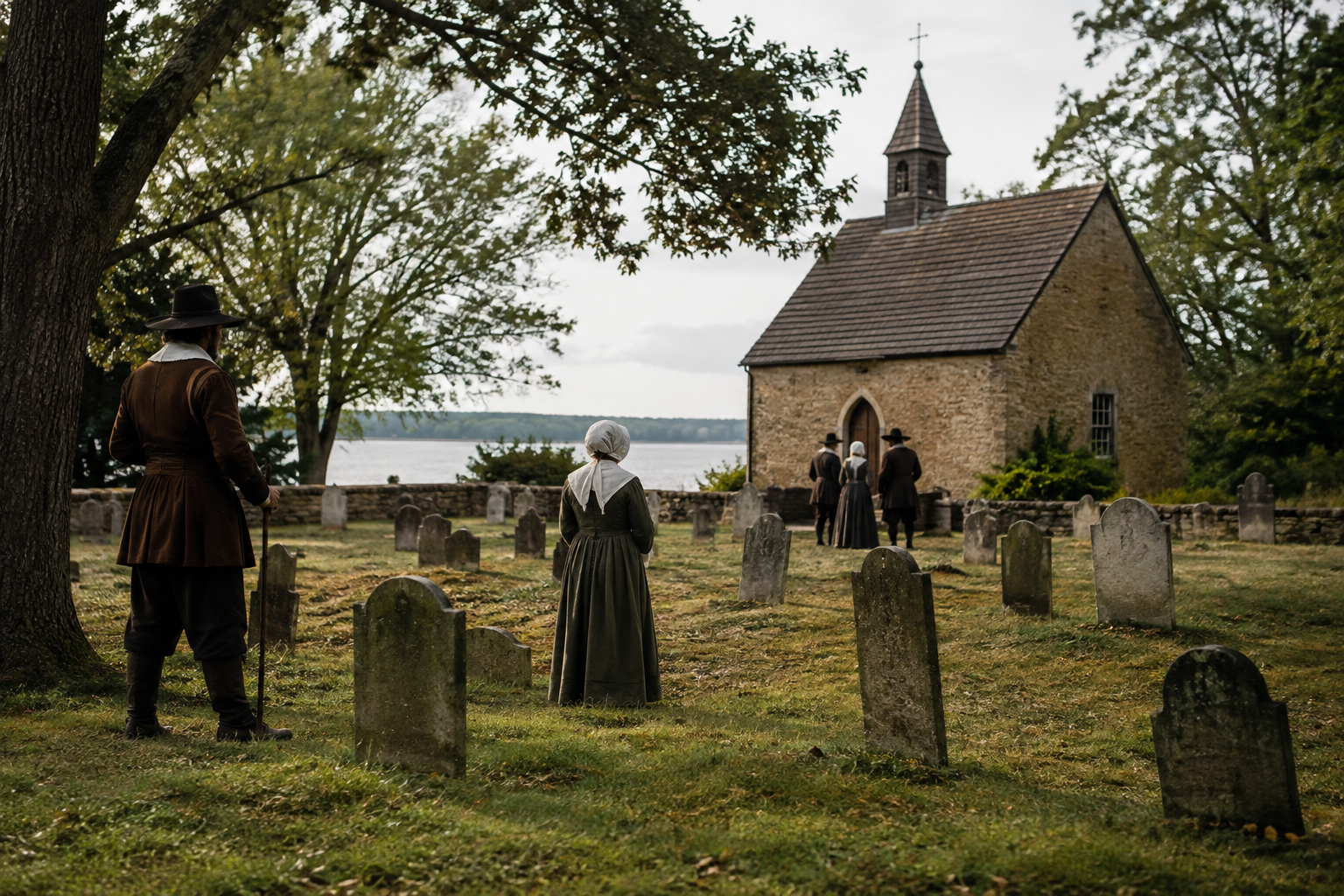
In the Chapel Field Cemetery at Historic St. Mary's City in Maryland, one man buried around 1667 AD carries a very modern sort of afterlife: he is known to us in part through Y-DNA. The individual labeled I35259 belongs here because he has been associated with the very narrow paternal branch R1b1a1b1a1a2c1a5c3b1a1a, a lineage nested deep inside the enormous R1b family that is common across western Europe and in many populations shaped by European expansion.
That may sound forbiddingly technical, but the setting is wonderfully concrete. St. Mary's City was the first colonial capital of Maryland, a 17th-century settlement built out of ambition, experiment, religion, trade, and hardship. So the interest of this haplogroup is not that it turns up in some misty heroic age, but that it appears in one of the best documented early colonial landscapes in North America, where archaeology and genetics can be set directly against written history.
The Chapel Field Cemetery is important because it belongs to the earliest generation of English colonial society in Maryland. Burials there come from a community planted on the western shore of the Chesapeake in the 1600s, at a moment when the Atlantic world was being remade by settlement, forced labor, commerce, and disease. A lineage like R1b1a1b1a1a2c1a5c3b1a1a, found in I35259, belongs to that story of movement rather than to a single tidy ethnic label.
We should be careful here. Y-DNA tracks one direct paternal line only: father to son, back through time. It does not summarize the whole ancestry of this man from St. Mary's City, and it certainly does not tell us everything about his language, status, or identity. But it does give us one sharply focused clue about how particular male lines from Europe became part of early colonial America.
A recent ancient DNA study on St. Mary's City examined exactly this colonial population in its archaeological context, linking genetics to the lives and deaths of people buried in Maryland's 17th-century capital: research on the genetic legacy of colonial St. Mary's City. That kind of work matters because it shifts the discussion away from family legend and toward excavated individuals with dates, places, and material context.
The main thing to notice about R1b1a1b1a1a2c1a5c3b1a1a is that it is very specific. The broad parent haplogroup R1b has a deep and complicated history in Eurasia and later became especially prominent in much of Atlantic Europe. But a long terminal branch like this is not a synonym for all R1b men, nor can we safely pour the whole prehistory of R1b into one 17th-century burial in Maryland.
Instead, the narrower subclade tells us that I35259 can be placed on a fine-grained paternal twig within that much larger tree. In practical historical terms, that matters because colonial cemeteries often contain people whose lives are close enough to the documentary record that genetic data can illuminate specific settlement histories rather than only vast prehistoric movements.
This is one reason early modern archaeology is so revealing. In prehistoric graves, we often wrestle with broad cultural labels and long chronological gaps. At St. Mary's City, by contrast, we are dealing with a colonial town whose political role, religious institutions, and social tensions are independently known. Genetics enters an already crowded archive.
There is a temptation to treat early English America as if it were simply an overseas copy of England. The archaeology of St. Mary's City resists that neat picture. This was a frontier capital in a contested Chesapeake environment, where European settlers, indentured servants, enslaved Africans, and Indigenous peoples all formed part of the same turbulent world, though not on equal terms.
The Chapel Field Cemetery therefore matters not merely as a place where one Y-haplogroup was identified, but as evidence for how populations were assembled on the ground. A paternal lineage associated with a colonial burial can speak to origins in the British Isles or nearby parts of Europe, but its real historical weight comes from the fact that it had already crossed an ocean and entered a new and brutal social order by the mid-17th century.
That is a useful corrective for anyone reading haplogroups too romantically. The paternal past is not only the story of tribal expansions or medieval dynasties. Sometimes it is the story of a man buried in a chapel cemetery in Maryland, inside a colony still finding out what sort of society it would become.
One sample is not a population. That sounds obvious, but it is worth saying because ancient DNA is most powerful when it is interpreted at the right scale. I35259 does not stand for every man in colonial Maryland, every English settler, or every bearer of this haplogroup. What he does provide is a securely placed data point: a direct paternal line present in a specific cemetery, at a specific colonial capital, around a specific date.
Archaeologists love this sort of evidence because it is bounded. We know the site. We know the historical setting. We know the burial belongs to the 17th century. And because St. Mary's City has been studied as a colonial settlement rather than as an isolated grave, the genetics can be read alongside material culture, mortuary practice, and the settlement's wider social history.
That is also why colonial-era ancient DNA has become so interesting in recent years. It allows us to see the making of Atlantic populations not as an abstraction, but as something visible in cemeteries, churchyards, plantations, and towns. The paternal line in I35259 is a tiny strand of that much larger process.
The wider R1b background of this lineage makes broad historical sense in a Maryland colonial cemetery, since many male settlers in the Chesapeake came from populations in which R1b branches were common. But the point is not to flatten the story into "European equals R1b." The more useful observation is that a finely resolved branch such as R1b1a1b1a1a2c1a5c3b1a1a shows how detailed paternal reconstruction can now be, even for individuals buried in the 1600s.
That detail opens interesting comparisons with other work on mobility and language in Europe. Studies of how lineages spread with changing populations, such as research discussed in MyTrueAncestry's piece on Germanic-language dispersals, remind us that paternal lines often outlast languages, kingdoms, and identities. By the time a branch appears in colonial Maryland, it has already passed through many historical filters.
And that is rather the charm of this evidence. The haplogroup name is microscopically precise; the human history behind it is expansive and messy. Somewhere along that paternal chain were men who lived in European villages, ports, market towns, or estates long before one descendant line ended up in Maryland's first capital.
For someone whose paternal line falls under R1b1a1b1a1a2c1a5c3b1a1a, the St. Mary's City burial offers a grounded historical reference point: this branch, or a reported association with it, appears in a documented 17th-century colonial cemetery in Maryland. That does not promise descent from this man, nor does it reduce your ancestry to one line. But it does place the branch in a real excavated community at the beginning of English Maryland, where genetics meets the archaeology of colonization in unusually direct fashion.

Comments