Haplogroup R1b1a1b1a1a2b1c1a1a2a1

– 5 min read


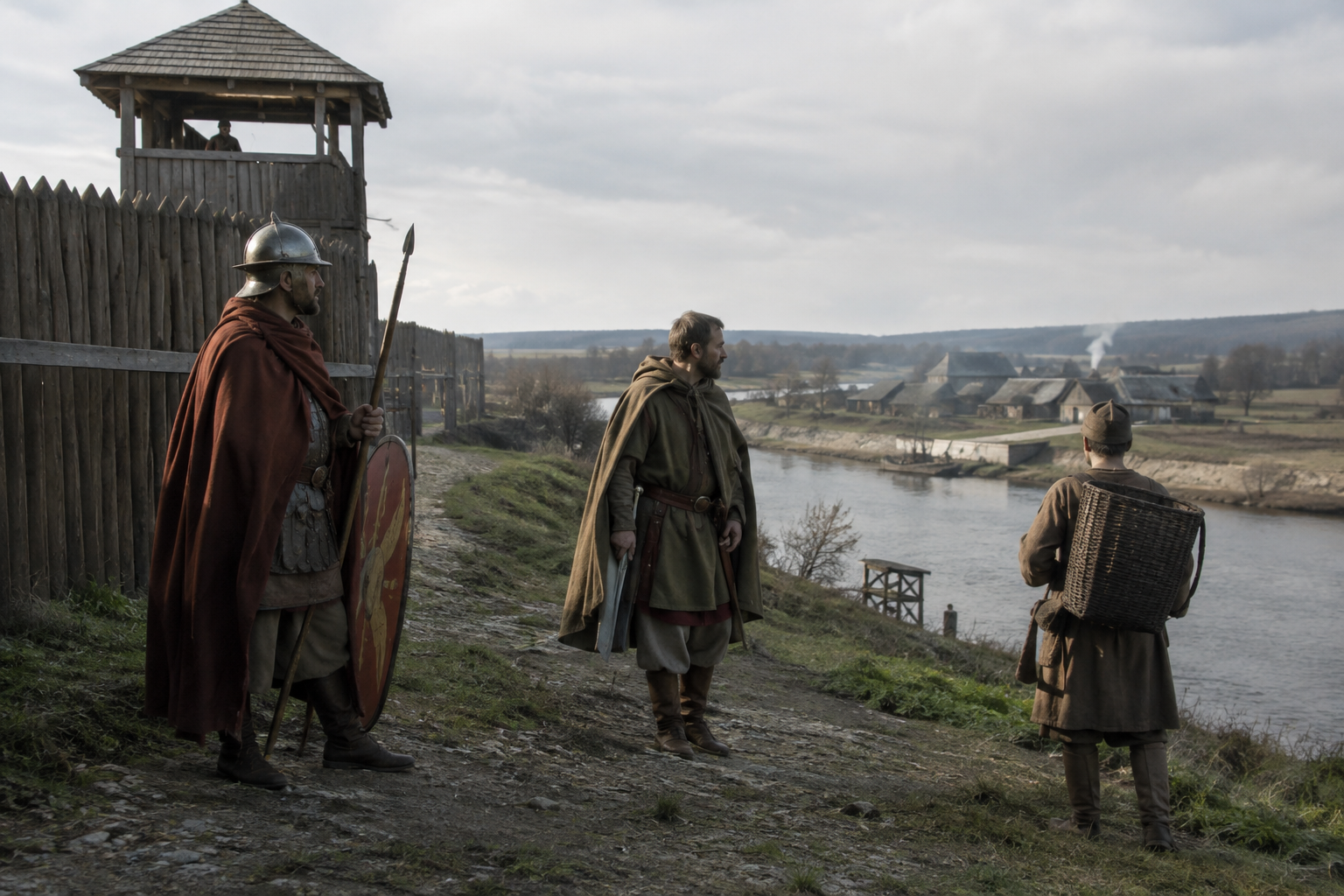
At Straubing-Azlburg on the Roman frontier in Bavaria, one man from around AD 400 carries a very narrow paternal signal into view: sample STRAZ_II_27, associated here with Y-DNA haplogroup R1b1a1b1a1a2b1c1a1a2a1. On paper that may look like an impossibly long string of letters and numbers. In historical terms, though, it places a direct male line inside one of the most unsettled landscapes of late antiquity: the Danube edge of the fading Western Roman world.
That setting matters. Straubing was not some remote village beyond events, but part of the frontier zone where soldiers, civilians, traders, migrants, and local communities met under Roman rule and then carried on through its transformation. A Y-chromosome line traces only one paternal thread, not a person's whole ancestry or identity, yet in a border cemetery even that single thread can be revealing. It asks a sharp question: what did male-line continuity look like when empire, language, and political loyalties were all in motion?
Straubing, ancient Sorviodurum, sat on the Danube corridor in what is now southern Germany. By about AD 400 this was a zone of pressure and adaptation. Roman administration still mattered, but frontier life had long depended on movement: troops recruited from different regions, families attached to military communities, local provincials, and newcomers from beyond the imperial boundary.
That is the right backdrop for STRAZ_II_27. We are not dealing with a neat ethnic label that can be read straight off a chromosome. We are dealing with a man buried in a frontier community at a moment when "Roman" and "barbarian" were categories people argued about, manipulated, and lived across. An ancient DNA study of these frontier populations, published in Nature, has helped illuminate just how mixed and locally specific such communities could be.
The haplogroup itself belongs within the vast broader family of R1b, one of the major paternal lineages in western Eurasia. But the article's branch, R1b1a1b1a1a2b1c1a1a2a1, is far narrower than that big umbrella. It would be a mistake to pour the entire prehistory of R1b into this one late Roman grave. What the sample gives us securely is a direct paternal line present at Straubing-Azlburg in late antiquity, not a complete migration map from prehistory to Bavaria.
With only one named ancient individual in the record here, the temptation is either to say too much or too little. Too much would mean inventing kin-groups, tribal identities, or a dramatic biography for STRAZ_II_27. Too little would miss the point of archaeology on the Roman edge, where even a single well-placed sample can anchor a wider historical picture.
Straubing-Azlburg sits in exactly the kind of landscape where lineages were being redistributed. Men could arrive through military service, through family migration, through local continuity from earlier provincial communities, or through networks that linked the Danube to regions farther north and east. A paternal lineage found here does not tell us which of those stories applies on its own, but it does show that this branch had entered, or persisted within, a frontier population at the very end of Roman power in the region.
That is historically interesting because the late fourth and early fifth centuries were not simply an age of collapse. They were also a period of reshuffling. Cemeteries from frontier zones increasingly reveal communities that cannot be reduced to a single origin story. The old textbook picture of solid Romans on one side and solid Germans on the other has been taking a battering from archaeology and genomics alike.
This is where careful language matters. Broader R1b lineages are widespread across Europe, and some sub-branches became especially common in different western and central European populations over long periods. But STRAZ_II_27's assignment to R1b1a1b1a1a2b1c1a1a2a1 should not be turned into a shortcut for ethnicity, language, or legal status.
A man with this paternal line could have spoken Latin, a Germanic language, or more than one language across his family network. He could have belonged to a locally rooted provincial family, a militarized frontier household, or a recently mobile group. Ancient DNA is powerful precisely because it complicates these old binaries. It shows that burial communities often contained several kinds of ancestry and several family histories at once.
That wider point fits neatly with other MyTrueAncestry discussions of language and migration in northern Europe. Genomics can illuminate broad processes, but it rarely hands us a simple ethnic name for one man in one grave.
Germanic languages and genomics
Roman frontiers were not just walls and watchtowers. They were social engines. The Danube limes drew in recruits, craftsmen, merchants, dependants, and families over generations. Even after formal imperial structures weakened, the communities shaped by that frontier did not simply vanish overnight. They adapted, reassembled, and carried older habits into new political worlds.
That is one reason a late Roman sample from Straubing-Azlburg is so useful for paternal ancestry. It places this branch not in an abstract "Central Europe," but in a very specific human environment: a settlement zone molded by empire and then tested by its fragmentation. If your own paternal line falls near this branch, the archaeological value lies less in claiming descent from a named people and more in recognizing the sort of world your line may have passed through - militarized, mobile, and socially mixed.
Recent ancient DNA work on frontier communities elsewhere in the Roman north has made similar points. Sites along the Lower Rhine and other military corridors show that movement was built into border life. The Danube was no different. It was a corridor, not a cul-de-sac.
The most responsible way to read R1b1a1b1a1a2b1c1a1a2a1 here is as a documented late antique paternal presence on the Bavarian frontier. That is already significant. It ties the branch to a period when old provincial communities and incoming groups were interacting intensely, and when the male line recorded in STRAZ_II_27 formed part of that living frontier society.
What it does not do is prove that everyone in this branch descends from Roman soldiers, frontier settlers, or any one Migration Period people. Y-DNA is narrow by design: wonderfully precise for one line, necessarily incomplete for the rest of a family tree. But that narrowness is exactly why it can be so evocative. A single line can survive political collapse, cultural change, and local resettlement while the rest of the historical scene shifts around it.
So the real significance of STRAZ_II_27 is not grandeur but placement. This branch appears in a man buried at the edge of empire, at a time when identities were layered and communities were being remade. For anyone exploring this paternal lineage today, that is a solid and intriguing historical foothold: not a mythic founder, but a documented presence in one of Europe's great contact zones.
Comments