Haplogroup R1b1a1b1a1a1c2b2b1a1a1b1

– 4 min read


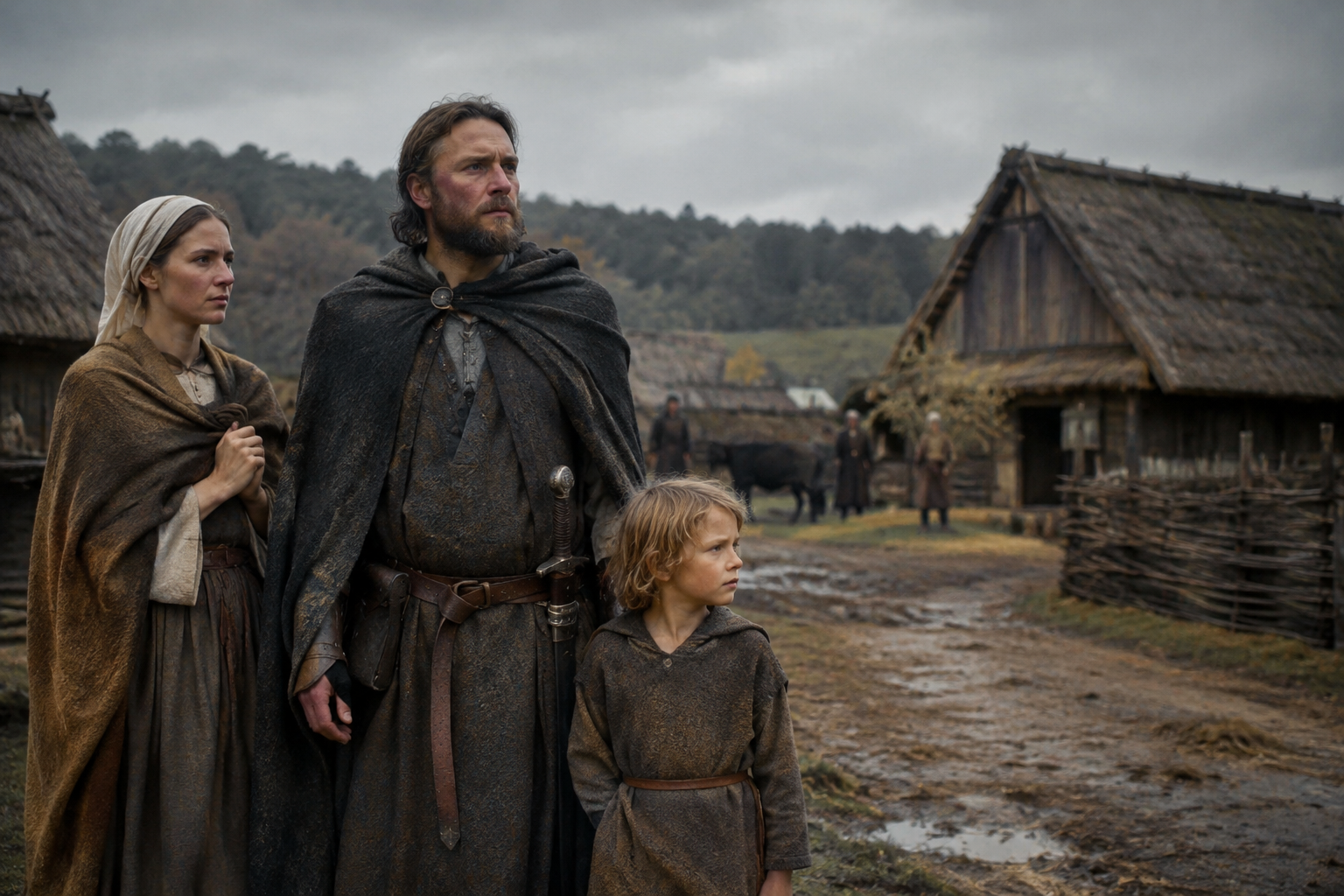
In about AD 605, a man now known as NIEcap4 was buried at Niederstotzingen in southern Germany, in the unsettled centuries after Roman rule had fractured in the West. He matters not because one skeleton can stand for an entire people - it cannot - but because this burial site has become one of the most revealing little windows onto early medieval mobility, status, and biological ancestry. In this case, the paternal line associated with him is reported here as R1b1a1b1a1a1c2b2b1a1a1b1, a very narrow branch within the much broader R1b family that is widespread across western Eurasia.
That distinction is worth making at once. A Y-DNA haplogroup traces one direct male line only: father to father to father. It does not capture a person's whole ancestry, language, identity, or political allegiance. But when an unusually specific branch turns up in an excavated early medieval cemetery, it gives us something wonderfully concrete: one thread in the very tangled fabric of post-Roman Europe.
Niederstotzingen is not just another cemetery pin on a map. It belongs to the period often called the Migration Era or the early Merovingian age, when political power in central Europe was being reorganized through local elites, military followings, and shifting regional loyalties. Southern Germany in the sixth and seventh centuries sat inside that turbulent zone where Roman provincial traditions, Frankish expansion, and other Germanic-speaking groups met and mingled.
An ancient DNA study examining these burials drew attention to exactly that complexity, showing that the community represented there was not biologically uniform. Some individuals were closely related, while others appear to have come from different ancestral backgrounds. That makes Niederstotzingen valuable for anyone interested in paternal lines like R1b1a1b1a1a1c2b2b1a1a1b1: the site is a reminder that early medieval identity was assembled through kinship, alliance, and mobility rather than neat ethnic boxes. Research on the cemetery can be found in this Science Advances study.
The sheer length of R1b1a1b1a1a1c2b2b1a1a1b1 tells you something important straight away: this is not a broad umbrella label, but a fine-grained terminal or near-terminal placement within the R1b tree. Broad R1b branches are found across large parts of Europe and beyond, so the historical meaning of a deep subclade depends heavily on where and when it is actually observed in ancient remains.
With NIEcap4, the safest reading is local and specific. We are looking at one paternal line present in an elite or high-status early medieval burial setting in southwestern Germany around the early seventh century. Without a larger cluster of securely published ancient matches in the same exact branch, it would be careless to turn that into a sweeping claim about origin, tribe, or language. What it does support is a more focused point: this branch was part of the male-line diversity circulating in post-Roman central Europe.
One reason Niederstotzingen has attracted so much attention is that it does not behave like a simple family plot. Genetic work on the site showed that some of the buried men were biologically close relatives, while others were not. That is historically fascinating, because it fits a world in which war-bands, retinues, fosterage, marriage links, and political service could pull men into the same commemorative space without all of them descending from the same paternal ancestor.
So where does that leave a lineage such as R1b1a1b1a1a1c2b2b1a1a1b1? It places one direct male line inside that mixed social setting. If you carry this haplogroup today, the real historical interest is not a fantasy of one unbroken noble pedigree, but the likelihood that your paternal line belonged to the same broad network of western and central European male ancestry that was moving through frontier societies after the end of Roman administration.
To understand why this matters, it helps to resist the old habit of imagining early medieval Europe as a map of solid-colored tribes. Archaeology and genetics have both been steadily dismantling that picture. Cemeteries in regions like Alemannia and neighboring zones show local continuity in some places, migration in others, and a great deal of cultural borrowing across political boundaries.
Niederstotzingen sits squarely in that story. The burials belong to a period when local aristocracies were consolidating power beneath larger Merovingian rule. Men buried in such cemeteries could be tied to regional power structures, military service, or household followings. A paternal lineage found there therefore speaks less to a single named "people" and more to the male-line composition of those emergent early medieval communities.
That broader context also helps explain why related posts on the Rhineland and Germanic-language spread are useful companions to this find. They explore the same historical landscape from different angles: not one simple migration, but overlapping movements and mixtures across centuries.
There is a temptation, when only one ancient individual is attached to a very precise branch, to shrug and move on. But archaeology often advances through exactly these stubbornly specific cases. NIEcap4 anchors this lineage in a real burial ground, a real century, and a real historical transition. That is far more informative than treating haplogroups as abstract labels floating free of place.
It also reminds us that early medieval Europe was not built solely by vast anonymous migrations. It was built by small groups, households, companions, rivals, and relatives, some local and some mobile, all leaving traces in cemeteries like Niederstotzingen. A narrow Y-lineage preserved there is one of the few ways we can watch those male lines appear in history before surnames, charters, and genealogies make them easier to follow.
Germanic Languages and Genomics
For someone researching R1b1a1b1a1a1c2b2b1a1a1b1 today, the most solid takeaway is not a grand origin myth but a historically grounded setting: this paternal branch is represented in an early medieval burial from southern Germany at Niederstotzingen, around AD 605. That places it in the world of post-Roman central Europe, where kinship and mobility were shaping new societies out of older Roman and non-Roman foundations. It is a small clue, but a good one - anchored in an excavated cemetery, not just in modern surname lore.
Comments