Haplogroup G2a2b2b1a1b1a2a

– 4 min read


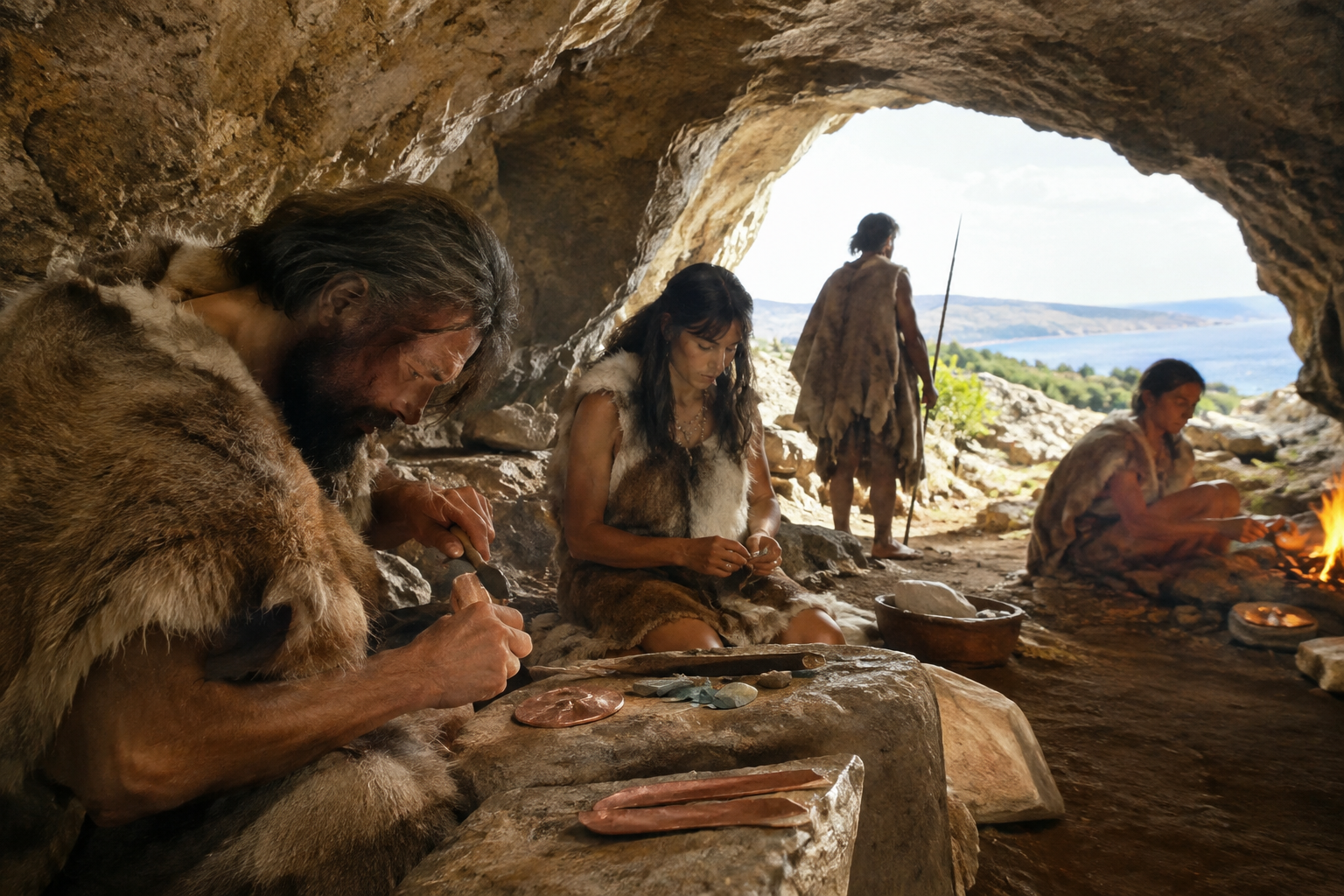
At Grotta Continenza in central Italy, one male dated to around 2910 BC, sample R4, carries a paternal line associated here with G2a2b2b1a1b1a2a. That may sound forbiddingly technical, but the setting is wonderfully concrete: a cave in prehistoric Italy, used by communities living through the long aftermath of the first farming expansions into Europe. Instead of a king or a warlord, the lineage appears here in the bones of an ordinary ancient person, which is often where the most useful history begins.
This matters because haplogroup G2a, in its broader sense, is one of the best-known Y-chromosome lineages linked with Europe's early farmers. A very narrow branch like G2a2b2b1a1b1a2a is not the same thing as the whole G2a family, and one sample cannot stand in for an entire peninsula. But R4 at Grotta Continenza does place this paternal line within a real Copper Age landscape in Italy, among people living thousands of years after farming had reached the peninsula and long before Roman history would make the region famous.
Grotta Continenza lies in Abruzzo, near the former Lake Fucino, an area with a deep prehistoric record. Caves in Italy are not merely dramatic backdrops for archaeology; they are often places where long sequences of human activity survive, sometimes across many different periods. That makes a sample like R4 especially valuable, because it belongs to a landscape where hunting, herding, farming, and settlement all changed over millennia rather than in one neat revolution.
By about 2910 BC, Italy was in the Copper Age, when metal was known but stone tools, local traditions, and older ways of life were still very much present. So when a Y-DNA lineage of the G2a family appears here, it fits a wider European pattern in which male lines associated with early farming remained part of local populations for a long time. The interesting point is not that R4 was somehow "the first farmer" in Italy; he clearly was not. It is that this paternal ancestry was still present deep into later prehistory, showing persistence as well as change.
A major ancient DNA study of prehistoric southeastern Europe, published in Science, helped establish the wider genetic background for this period: Europe's farming populations were not static blocs, but communities reshaped over time by mixture, regional isolation, and local survival. Grotta Continenza fits into that larger world, even if this particular branch must be treated carefully and specifically.
Y-DNA traces one direct paternal line: father to son to son, across many generations. That makes it powerful for studying male-line continuity, but it is only one thread in a person's ancestry. R4's haplogroup does not tell us his language, his appearance, or the total ancestry of his community. Nor should we lazily project every broad claim about G2a onto the exact branch G2a2b2b1a1b1a2a.
Still, the broader family resemblance matters. Across early and middle Neolithic Europe, G2a lineages are repeatedly found among farming populations descended in part from people who moved westward out of Anatolia into the Balkans and beyond. By the Copper Age in Italy, those earlier movements had already become local history. A man carrying this branch in Grotta Continenza was not a wandering symbol of migration; he was part of an established prehistoric Italian population whose roots stretched back through earlier farming expansions.
One of the hardest things for modern readers to grasp is that "farmer ancestry" in Europe was not a brief episode. It lasted, adapted, and mingled with other ancestries over thousands of years. In some places, paternal lines changed sharply in later prehistory; in others, older lines persisted. The value of Grotta Continenza is that it shows the continued presence of a farming-associated paternal lineage in central Italy late enough for us to ask not just where it came from, but how long it endured.
That endurance is especially relevant in Italy, where geography encourages regional variation. Mountain zones, interior basins, coastal routes, and islands all produced slightly different histories. Ancient DNA from other Italian contexts has increasingly shown that there was no single prehistoric Italian population moving in lockstep. Instead there were local communities carrying different blends of ancestry and, sometimes, different paternal histories as well.
A cave burial or cave-associated individual can tempt us into romantic narratives about ancient survival, hidden peoples, or special ritual identities. Better to be stricter. What Grotta Continenza offers is not a mythic tale but something more solid: a datable human presence in a place with long prehistoric use, and a paternal lineage that sits within one of Europe's best-attested early farming haplogroup families.
That also makes the site a useful corrective to over-simple migration charts. European prehistory is often told as a sequence of arrows on maps: farmers arrive, then steppe ancestry arrives, then everything changes. In truth, those changes were uneven. Some communities saw marked turnover; others preserved older lines much longer. R4 reminds us that ancient Italy was not merely receiving waves from elsewhere. It was also a place where older paternal legacies could remain rooted.
For this exact haplogroup, the article's evidence is intentionally narrow. We have a specific ancient individual, R4, from Copper Age Italy. That is enough to anchor the branch archaeologically, but not enough to map its entire spread, frequency, or social role. This is an important distinction. Ancient DNA articles are strongest when they resist the temptation to inflate one good sample into a grand theory.
In practical terms, that means G2a2b2b1a1b1a2a is best understood here as a fine-grained paternal offshoot within a much older and historically important male lineage family. Its appearance at Grotta Continenza suggests continuity from the world shaped by Neolithic farmers into later Italian prehistory, but not a monopoly, a dynasty, or a fixed ethnic identity.
If your direct paternal line falls under G2a2b2b1a1b1a2a, Grotta Continenza offers a sober but intriguing point of connection: by the Copper Age, a man carrying this branch was living in central Italy within a society still bearing the long legacy of Europe's first farmers. That does not make every present-day carrier "Italian" in any simple sense, nor does it promise descent from one excavated individual. What it does suggest is that your paternal line belongs to a family of lineages deeply tied to the prehistoric spread and local persistence of farming communities in Europe.
And there is something rather pleasingly unglamorous about that. Not a conquering emperor, not a named dynasty, but a real ancient man in a cave near Lake Fucino, quietly carrying forward one small branch of a much older story.
Comments