Haplogroup J2b2a1a1a1b3a

– 5 min read


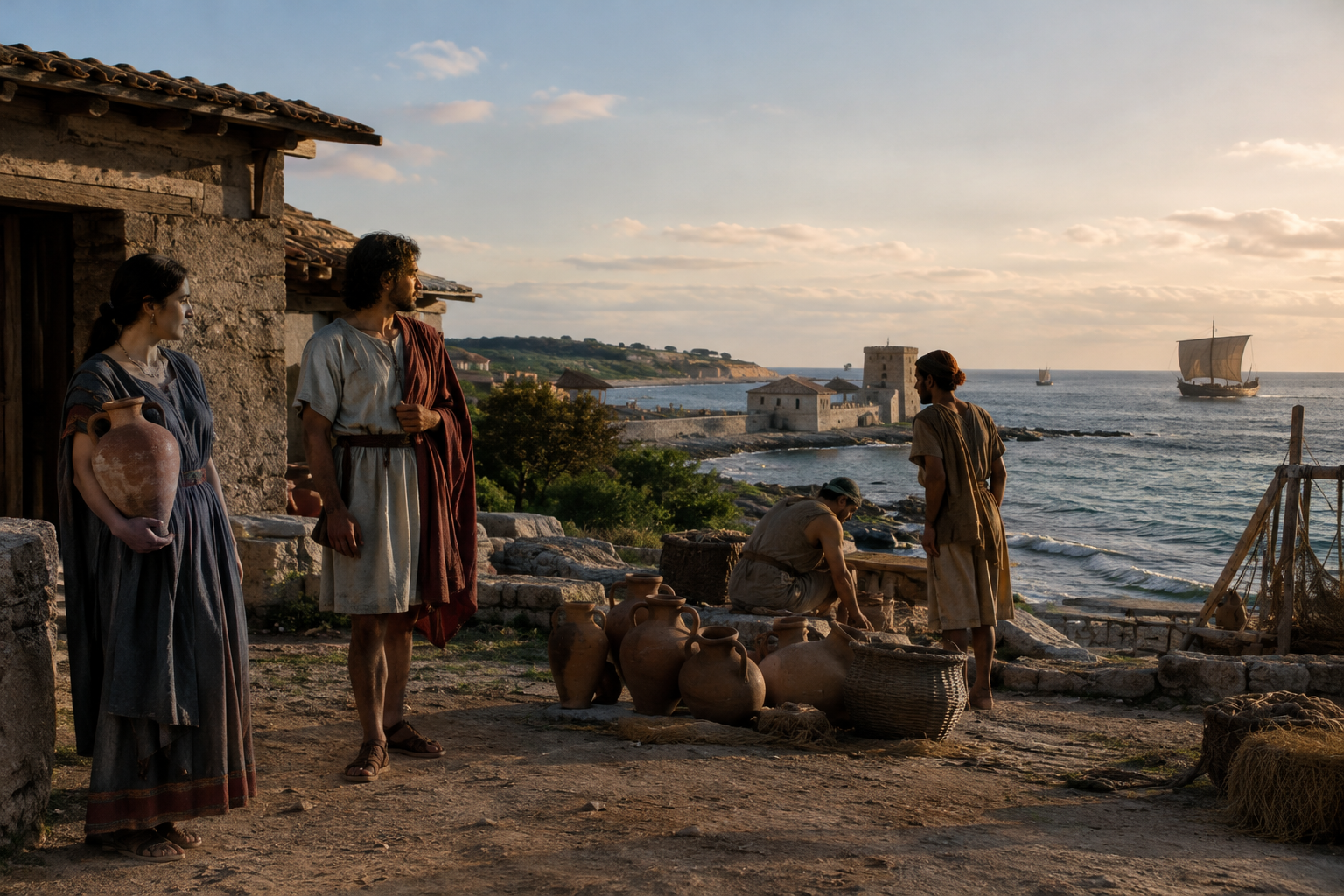
At Civitavecchia on the Tyrrhenian coast, one ancient man offers a very sharp glimpse into a lineage that can otherwise feel maddeningly abstract. The sample known as R474, dated to around 650 BC and identified as Etruscan, ties the Y-DNA haplogroup J2b2a1a1a1b3a to a real person living in the world of early historic Italy: ports, city-states, seaborne exchange, and the dense local politics of Etruria.
That matters because Y-DNA is at once very narrow and very revealing. It tracks one direct paternal line only, not a person's whole ancestry, language, or identity. But when a branch like J2b2a1a1a1b3a appears in an Etruscan-context individual from coastal Italy, it becomes part of a larger archaeological question: how paternal lines were distributed in Iron Age central Italy, and how old Mediterranean networks intersected with local communities.
Civitavecchia today is famous as a harbor near Rome, but in the first millennium BC this coast belonged to a more complicated landscape. It sat within the orbit of Etruscan power, in a region where maritime movement was ordinary rather than exceptional. Goods, styles, and probably people circulated constantly between Etruria, Sardinia, Sicily, the Greek world, and the wider Mediterranean.
So sample R474 is interesting not because one skeleton can stand for all Etruscans - it cannot - but because it places this paternal line inside that coastal setting. The date, around 650 BC, falls in the Orientalizing and early Archaic horizons of Etruscan history, when elite display, craft exchange, and overseas contact were particularly visible in the archaeology. A lineage found here belongs to a society already thoroughly plugged into Mediterranean traffic.
A major ancient DNA study of Iron Age and Roman Italy, published in Science, helped establish just how informative these central Italian burials can be. One of its enduring lessons is that cultural labels and genetic profiles do not map onto each other in simple, old-fashioned ways. Etruscan culture was unmistakably local and distinctive, yet the people associated with it fit into broader patterns of ancestry seen in neighboring Italian populations.
The long name matters. J2b2a1a1a1b3a is not the same thing as haplogroup J in general, nor even as J2 in general. It is a much narrower downstream branch. That means we should be careful: broad statements about all J2 lineages across the Near East, Balkans, or Mediterranean cannot simply be pasted onto this exact subclade without specific evidence.
Still, the larger family background is useful. Haplogroup J2 is widely associated, in broad terms, with populations shaped by the eastern Mediterranean and western Asian worlds, and it appears in many ancient and modern contexts linked to farming expansions, trade zones, and later historical mobility. For a branch as specific as J2b2a1a1a1b3a, though, the safest historical footing comes from documented finds like R474 rather than from grand migration slogans.
In other words, if you belong to this haplogroup today, the strongest statement here is not that your paternal line was "Etruscan" in any exclusive sense. It is that one attested bearer of the branch was living in an Etruscan community on the central Italian coast in the 7th century BC. That is already valuable evidence.
There has long been an argument - stretching from ancient authors to modern scholarship - about where the Etruscans "came from." Some ancient writers imagined an origin in Anatolia; others treated them as indigenous to Italy. Ancient DNA has complicated the debate in the best possible way: it shows that populations in Etruria were neither a sealed-off local relic nor a simple transplant from somewhere else.
That makes R474 especially useful as a historical witness. A coastal Etruscan man carrying J2b2a1a1a1b3a fits a world in which central Italy was both rooted and connected. Ports on this coast were not just entry points for exotic luxuries; they were places where family lines, alliances, and communities could absorb the effects of centuries of movement without losing their local cultural character.
It is worth stressing the scale of the evidence. One paternal line does not explain the whole Etruscan population. Iron Age Italy contained multiple Y-DNA lineages, just as any living population does. But when a branch appears in an Etruscan burial, it reminds us that Etruscan society was made up of real families with varied paternal histories, not a single biological block.
Civitavecchia's deeper significance lies in geography. This was not some remote inland valley but part of the corridor that later fed into Roman power. Etruscan cities and coastal communities helped shape the political and cultural landscape from which Rome emerged. So an Iron Age paternal lineage found here belongs to a region that would soon be drawn into the Roman Republic's expansion, and then into the extraordinary human mixing of the Roman Empire.
That does not mean R474 was "Roman" in any later imperial sense. He was not. But it does mean that this haplogroup was present in one of the key zones where pre-Roman and Roman Italy overlap historically. For descendants researching the branch today, that opens an intriguing possibility: some lines now scattered across Europe and beyond may have passed through central Italian populations before later imperial and post-imperial dispersals carried them elsewhere.
Studies of Roman-period and post-Roman Italy have repeatedly shown that the peninsula was a place of demographic layering rather than clean replacement. Coastal and urban regions especially could gather ancestry from several directions over time. A lineage seen in an Etruscan context may therefore belong to a much longer Italian story, not merely to one cultural moment.
Readers sometimes assume that a single ancient sample is too little to say anything useful. But archaeology often advances through exactly this sort of disciplined modesty. One secure placement of a rare or specific branch can anchor a discussion far better than a dozen vague guesses.
With J2b2a1a1a1b3a, the value of R474 is that he is not floating in myth or surname lore. He belongs to a named site, an approximate date, and a recognizable archaeological world. He shows that this paternal line, or a classification associated with it, had reached - or persisted in - Etruscan coastal Italy by the mid-1st millennium BC.
That also fits neatly with the broader lesson from Mediterranean archaeogenetics: lineages moved through trade zones, colonial contacts, marriage networks, and local continuities in ways that refuse easy ethnic labels. The past was not tidy, and the Y chromosome is often at its most useful when it reveals that untidiness clearly.
For now, the most distinctive historical anchor for J2b2a1a1a1b3a in this evidence is an Etruscan man at Civitavecchia around 650 BC. That does not turn the haplogroup into an exclusively Etruscan signature, but it does place it squarely in the busy, outward-looking world of Iron Age central Italy. For anyone tracing this paternal branch today, that is a meaningful clue: your direct male line is at least one documented step closer to the harbors, communities, and family histories of the ancient Tyrrhenian coast.
Comments