Haplogroup R1a1a'b
– 5 min read


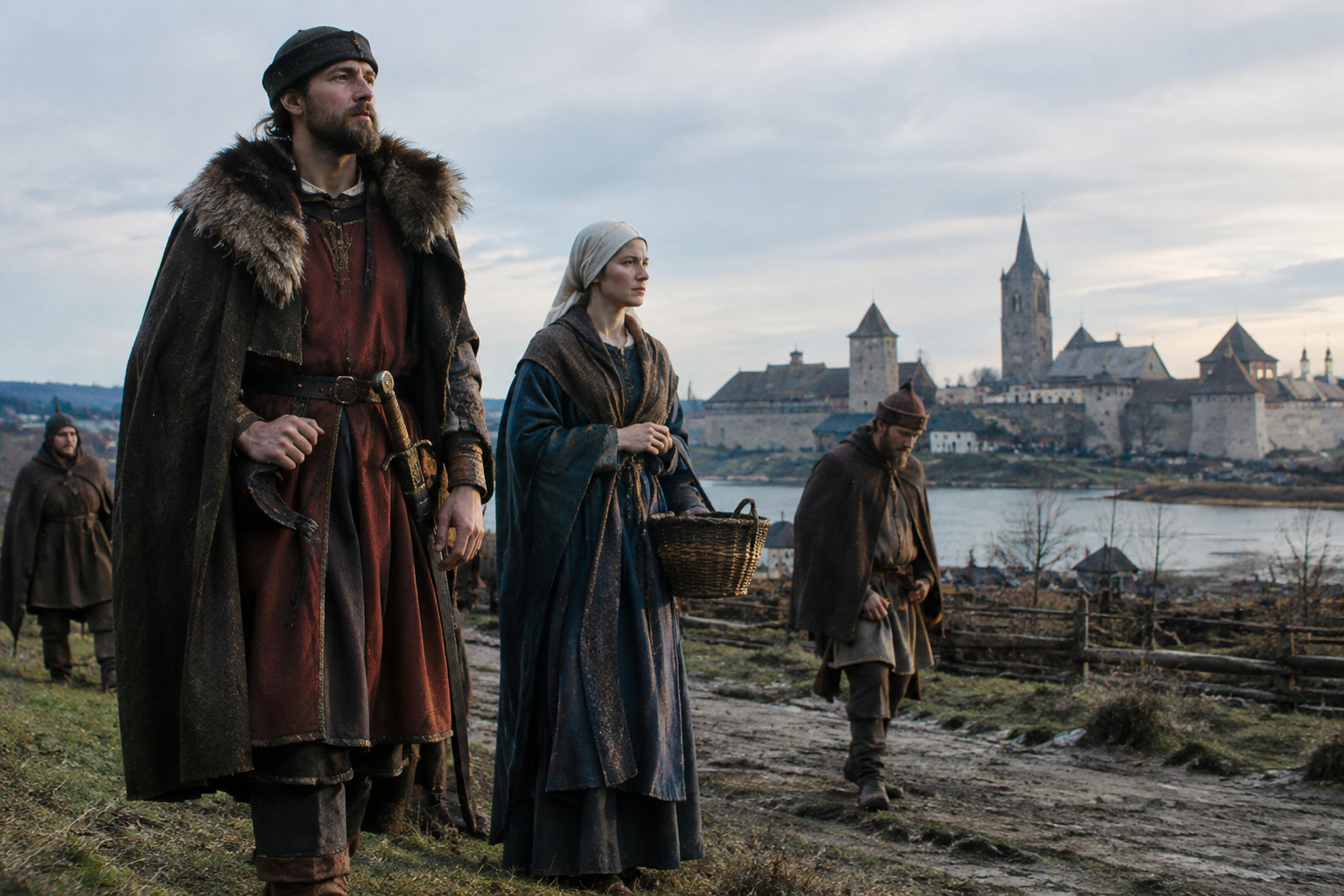
One of the clearest ancient signposts for haplogroup R1a1a'b in this set of evidence is a man identified as OLS03, dated to around AD 1200 in medieval Livonia. That is already a revealing setting. Livonia, on the eastern shore of the Baltic, was not some quiet edge of Europe in the High Middle Ages. It was a frontier of trade, conversion, warfare, and movement, where Finnic, Baltic, Slavic, Scandinavian, and German-speaking worlds met in ways that were often messy and intimate.
So the interest here lies not in a grand royal pedigree, but in something archaeologically sharper: a paternal line associated with a medieval man from a region where identities were layered and local populations were being reshaped. Y-DNA traces one direct male line only, not a person's whole ancestry, but in a place like Livonia even that single line can be historically suggestive. With OLS03, haplogroup R1a1a'b appears not as an abstraction on a map, but as part of a lived medieval Baltic world.
By about AD 1200, Livonia was undergoing profound change. This was the period of crusading expansion into the eastern Baltic, the growth of fortified centres, missionary activity, and new political structures imposed over older local communities. Yet archaeology and genetics alike keep warning us against a simplistic picture of outsiders arriving in a vacuum. Populations in this region already had deep local roots and long histories of contact across the Baltic Sea.
That makes OLS03 valuable precisely because he belongs to this moment of transition. A paternal lineage reported as R1a1a'b fits comfortably within a wider eastern and northeastern European story, but the sample matters because it is anchored to a real medieval context rather than a modern distribution map. The question is not merely where the lineage existed, but what its presence means in a borderland where language, faith, and allegiance did not always travel together.
Baltic connections in early medieval Finland
The label R1a1a'b belongs to the broader R1a family, one of the major Y-chromosome lineages found across large parts of Eurasia. But it is important not to overstate that fact. A broad parent branch can have many regional histories, and a medieval individual assigned to R1a1a'b should not be turned automatically into proof of one language, one tribe, or one migration route.
Still, broad patterns matter when handled carefully. In the eastern Baltic and neighboring regions, R1a lineages are historically relevant because they recur in populations shaped by long interaction among Baltic, Slavic, and some Scandinavian spheres. In other words, OLS03's paternal line does not solve the ethnic history of medieval Livonia, but it does belong to a set of lineages that are at home in the wider northeastern European landscape.
This is where ancient DNA improves on old-fashioned identity labels. Rather than treating medieval Livonia as neatly divided into named peoples, genetics helps us see it as a contact zone. One Y-chromosome lineage might point in one direction, genome-wide ancestry in another, and burial context in a third. History is often like that: less heraldic shield, more crowded port.
To understand why a medieval Livonian R1a1a'b sample is interesting, we need to remember how connected the eastern Baltic had long been. Rivers linked inland forests to the sea; maritime routes tied together present-day Latvia, Estonia, Finland, Sweden, and beyond; and political shifts repeatedly moved warriors, traders, clergy, and settlers through the region. By the medieval period, people in Livonia were living in a landscape already shaped by centuries of exchange.
An ancient DNA study of the region, published in Current Biology, helped underline that Baltic prehistory and early history cannot be reduced to a single population event. Instead, the eastern Baltic shows continuity in some respects and change in others, with different forms of ancestry and mobility appearing at different times. That broader background makes a sample like OLS03 more than a curiosity: he belongs to a region where paternal lines, local ancestry, and historical transformation intersect in particularly vivid ways.
Medieval Livonia is often discussed through chronicles written by conquerors and missionaries. Ancient DNA adds a quieter source of evidence: the people in the ground. A sample such as OLS03 does not speak in the language of bishops or military orders. He speaks in the much blunter language of biological presence. Someone with this paternal line was there, in that society, at that date.
Viking-Age Latvia and Baltic kinship
There is a temptation, when faced with only one named ancient sample, to shrug and move on. But single individuals can be historically revealing when they stand in the right place and time. OLS03 is not a legendary founder or a dynastic patriarch. He is, in some ways, more useful than that. He represents an ordinary reality of medieval northeastern Europe: populations were not static, and paternal lines that today seem tied to modern nations were already part of mixed and changing communities.
That is especially important for people exploring their own Y-DNA. Many descendants of R1a branches understandably want a dramatic origin story, perhaps involving one people and one heroic migration. The medieval Baltic warns against that kind of neatness. A lineage can be old, widespread, and historically significant without belonging to a single ethnic script. In Livonia, men carrying such lines may have lived through Christianization, trade expansion, conflict, and cultural blending without fitting our modern boxes at all.
Comparable MyTrueAncestry work on language spread and mobility in early medieval Europe also helps frame the point: paternal lineages can travel with very different historical processes, from family continuity to frontier settlement to elite expansion. None of those should be assumed automatically from Y-DNA alone.
Germanic language spread and ancient genomics
Older nationalist histories often liked to imagine the Baltic past as a sequence of clearly bounded peoples replacing one another. Archaeology has been dismantling that for years, and genetics has joined in with a certain relish. The reality is one of overlaps: local continuity beside incoming influence, cultural adoption without total population replacement, and communities whose members may have had different paternal origins while sharing the same settlement and material world.
For that reason, R1a1a'b in medieval Livonia should be read as a thread in a wider fabric, not the whole cloth. It may align with lineages common across eastern Europe, but its historical meaning comes from the Livonian setting itself: a frontier where old local societies met crusading institutions, where the Baltic Sea connected as much as it divided, and where genetic evidence can catch the human detail that written narratives flatten.
Migrations around the northern Black Sea
If your paternal line falls under R1a1a'b, OLS03 offers a grounded medieval glimpse rather than a myth. By around AD 1200, this lineage was present in Livonia, a region shaped by Baltic interaction, local continuity, and intense historical change. That does not make every modern carrier "Livonian," still less the descendant of one medieval man. But it does place the haplogroup firmly inside the real human landscape of the eastern Baltic, where ancestry was never simple and that is precisely what makes it interesting.

Comments