Haplogroup I1a1b1a4a2f1a1a7

– 5 min read


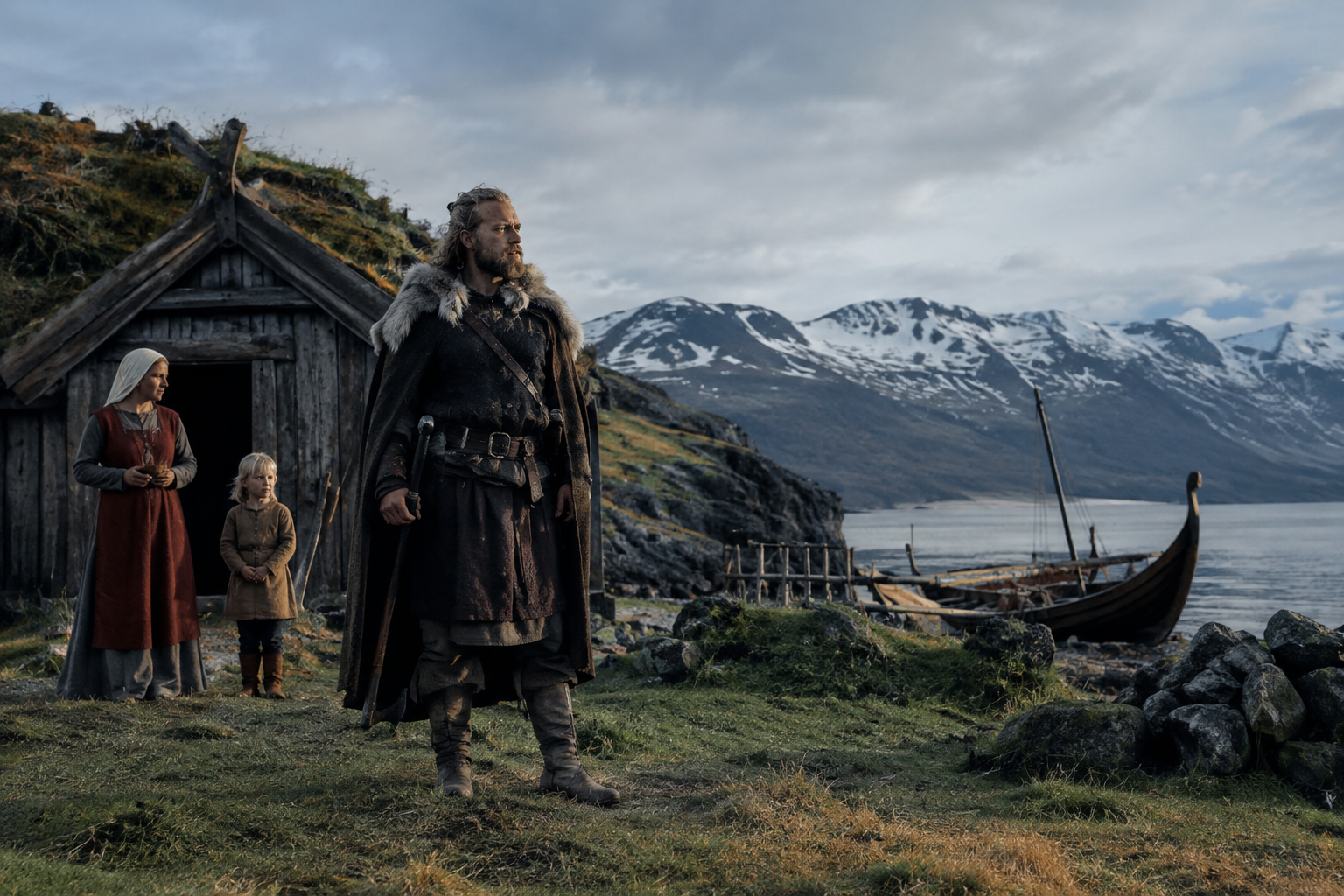
One of the clearest clues for the haplogroup I1a1b1a4a2f1a1a7 in this set comes from a Viking Age individual identified as HSJ-A1, dated to around AD 950 and described as a Norwegian Viking in Iceland. That is already a revealing combination. By the mid-10th century, Iceland was a new society on the edge of the North Atlantic world, settled by people whose family histories stretched back across Norway, the British Isles, and the seaways of the Viking diaspora.
What makes HSJ-A1 interesting is not that he somehow "stands for" all Vikings, because no one burial can do that. It is that this one paternal line places the article's branch inside a historically vivid setting: the Norse movement into Iceland during the settlement period and early commonwealth age. In Y-DNA terms, I1a1b1a4a2f1a1a7 is a very narrow branch of the broader haplogroup I1, a lineage strongly associated in many studies with later northern European male lines. Y-DNA tracks one direct paternal line only, but that single line can still anchor a remarkable historical story.
Iceland is often imagined as a remote and almost empty destination at the far end of the Viking world, but that is precisely why it matters. Settlement there was not the result of a slow prehistoric spread. It was a historically recent expansion, within living memory for the people involved, carried by named families, ships, legal traditions, livestock, and social rivalries. A man like HSJ-A1 lived in a world where the voyage from western Norway to Iceland was not abstract migration but family strategy.
The label "Norwegian Viking Iceland" should be handled carefully. It points to cultural and geographic context, not to a simple genetic formula. Viking Age Icelanders were not genetically uniform, and modern research on Iceland has repeatedly shown mixed origins, especially from Scandinavia and the British Isles. Still, a paternal line within I1 fits comfortably into that North Atlantic Norse setting, where male-mediated Scandinavian ancestry is a recurring part of the evidence.
A major ancient DNA study of Viking Age populations, published in Science, helped establish just how mobile and varied this world was. The broader lesson from such work is important here: Viking identity was not reducible to one haplogroup, yet some paternal branches do appear again and again in regions shaped by Scandinavian expansion. That makes HSJ-A1 less a lone curiosity than a useful point on a wider map.
The full designation I1a1b1a4a2f1a1a7 is very precise, far more precise than the broad labels people often use in popular ancestry discussions. That precision matters. It means we are not talking about all of I1, nor even all Scandinavian I1, but one much narrower twig on a deep paternal tree.
The parent haplogroup I1 has a long history in northern Europe, but it would be careless to project every claim made about I1 onto this exact subclade. A branch this specific may have expanded in a much later and more local way than the parent lineage. In practice, that means the safest historical reading is not "this line explains the Viking world," but rather "this line was present within the Viking world, and at least one bearer is securely placed in 10th-century Iceland."
That distinction may sound fussy, but it is exactly the sort of fussiness that keeps ancient DNA useful. Archaeology gives us the site and period. Genetics gives us a paternal signature. History gives us the social setting. Put together, they show that this branch belonged to the northwestern European world that helped populate Iceland, without pretending that one chromosome can substitute for an entire people.
Iceland is especially valuable because it was settled late enough to sit close to written history, but early enough to preserve the biological signals of a founding population. That makes every securely identified ancient individual there more historically legible than many earlier prehistoric burials. When a lineage appears in Iceland around AD 950, we are looking at the aftermath of one of Europe's best-known migration episodes: the Norse settlement of the North Atlantic.
Yet settlement was not simple transplantation from Norway. Archaeology, saga material, and genetics all point to a more entangled picture. Households formed in Iceland could include people with different regional origins, and the Viking world itself linked western Scandinavia to the Irish Sea, the Scottish islands, and beyond. A paternal lineage like that of HSJ-A1 may therefore reflect Scandinavian male ancestry within a society that was already mixed in more ways than older nationalist histories liked to admit.
This is one reason Icelandic evidence matters so much for descendants today. A line found in Viking Age Iceland does not merely hint at "Scandinavian ancestry" in the abstract. It places a paternal branch in one of the most dynamic colonial frontiers of the early medieval North, where mobility, kinship, and law created a new society astonishingly quickly.
Norse settlement in the North Atlantic
Because I1 is so often discussed alongside Scandinavia and Germanic-speaking regions, there is a temptation to turn a haplogroup into a language badge. The evidence does not work that way. Languages spread through social power, migration, intermarriage, and cultural adoption; paternal lines are only one part of that picture. Still, the Viking Age is one of the periods where male-line movement and language expansion clearly overlapped in important ways.
That overlap is why broader work on northern European population history is relevant here. Studies of early medieval and Migration Period communities have shown that northern Europe was full of movement long before and during the Viking Age, with communities often made up of people from different backgrounds. For readers interested in that bigger backdrop, the spread of Germanic-speaking groups and their genomes has been explored in related MyTrueAncestry coverage.
For I1a1b1a4a2f1a1a7, then, the strongest claim is not linguistic certainty but historical plausibility. This is a branch found in a Norse Icelandic context during the Viking Age. That places it inside a world where Old Norse speech, Scandinavian networks, and maritime expansion were all central facts of life.
Ancient DNA articles sometimes seem to value only huge datasets, but single individuals can be powerful when the context is good. HSJ-A1 is tied to a place, a period, and a historical process that matter enormously in North Atlantic history. He helps put a very specific paternal branch on the ground in Iceland during the age of Viking expansion.
That does not make him the founder of the branch, nor the ancestor of everyone carrying it today. What he gives us is firmer and, in its way, more interesting: proof that this paternal line had reached one of the Viking world's newest settlements by around AD 950. In other words, this was not a lineage stranded in some isolated corner. It was part of the human movement that built Iceland.
For someone exploring I1a1b1a4a2f1a1a7 today, the most useful takeaway is this: the branch is represented in a documented Viking Age Icelandic individual, HSJ-A1, from around AD 950. That places the lineage in a real and memorable historical setting: the Norse expansion into the North Atlantic, where new communities were being built from mobile and often mixed populations. It does not promise saga heroes or named dynasties, but it does connect this paternal line to one of medieval Europe's most dramatic settlement zones.


Comments