Haplogroup R1a1a1b1a2b3a4a2

– 5 min read


One of the clearest clues for the Y-DNA haplogroup R1a1a1b1a2b3a4a2 comes not from a battlefield or a royal chronicle, but from a village cemetery at Niederwünsch in Sachsen-Anhalt. There, a striking cluster of men dated to around AD 1100 - including NDW197, NDW198, NDW091, NDW098, NDW053, NDW055, NDW057, NDW062, NDW068, NDW084, NDW044, NDW051, NDW003, NDW008, NDW015, and NDW020 - has been identified as part of a Western Slavic settler community. When the same paternal branch appears again and again in one medieval site, it tells us something important: this was not an isolated traveler, but a lineage embedded in a living community.
That matters because Y-DNA follows one direct paternal line only - father to son to son - and so it captures just one thread of a person's ancestry. Even so, repeated appearances of R1a1a1b1a2b3a4a2 in these medieval contexts make this branch especially interesting for the history of Slavic-speaking populations in central Europe. Rather than a grand tale of a single migration, the evidence here points to continuity, settlement, and the ordinary business of communities taking root.
Niederwünsch sits in a region where archaeology and history both record the long presence of West Slavic groups in what is now eastern Germany. By the 10th to 12th centuries, this was a frontier zone in the fullest medieval sense: politically contested, linguistically mixed, and shaped by colonization, tribute, local lordship, and Christian institutions. A cluster of male burials sharing the same paternal branch does not prove they were all close relatives, but it does suggest that this Y-line had substantial local depth.
That is perhaps the most revealing thing about this haplogroup in the present evidence. We are not looking at a single prestigious burial from which historians try to spin an entire people. We are looking at many men from one settlement horizon, all associated with a Western Slavic community. The weight of the pattern is social as much as genetic: this was a lineage that seems to have been reproduced across generations within a settled population.
An ancient DNA study examining these burials and related medieval material in the region is linked through this research preprint, which is relevant because it places these kinds of central European medieval genomes into a broader archaeological frame rather than treating them as isolated curiosities.
Medieval origins in eastern Germany
The long label R1a1a1b1a2b3a4a2 marks a very specific twig on the wider R1a tree. The parent haplogroup R1a is famous in discussions of Eurasian population history, but that fame can be misleading. A narrow branch like this one cannot simply inherit every claim ever made about R1a as a whole. What the current sample set actually supports is much more precise: this branch appears in medieval central European individuals associated with Western Slavic settlement, and it also appears in nearby parts of east-central Europe.
That narrower focus is more useful anyway. Haplogroups become historically meaningful when they are tied to real places and dated people. Here, the important point is not some vast and vague story about steppe ancestry, but the medieval visibility of one paternal line in Slavic-settled communities between the Elbe-Saale region, Moravia, and the Carpathian Basin.
A second important appearance comes from POH11, dated to about AD 975 at Pohansko in Moravia, in the present-day Czech Republic. Pohansko is a major early medieval site, well known in discussions of Great Moravia and the transformations that followed its decline. A sample from this setting matters because it pushes the branch into a slightly earlier horizon than Niederwünsch and places it in a region central to the formation of early Slavic polities.
We should be careful here. One individual from Moravia does not prove direct descent from the men at Niederwünsch, nor does it define the whole male population of the region. But when a branch appears at Pohansko around the late 10th century and then repeatedly among Western Slavic settlers in Sachsen-Anhalt around AD 1100, the combined picture becomes harder to dismiss as chance. It begins to look like a paternal line with a real place in the medieval Slavic world of central Europe.
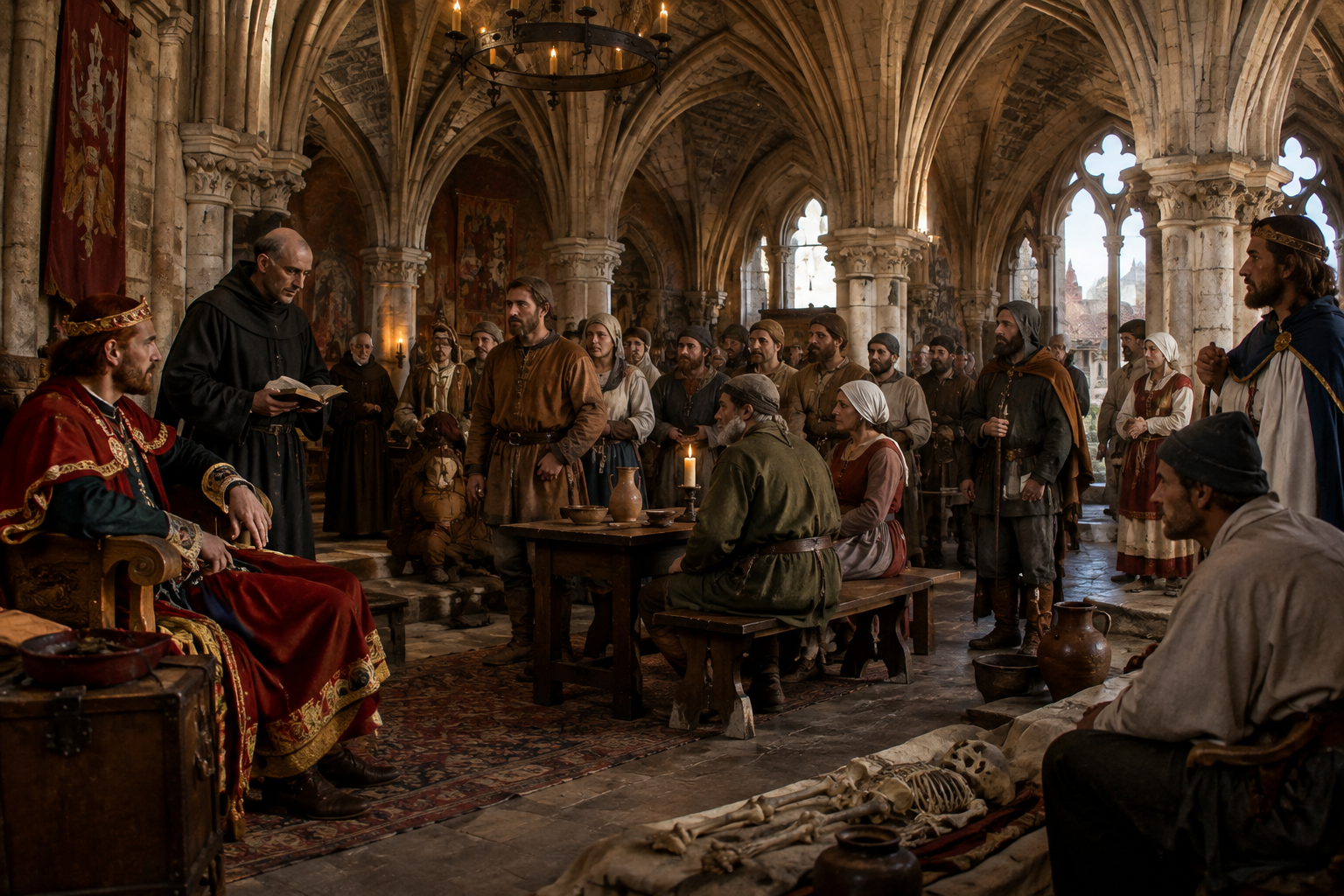
The most eye-catching individual in the list is probably HUASper84, identified as a member of the Hungarian nobility from the Gothic Vault of the Royal House of Aba in a Benedictine monastery, dated to AD 1405. This is a very different setting from a village cemetery. It belongs to the world of aristocratic memorial culture, dynastic burial, and late medieval Hungary.
Now, one must not force the point. A noble burial does not magically explain the entire haplogroup, and it certainly does not mean that everyone carrying this branch descends from medieval Hungarian magnates. Still, the Aba sample is historically valuable because it shows that the same paternal branch was present not only in Slavic-settled communities to the northwest, but also in a noble context within the Carpathian Basin several centuries later.
This fits a broader truth about medieval central Europe: elites, frontier settlers, clergy, retainers, and rural communities were entangled across large regions. The Carpathian Basin was not sealed off from its Slavic neighbors, nor were western Slavic lands isolated from Hungarian politics. Research on medieval Hungary and elite burials, including genomic work associated with these materials, has increasingly shown how much continuity and mixture could coexist within aristocratic settings.
Medieval Hungary's elite genomes
There is also I3345, listed as a "Skeleton Lake Traveller - Hellenic" and dated to about AD 1810. This is plainly a very different kind of case: later in date, geographically distant from the medieval central European cluster, and attached to a mobile individual rather than a settled cemetery population. Its significance lies less in defining the core history of the haplogroup than in reminding us that paternal lines travel with people, and people travel for all sorts of reasons - trade, war, pilgrimage, service, or accident.
That is why the medieval cluster remains the stronger foundation for interpretation. One outlying later traveler can show reach; sixteen men in one Western Slavic settlement horizon show structure. Archaeologically, the Niederwünsch burials are the anchor. Historically, Pohansko broadens the branch into Moravia, while the Aba noble sample shows that the same line could also appear within a late medieval elite environment.
On present evidence, R1a1a1b1a2b3a4a2 is most distinctive as a medieval central European paternal line with especially strong visibility in a Western Slavic settler community at Niederwünsch, an earlier appearance at Pohansko in Moravia, and a later appearance in a noble context in Hungary. That is a rather good historical spread: village, regional center, and aristocratic burial, all within the connected worlds of east-central Europe.
For someone researching this paternal branch today, the most responsible takeaway is not a fantasy of guaranteed royal descent, but something more solid and more interesting: this lineage appears in the documented population history of medieval Slavic-speaking and neighboring societies across central Europe, where settlement, mobility, and status all intersected over centuries.



Comments