Haplogroup J2a1a1a2a

– 6 min read


At Vilardida near Tarragona, an early medieval burial dated to about AD 718 adds an unexpectedly long western chapter to the history of Y-DNA haplogroup J2a1a1a2a. The individual, sample I28361, lived in a Visigothic-period world that was already changing fast under the first decades of Islamic rule in Iberia. On its own, one man from northeastern Spain would not tell us much. But set beside older finds from Armenia, Anatolia, and Iron Age Iran, he helps sketch a paternal line that appears not as a sudden conquest marker, but as part of the deep and mobile human history of the Near East and Mediterranean.
That distinction matters. Y-DNA traces one direct paternal line only, not a person's whole ancestry, language, or identity. Even so, when the same branch turns up in very different archaeological settings, it can reveal where a lineage was present, how long it endured, and how widely it circulated.
The westernmost sample in this small set is I28361, identified from Visigothic early medieval Spain at Vilardida, Tarragona, around AD 718. Tarragona was no backwater. It sat within a region shaped by Roman urban life, post-Roman political change, Christian institutions, and connections across the western Mediterranean. A lineage such as J2a1a1a2a appearing here is therefore historically plausible, but still worth pausing over because it reminds us how mixed post-Roman Iberia could be at the level of paternal ancestry.
One should be careful not to turn that single result into a grand claim about "the Visigoths" as though they were a biologically uniform people. They were not. Nor does this one burial prove a direct migration from the Caucasus or Iran. What it does show is that by the early 8th century, a branch within the wider J2 family had found its way into the human landscape of northeastern Spain, where Roman, local Iberian, and wider Mediterranean ancestries had been blending for centuries.
That broader Iberian context has become much clearer through recent ancient DNA work on the peninsula, where Roman and post-Roman mobility repeatedly brought in people with eastern Mediterranean and other non-local connections. For readers interested in that longer background, see the MyTrueAncestry discussion of Roman continuity and change in Spain.
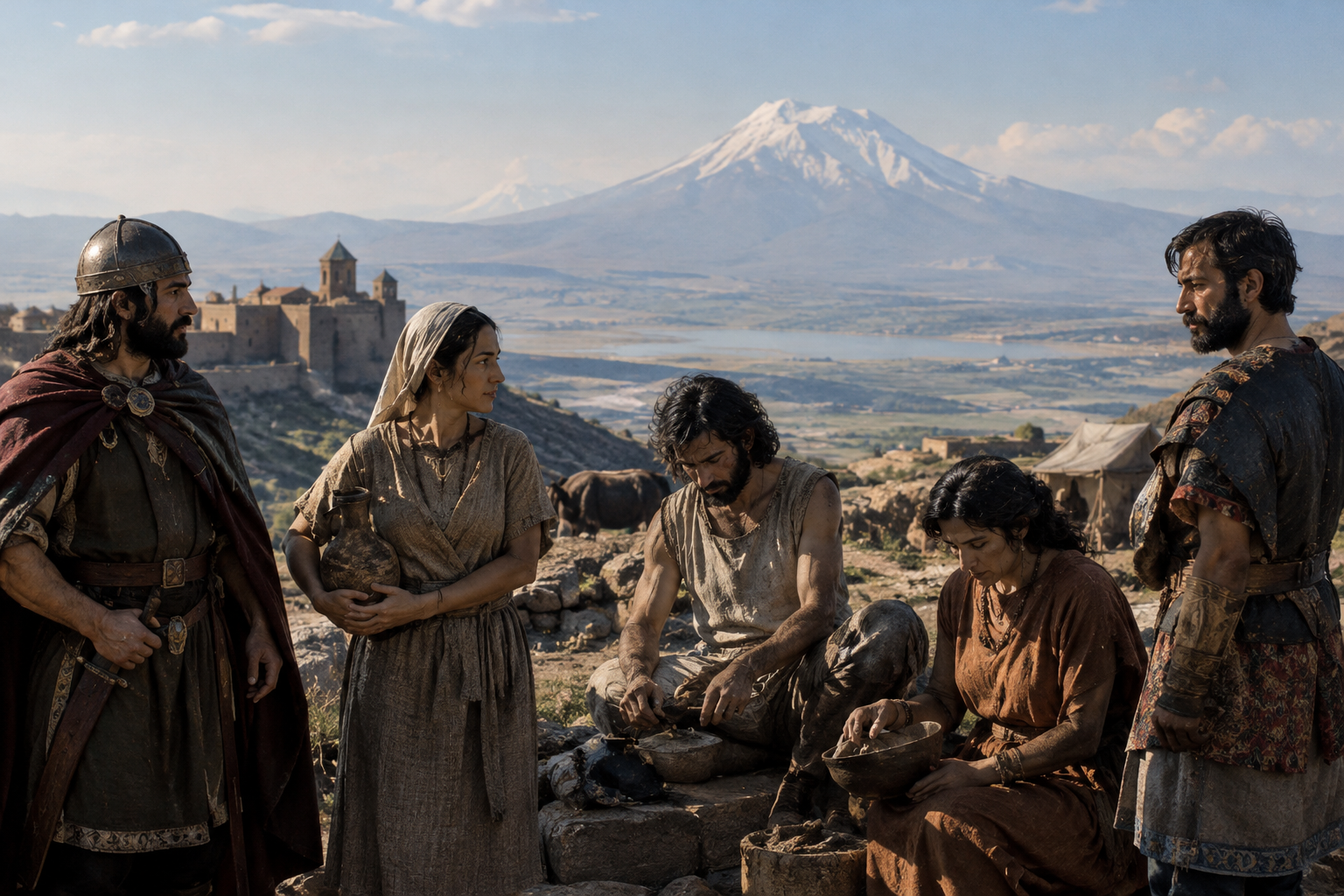
The oldest sample in this group is by far the most striking: I3930 from Masis Blur in ancient Armenia, dated to about 7900 BC. This is very early indeed, in the world of the first farming communities of the South Caucasus and neighboring regions. If the identification is correct at the level associated with this article's branch, it places J2a1a1a2a within a zone long recognized as crucial to the spread of food production, village life, and later interregional exchange.
Now, one must not flatten all of prehistory into a single migration story. A Neolithic male line found in Armenia does not automatically mean every later carrier moved west in one continuous stream. But Armenia and the South Caucasus sit in exactly the kind of contact zone where such paternal lineages could persist, diversify, and enter new populations over many millennia.
This is where the wider haplogroup background helps. J2 in general is frequently associated with ancient populations of the Near East, the Caucasus, and the eastern Mediterranean. That does not mean every sub-branch shares the same exact path. Still, the presence of I3930 at Masis Blur makes the eastern homeland of the wider lineage more than an abstract idea; it anchors this branch in a very early archaeological setting.
A major ancient DNA study of Eurasian populations published in Science helped sharpen the broad prehistoric picture in which Caucasus and Anatolian populations played a central role in later West Eurasian population history. Even when a paper is not being used here as a line-by-line sample gazetteer, that wider framework is essential for understanding why an Armenian Neolithic appearance of J2-related lineages matters.
The sample I10542 from ancient Marmara, Bursa, in Anatolia, dated to about 3500 BC, gives the story a geographical turn that is almost textbook in the best sense. Northwestern Anatolia is not merely "between" regions on a map. It was one of the great connective corridors of prehistory, where movements between the Aegean, inner Anatolia, and the Balkans could leave both archaeological and genetic traces.
Finding this paternal branch in the Bursa region suggests continuity or movement within a broad arc running from the South Caucasus into Anatolia. By the 4th millennium BC, these lands were already full of interacting communities rather than isolated blocks. Metals, animals, crops, and ideas were moving; people did too, though not always in the tidy waves older textbooks liked to imagine.
For J2a1a1a2a, that matters because Anatolia offers a plausible setting for both persistence and diffusion. A lineage can remain locally rooted for thousands of years and yet also appear far away through marriage networks, village fission, trade-linked mobility, elite movement, or gradual demographic spread. That is a more realistic picture than imagining one "tribe" carrying one haplogroup across continents like a flag.
Readers who want a wider Mediterranean perspective on how lineages from Anatolia and adjacent regions later entered the Roman world may find this especially useful.
The most historically textured eastern sample here is I4238, dated to about 1150 BC, from Hasanlu Period Dinkha Tepe in Iron Age Iran. Northwestern Iran in this period was a dense and interesting world: highland polities, fortified settlements, shifting alliances, and links eastward, westward, and southward. It was exactly the sort of region in which long-established paternal lines might endure while populations themselves remained anything but static.
Hasanlu is famous archaeologically because the wider region preserves evidence for major social change in the Late Bronze and Iron Age. Dinkha Tepe, as part of that northern Iranian setting, places J2a1a1a2a squarely inside a landscape of early state formation and cross-regional exchange. That does not make the haplogroup "Iranian" in any exclusive sense, but it does show the branch was present in a historically consequential corridor between Mesopotamia, Anatolia, the Caucasus, and the Iranian plateau.
That Iranian context sits well with the broader picture emerging from ancient DNA studies of the plateau and adjoining regions: substantial continuity in some local ancestries, but with repeated layers of contact and admixture. For those interested in the Iranian side of the story, this related MyTrueAncestry article offers a helpful adjacent case.
Put the four finds together and a pattern emerges. I3930 in Neolithic Armenia, I10542 in 4th-millennium BC Anatolia, I4238 in Iron Age Iran, and I28361 in early medieval Tarragona do not document one family or one uninterrupted migration route. What they do suggest is a branch with strong eastern roots that remained present across the Caucasus-Anatolia-Iran zone for a very long time before appearing, at least in one documented case, in the far western Mediterranean.
That is exactly the kind of pattern one might expect from a J2-related paternal line. Not spectacularly explosive, not tied to one famous conquest, but durable, urban-friendly, and often at home in the old connective tissues of western Eurasia: farming frontiers, trade corridors, imperial provinces, and mixed frontier societies. A recent Cell study on ancient populations of later Europe and the Mediterranean reflects the sort of large-scale archaeogenetic work that keeps revealing just how entangled those societies were.
The Iberian endpoint in this set is particularly interesting because it fits with a growing body of evidence that early medieval Spain cannot be read as a simple succession of biologically distinct peoples. Visigothic, Roman, local Iberian, and Mediterranean-linked ancestries overlapped in real communities. That makes a J2a1a1a2a result in Tarragona less an anomaly than a reminder of how connected the peninsula remained.
Another useful comparison comes from recent work on diverse origins in early medieval central Spain, where burial populations again resist any simple ethnic reading.
For someone researching haplogroup J2a1a1a2a, the most responsible takeaway is not a promise of descent from a famous people, but something better grounded: this branch is consistent with a paternal history rooted deep in the ancient Near East and South Caucasus, with later movement through Anatolia, Iran, and at least occasionally into Mediterranean Europe. In other words, it belongs to the long human traffic of the region, not to a single episode. That may sound less romantic than a legend, but archaeologically it is far more interesting.
Comments