Haplogroup I2a2a2a

– 5 min read


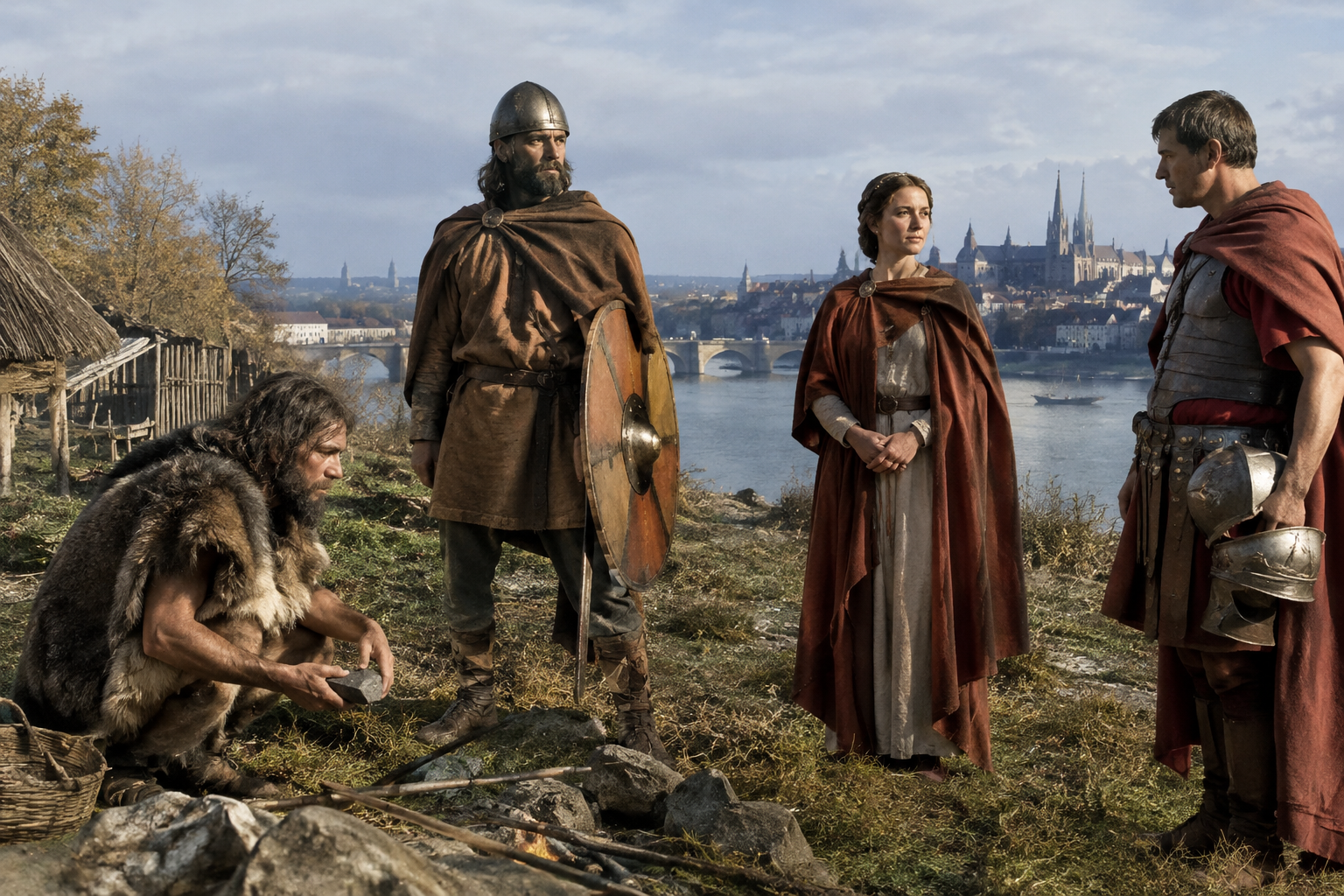
At Basel-Waisenhaus in Switzerland, three male burials dated to the late 4th and around 400 AD stand out for a simple but important reason: they place Y-DNA haplogroup I2a2a2a in a real frontier-world setting, where Roman institutions, local populations, and incoming groups overlapped. The men identified as KH201114, KH201114a, and KH201114b were buried in a period when the western empire was fraying and the upper Rhine was becoming one of the most complicated cultural zones in Europe.
That matters because a Y-chromosome lineage is not a whole identity card. It traces one direct paternal line only. But when the same branch appears in both a Neolithic burial in southern England and later burials from late Roman Switzerland, it gives us something far better than a slogan about "origins": it gives us evidence for long-term male-line survival across very different archaeological worlds.
The Basel-Waisenhaus burials belong to a landscape shaped by the Roman frontier, military movement, and the political reordering of late antiquity. One of the men is explicitly described as an Alemanni grave from Basel-Waisenhaus in 387 AD, while the other two are classified more broadly as Late Roman Age individuals from the same site, around 400 AD. That distinction is worth keeping. "Alemanni" is a cultural-historical label attached to a burial context, while the Y lineage tells us only about a paternal branch.
Still, the cluster is revealing. Three men from one Swiss site, close in time, associated with I2a2a2a, suggest that this paternal line was present in the mixed communities forming along the upper Rhine at the end of Roman rule. This was not an empty border awaiting newcomers. It was a lived-in zone of soldiers, farmers, families, traders, and communities whose identities would have shifted with politics, service, alliance, and settlement.
An ancient DNA study examining burials from this broader historical setting has helped show just how entangled these frontier populations could be, not as neat blocks of "Romans" and "barbarians" but as communities with varied ancestry and local continuity. For readers interested in that wider context, see this research on the late antique and early medieval frontier world.
Roman-German frontier blending
I2a2a2a sits within the broader haplogroup I, one of the old European Y-chromosome families. But it is important not to smudge the levels together. The large parent clade has a deep prehistoric history in Europe; that does not mean every downstream branch followed the same path in the same way. The article's focus is the narrower branch I2a2a2a, and the safest thing to say is that the current sample set places it in both Neolithic and late antique contexts in northwestern and central Europe.
That is already historically interesting. It means the branch was not confined to one famous migration episode, one named people, or one moment of conquest. Instead, the evidence points to durability. A paternal line could persist through the spread of farming, the rise and fall of Bronze and Iron Age societies, the Roman Empire, and the reshaping of Europe after Rome, all without needing to belong to a single fixed ethnic story.
The earliest sample in this group is I6750 from Fussell's Lodge near Salisbury in England, dated to about 3710 BC. That places I2a2a2a in the Neolithic, among the first farming centuries of southern Britain. Fussell's Lodge is well known archaeologically as part of the monument-rich world of early Neolithic Wessex, a landscape of long barrows, enclosure-building, and new ways of organizing the dead and the living.
This is where the story becomes especially good, because it is not tidy. Early European farming is often described as if one population simply replaced another. The archaeological and genetic reality was much more uneven. In many regions, incoming farming ancestry mixed with existing forager-descended populations, and male lines of older European depth could continue within farming societies. Research on Neolithic Britain published in this major ancient DNA study transformed the picture of how the first farmers reached Britain and how their descendants were structured.
The Fussell's Lodge sample does not mean that every later carrier of I2a2a2a descends directly from that individual in any simple genealogical sense. But it does show that this branch had entered, or persisted within, the world of Neolithic monument-building in Britain by the late 4th millennium BC. That gives the haplogroup an unexpectedly deep archaeological footing.
Put those two settings side by side and the contrast is striking. At Fussell's Lodge, we are in a world before metal, before Rome, before written history in Britain. At Basel-Waisenhaus, we are in a Christianizing, militarized, post-imperial frontier zone linked to imperial administration, Germanic confederations, and the collapse of western Roman authority.
And yet the same Y-DNA branch appears at both ends of that enormous timespan. This is precisely why ancient DNA is so useful when handled carefully. It does not flatten history; it reveals continuity through change. A paternal line can remain present while language, burial custom, political allegiance, and everyday material culture alter almost beyond recognition.
For I2a2a2a, the present evidence fits a pattern seen in other European Y lineages: not a single spectacular migration tale, but persistence, movement, and reappearance in different social settings. In one age, the carriers of such a lineage might belong to communities building long barrows. In another, they appear in the burial ground of a late Roman or Alemannic community on the Rhine frontier.
A single sample can be a curiosity. Three related-context samples from Basel-Waisenhaus are something more substantial. KH201114, KH201114a, and KH201114b do not prove a ruling family, a clan, or even close biological kinship. But they do suggest that I2a2a2a was not a one-off anomaly at this site.
That matters historically because late antique Switzerland sat at a meeting point between imperial structures and emergent post-Roman polities. The Alemanni were not a genetically uniform "tribe" in any modern sense, and Roman provincial populations were hardly uniform either. What ancient DNA keeps showing, in Switzerland as elsewhere, is that frontier communities were mixtures of local continuity and mobility. A paternal lineage such as I2a2a2a could be carried by men participating in precisely that mixed world.
Mobility in ancient Switzerland
There is a temptation, always, to turn a haplogroup into a badge: farmer, native European, Celt, Germanic warrior, Romano-Briton. The samples here resist that kind of simplification. I6750 from Neolithic Salisbury and the Basel-Waisenhaus men belong to vastly different historical settings, and the useful lesson is not that they shared one culture, but that one paternal branch could pass through many cultures.
That makes I2a2a2a a particularly attractive lineage for family historians with deep roots in Europe. Its ancient appearances, at least in the evidence discussed here, suggest endurance rather than a single narrow ethnic label. The branch belongs to Europe's long male-line history of survival, absorption, and reinvention.
Roman and early medieval Britain
The most distinctive thing about I2a2a2a is not that it can be tied to one heroic people, but that it appears in archaeological settings separated by more than four millennia: early Neolithic Wessex and the late Roman upper Rhine. For someone researching this paternal line today, that is a sober but exciting conclusion. Your Y-DNA points to one strand of ancestry that was present in Europe's deep past and still visible in the complicated human landscape that emerged as Rome faded from the west.






Comments