Haplogroup R1a1a1b1a2a3a1a
– 5 min read


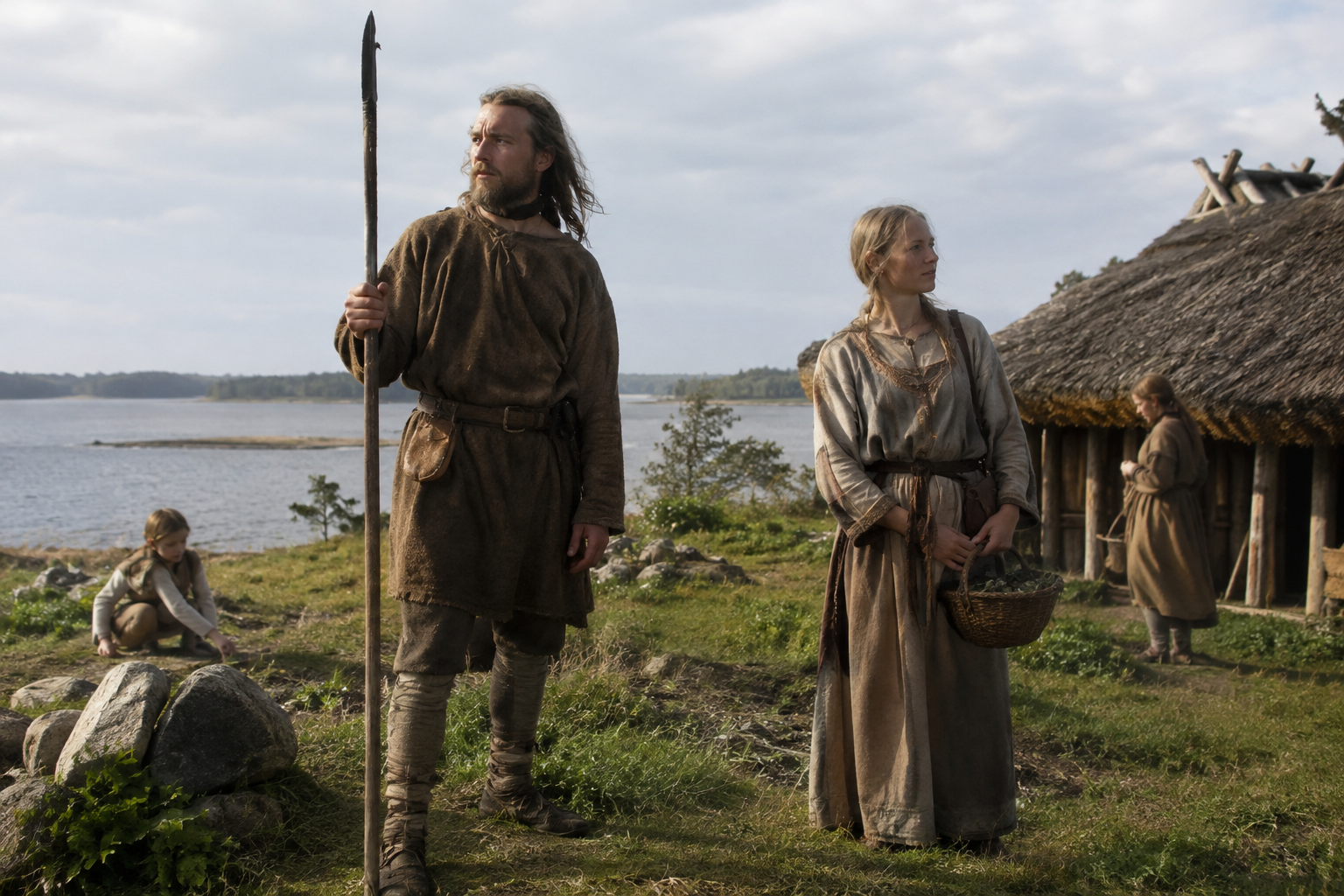
One of the clearest ancient signposts for the Y-DNA haplogroup R1a1a1b1a2a3a1a in this dataset is a man identified simply as V10, dated to around 610 BC in Late Bronze Age Estonia. That is already enough to make him interesting. Estonia at the end of the Bronze Age sat on a northern frontier where local continuity, Baltic interaction, and wider eastern connections all met, and a paternal line turning up there invites a very specific historical question: how did one branch of the larger R1a family become established in this part of the eastern Baltic?
The first thing to say is that a Y-DNA haplogroup tracks only one line of descent, father to son to son. It does not describe a person's whole ancestry, language, or identity. Even so, when an ancient Estonian male such as V10 is associated with R1a1a1b1a2a3a1a, he gives us a useful anchor point for thinking about how paternal lineages linked to the wider R1a world were present in the eastern Baltic before the Roman period and long before medieval states drew the maps we know.
V10 matters because the eastern Baltic is one of those regions where archaeology has long shown continuity in settlement and material culture, but ancient DNA has made the human story sharper. By around the 7th century BC, communities in Estonia were living in a landscape shaped by coastal exchange, inland farming and herding, and connections across the Gulf of Finland and farther south into the Baltic zone. A paternal lineage from the wider R1a family in this setting is not a surprise, but its presence is historically useful because it helps place this branch in a real archaeological population rather than in modern surname projects or abstract phylogenetic trees.
A major ancient DNA study on the region, published in Current Biology, helped clarify just how complex the population history of Estonia and its neighbors was across the Stone, Bronze, and Iron Ages. The key lesson from that body of work is not that one lineage "arrived" in a single dramatic event, but that the eastern Baltic was shaped by repeated layers of ancestry and contact. V10 sits within that long process.
The label R1a1a1b1a2a3a1a is a narrow branch inside the much larger R1a haplogroup. That wider family is well known across large parts of Eurasia and appears in many ancient contexts, from the steppe to Central Europe to the Baltic. But it would be a mistake to pour all of that enormous history straight into this one subclade as if they were the same thing.
For the purposes of this article, the safest reading is a modest one. V10 shows that a paternal line assigned here to R1a1a1b1a2a3a1a was present in Late Bronze Age Estonia. That is good evidence for local presence; it is not, by itself, proof of a single migration route, a named tribe, or a fixed ethnic identity. Archaeology and genetics are strongest when they are allowed to stay precise.
This is especially important in the eastern Baltic, where language, culture, and ancestry do not always line up neatly. The region later became home to Finnic-speaking populations, but Bronze Age and early Iron Age paternal ancestry cannot simply be translated into later linguistic labels. Ancient DNA is excellent at showing biological relationships and broad population change; it is much less tidy when recruited to solve every historical identity question at once.
Estonia is not just a peripheral dot on the map. In prehistory it was part of a connected northern world of seaways, forest zones, and exchange networks. Amber, metals, ideas, and people moved through this landscape, though not always in great surges. The presence of an R1a-associated male there by around 610 BC fits a broader pattern in which eastern Baltic populations had already absorbed earlier transformations linked to Bronze Age population shifts.
That broader context matters because the R1a story in northeastern Europe is older than the Iron Age societies later described in classical and medieval texts. By the time we reach V10, the deep prehistory of the region had already included contacts ultimately connected to the spread of steppe-derived ancestry into northern Europe. What a sample like this offers is not the first chapter, but a valuable middle chapter: evidence that one paternal branch persisted within an established Baltic population.
There is also a useful caution here. A single ancient male does not stand for all Bronze Age Estonians, and one Y-chromosome branch cannot summarize an entire cemetery, much less a whole country. Yet one securely dated individual can still be revealing, because he fixes a lineage to a time and place that archaeology understands.
For people researching this haplogroup today, the most sensible historical frame is the eastern and northeastern European one. The branch sits within a paternal family that became widespread across many Slavic, Baltic, and some Scandinavian-adjacent settings, but ancient Estonia reminds us that these northern lineages were part of the Baltic world well before the Middle Ages. In other words, this is not only a story of famous historical peoples on the move. It is also a story of local communities maintaining male lines over very long stretches of time.
That is one reason the eastern Baltic has become so important in archaeogenetics. It allows researchers to compare continuity and change in a region where later history brought Finnic-speaking groups, Scandinavian contact, and cross-Baltic mobility into close contact. Articles on subjects such as the spread of Germanic languages are useful here not because they identify V10 as "Germanic," which they do not, but because they show how ancient DNA can illuminate movement around the Baltic without reducing every burial to a later ethnic label.
The comparison with Finland is also illuminating. Across the Gulf of Finland, later populations show a complicated mixture of local Baltic, northeastern European, and in some cases more easterly influences. That does not make Estonia and Finland interchangeable, but it does underline the point that northern populations were formed through regional interaction, not isolation. A paternal branch found in Estonia during the Late Bronze Age belongs in that dynamic setting.
If your paternal line falls under R1a1a1b1a2a3a1a, V10 offers something quite concrete: a prehistoric anchor in the eastern Baltic, around the end of the Bronze Age. He does not prove that every modern carrier descends from Estonia, and he certainly does not confer a tribal badge or noble pedigree. But he does show that this branch, or a closely reported association with it, had reached a real northern community more than 2,500 years ago.
That is often the most useful kind of ancient DNA evidence. Not myth, not prestige, not a fabricated straight line from one grave to a modern surname - just a documented man in a documented place, helping to map where a paternal lineage belonged in the ancient world. For R1a1a1b1a2a3a1a, Late Bronze Age Estonia is therefore not a footnote. It is one of the places where the lineage becomes historically visible.

Comments