Haplogroup R1a1a1b

– 5 min read


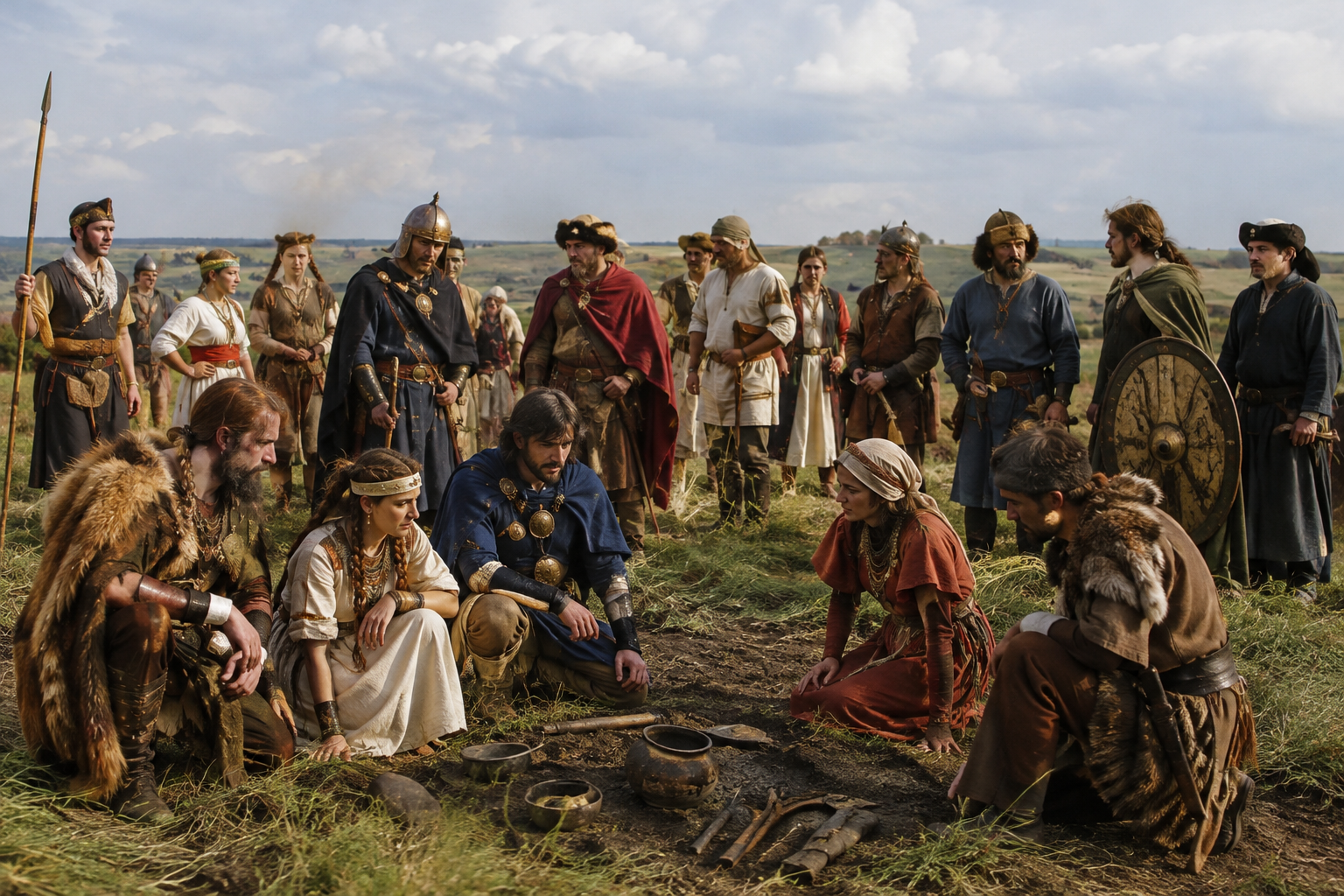
At Leubingen in Thuringia, a cluster of Early Bronze Age males dated to around 1950 BC offers one of the clearest starting points for thinking about Y-DNA haplogroup R1a1a1b. The site is better known in wider archaeology for the Unetice world of early metalworking and elite burial landscapes, but for paternal-line research the striking thing is repetition: LEU021, LEU031, LEU011, LEU010, and LEU009 are all associated here with the same branch label in the record supplied to us.
That matters because Y-DNA follows one direct male line only. It does not describe the whole ancestry, language, or identity of any one person. But when the same paternal branch appears again and again across very different places and periods, it becomes historically interesting. In the case of R1a1a1b, the pattern is not confined to one people or one frontier. It turns up in Bronze Age central Europe, in Iron Age steppe settings, in the Baltic and Scandinavian world, and later among early medieval communities stretching into the Carpathian Basin and Slavic-settled Germany.
The Leubingen group is useful precisely because it is not a lone, glamorous outlier. Multiple men from the same broad region and period carry the branch label, suggesting that this paternal line had already become established in parts of central Europe by the Early Bronze Age. That fits a wider archaeological picture in which the centuries after the Corded Ware horizon saw new regional societies forming, some with strong continuity in male-line patterns and some with marked local clustering.
Nearby central European examples broaden that picture. BNL004 from Brandys nad Labem in the Czech lands, CHL008 and CHL003 from Chieby, KO7001 from Bell Beaker context at Kolin, and VLI051 from Vlineves in Bohemia show the branch appearing in overlapping Bronze Age settings rather than a single isolated culture. The labels here range across Unetice, Bell Beaker-derived, and Corded Ware-related contexts. That does not mean all these groups were one population in any simple sense; it does suggest that one paternal line could persist through major cultural reorganisation.
A wider ancient DNA study of prehistoric Europe has helped frame this larger problem, showing just how important male-line turnover and persistence were in the third and second millennia BC, especially in societies shaped by post-steppe expansions https://www.nature.com/articles/nature25738. R1a is one of the major players in that broader story, but the narrower label R1a1a1b should be treated with care: the article branch is more specific than the big umbrella haplogroup, and not every ancient R1a male belonged to this exact lineage.
If Leubingen shows durability in central Europe, the Ukrainian and Kazakh material shows reach across the steppe and forest-steppe. UKR104 from the Siversky Donets Basin, dated around 350 BC, sits in the Scythian forest-steppe zone. UKR116 from Karavan in Kharkiv, around 715 BC, UKR014 from Mamay-Gora in Zaporizhzhia, and UKR036 from Medvyn Tract Girchakiv Lis all place the lineage in Iron Age settings tied to the northern Black Sea world.
These are not all the same kind of site, and that is the point. "Scythian" in archaeology covers a wide network of mobile and semi-settled communities, elite burials, and regional variants from the Pontic zone deep into Central Asia. A paternal lineage appearing across that spread tells us something about connectivity, but not that one clan ruled the whole steppe, nor that every bearer would have called himself Scythian in the same way.
Research on mobility in Ukraine from the Bronze Age into the early modern period helps place these finds in a landscape shaped by repeated movement, contact, and local survival rather than a single one-off migration event https://www.researchgate.net/publication/380994383_North_Pontic_crossroads_Mobility_in_Ukraine_from_the_Bronze_Age_to_the_early_modern_period. For R1a1a1b, that is a useful caution. The branch appears in the north Pontic world, but its history there was probably layered, with different communities carrying related paternal lines across many centuries.
The Central Asian evidence makes R1a1a1b even more interesting. BKB003 from an elite Tasmola grave at Bakybulak in central Kazakhstan, KOT002 from Koktubek in East Kazakhstan, and ESZ015 from Eleke Sazy, dated around 959 BC, connect the branch with Saka or Scythian-era populations east of the Caspian world. KKM001, NUR002, and AIG006 continue that pattern in Iron Age Kazakhstan, while BRE014 from Berel, dated around AD 300 and labelled Xianbei Hun, shows that such paternal lines remained present in later eastern steppe populations too.
There is a temptation, always, to force these results into a neat tale of one people galloping across Eurasia. Archaeology is more awkward than that. Elite graves in Kazakhstan, Pontic burials in Ukraine, and later steppe-associated individuals in Mongolia or the Altai need not represent one uninterrupted dynasty. What they do show is that this paternal branch, or closely related men reported under it, was part of the human fabric of the steppe corridor for a very long time.
Even the later medieval samples TAV001 from Tavan Tolgoi and UGU002 from Uguumur Uul remind us how durable some male lines could be in Inner Asia. Yet continuity of branch label is not the same thing as continuity of language, empire, or ethnicity. The steppe repeatedly changed its political masters while often reusing older human networks.
R1a1a1b is not confined to the steppe-facing world. RISE94 from Viby in Sweden, dated to around 2472 BC and labelled Battle Axe, places the branch in the Scandinavian version of the Corded Ware horizon. Olsund from Halsingland in Sweden, though Late Neolithic, and later Scandinavian finds such as CGG105622 and CGG105626 from Sund in Norway show the lineage in northern Europe across a great sweep of time.
The Baltic material is equally telling. V14, X10, and X05 from Bronze Age Estonia, X04 from Iron Age Saaremaa, Kivutkalns194 from Latvia, and Turlojiske1 from Lithuania demonstrate that the branch was established around the eastern Baltic long before the medieval period. This is one reason any simple map of "steppe" versus "northern" ancestry quickly falls apart: paternal lines moved, but they also settled, branched, and became part of local histories.
By the Viking Age, the lineage appears again in CGG106774 from Bogovej in Denmark and VK466 from Gnezdovo in Russia. Those two sites sit in very different historical settings: one Scandinavian, one in the Varangian-Rus world of eastern Europe. Yet both belong to the same broad northern conversation about trade, raiding, mobility, and settlement.
Baltic and early medieval Finland
One of the most revealing features of this haplogroup's sample set is how often it appears in frontier societies of Late Antiquity and the early Middle Ages. KUP025 comes from an early Avar elite grave at Kunpeszer in Hungary. RKF007 and RKO020 are from Migration Period cemeteries at Rakoczifalva. HMU057, from post-Roman Pannonia, and GYS012 from Arrabona in Hungary belong to the same broad world of reshuffled loyalties and mixed communities after Roman power weakened in the region.
Add to that the Sarmatian samples CGG021909 and CGG021913 from Madaras, DRH014 from a Thuringii context in Saxony-Anhalt, and the substantial cluster from Niederwuensch in medieval Germany - NDW032, NDW007, NDW094, NDW056, NDW009, NDW016, NDW018, and NDW029 - and a pattern emerges. R1a1a1b repeatedly appears in communities living along cultural seams: Roman and barbarian, Germanic and Slavic, steppe and settled agricultural worlds.
That does not make it a "frontier haplogroup" in any exclusive sense. But it does show why direct paternal ancestry can illuminate historical processes that written sources blur. Men carrying the same lineage could end up in Avar-linked elite graves, western Slavic settler communities, or post-Roman provincial populations. The paternal line survived while the political labels changed.
For someone exploring R1a1a1b today, the strongest ancient signal is breadth with persistence. This branch appears in Early Bronze Age central Europe, in the Iron Age steppe and forest-steppe, in the Baltic and Scandinavian north, and in the mixed societies of the early medieval frontier. That does not identify one tribe, one kingdom, or one famous ancestor. It suggests instead that your direct paternal line belongs to a long-lived Eurasian network that kept resurfacing wherever mobility, settlement, and cultural blending were most intense.

Comments