Haplogroup R1a1a

– 5 min read


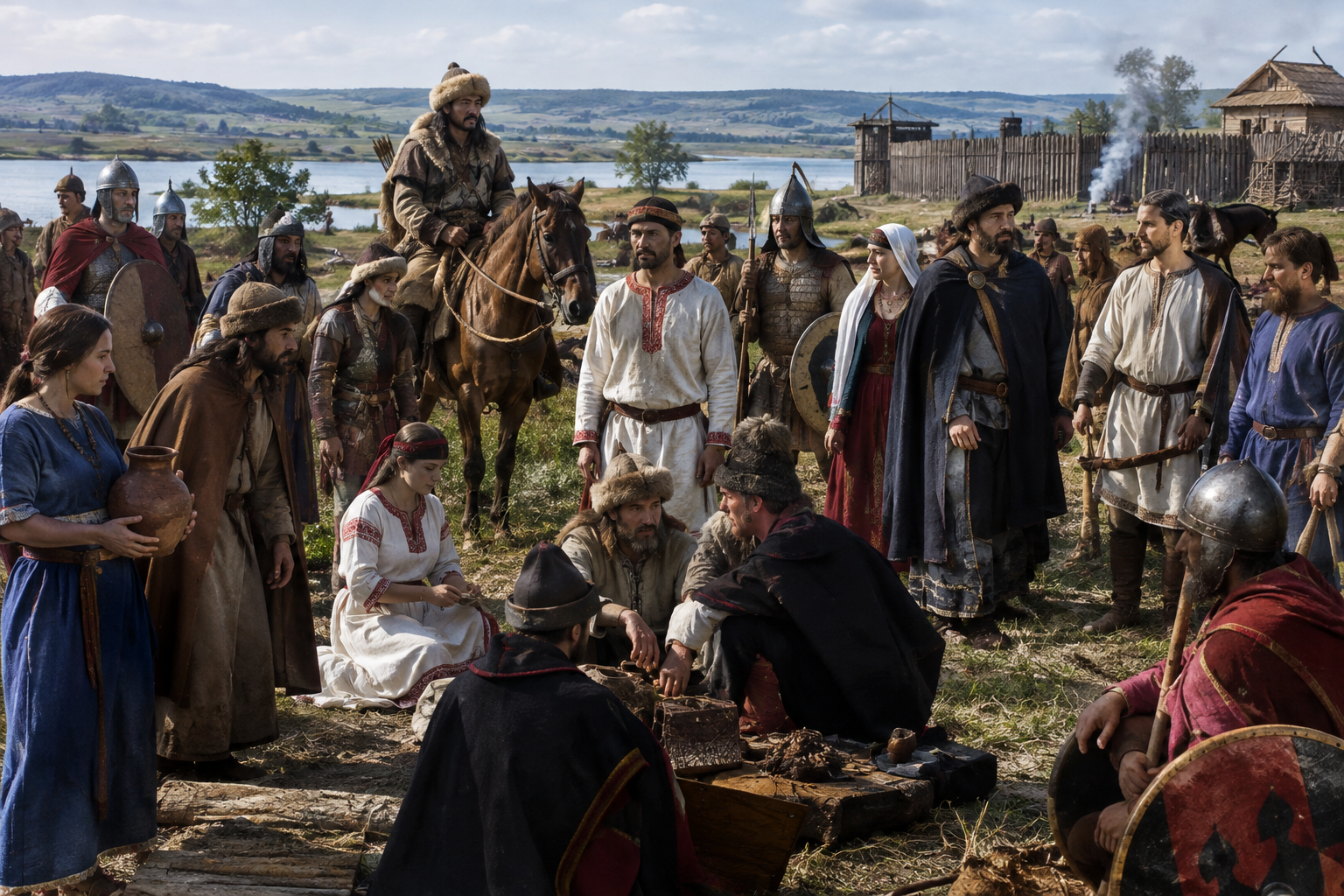
At Bilsk in the Poltava region of Ukraine, archaeologists have been working with one of the great fortified landscapes of the early steppe world: a vast hillfort long associated with the Scythian horizon. Among the ancient individuals linked to this setting is sample UKR083, dated to around 400 BC and reported here under the Y-DNA haplogroup R1a1a. That matters because Bilsk is not some isolated grave on the edge of history. It sits in a zone where mobility, exchange, conflict, and cultural mixture were part of everyday life.
R1a1a, of course, is a paternal lineage marker: it follows one direct male line only, not a person's whole ancestry. Even so, when this branch appears again and again across the steppe, central Europe, Poland, and Viking Age Scandinavia in the sample set here, it tells a rather interesting story. Not of one people marching intact across a map, but of a durable paternal line that turns up in very different historical settings over more than two millennia.
The Ukrainian samples are the clearest place to begin because they show R1a1a in the North Pontic region both before and during the classical Scythian period. Alongside Bilsk's UKR083, the lineage appears in UKR150 from the pre-Cimmerian hillfort at Dykyi Sad near Mykolaiv, dated to about 1100 BC, and in UKR170 from Petrykiv in Ternopil region, dated to around 800 BC and described as Early Iron Age Ukraine Germanic in the sample listing.
That sequence is useful because it spans changing archaeological labels without requiring us to pretend those labels mean the same thing. "Pre-Cimmerian," "Scythian," and later ethnic identifications describe historical or archaeological frameworks, not a single unbroken tribe. What the recurring paternal signal suggests is continuity of some male lines in a region that was repeatedly reshaped by new alliances, new elites, and new cultural fashions.
A study of mobility in this wider Ukrainian zone can be found in this research on the North Pontic crossroads. That is a sensible frame for R1a1a here: not a badge of one neatly bounded identity, but a lineage appearing in a corridor where populations met, moved, and mixed.
If Ukraine shows R1a1a in a steppe-facing frontier, the Bronze Age samples from Poland and Czechia show that the lineage also had a deep central European presence. The set includes poz792 from Hrebenne in Lublin, dated to about 2130 BC; poz534 from Sandomierz Swiniary Stare, around 1950 BC; poz661 from Żerniki Górne, around 1450 BC; and I5042 from Moravska Nova Ves in Czechia, around 2100 BC.
Those are important dates. They place R1a1a well before the medieval kingdoms, well before Gothic movements, and well before the Viking Age links that often dominate popular imagination. In other words, this paternal branch was already present in Bronze Age societies of central Europe, among communities living through the long aftermath of earlier steppe-related expansions and the making of regional Bronze Age cultures.
We should be careful here. A haplogroup cannot by itself tell us what language these men spoke or how they identified themselves. But in broad archaeological terms, these samples help explain why later appearances of R1a1a in Poland and surrounding regions do not look like sudden intrusions. They often look more like the persistence, reshaping, and re-use of older paternal foundations.
Late Bronze Age Central Europe
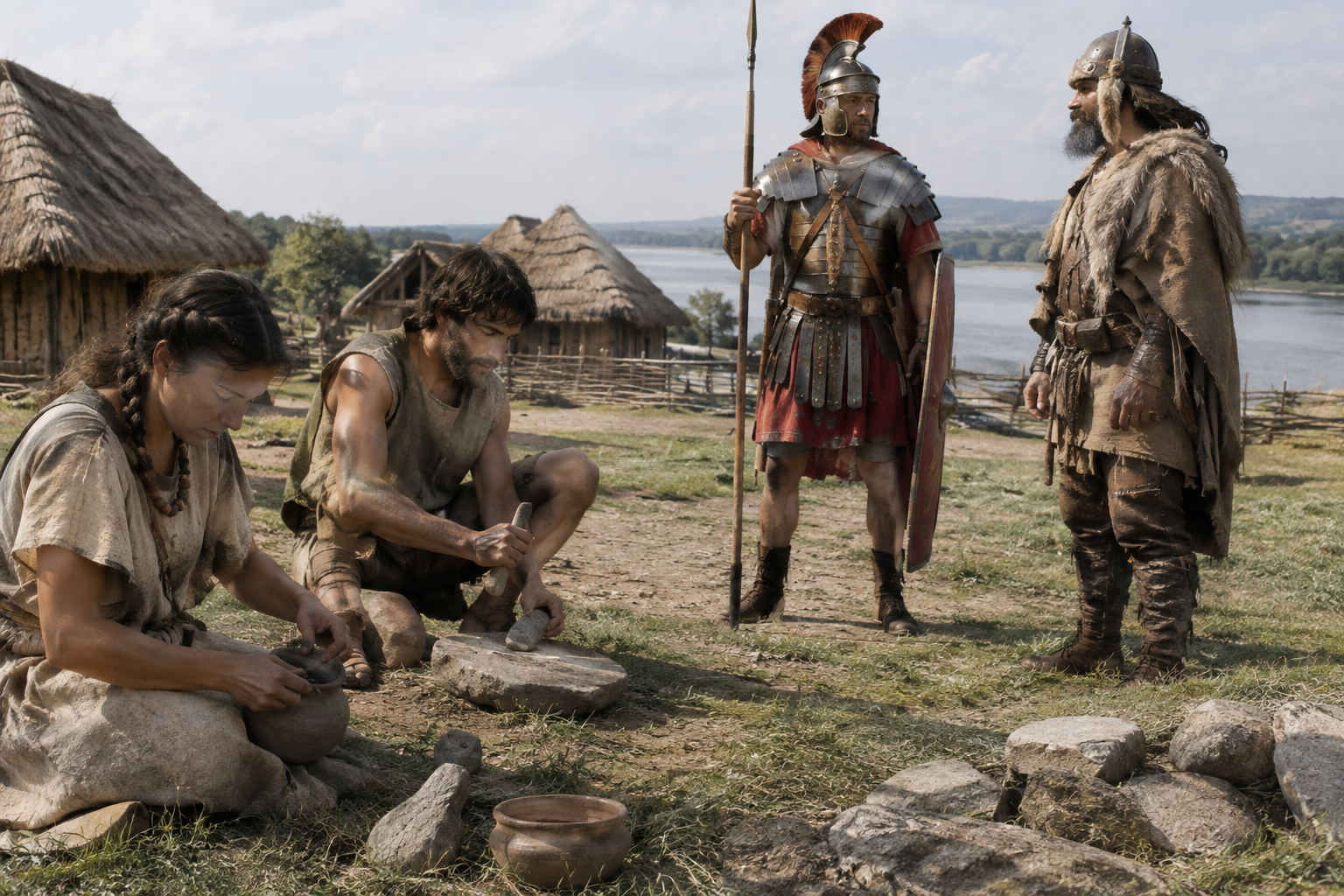
The next cluster is especially revealing because it brings R1a1a into the famously mixed societies of late antiquity. In Poland, sample PCA0002 from Kowalewko, dated to about AD 200, is classified as Gothic Wielbark. Farther south, the lineage appears in a run of fifth- to seventh-century contexts in the Carpathian Basin: SZL035, SZL018, and SZL080 from the Savaria-Szeleste area in Pannonia, around AD 525, and RKO004 plus RKF265 from Rakoczifalva in Hungary, around AD 650.
This is precisely the sort of evidence that discourages simplistic history. A "Gothic" cemetery, a "Longobard period" burial ground, and "post-Roman" Pannonian communities are not genetically uniform blocs. The men buried there could represent local families, incoming groups, mixed households, or communities already formed out of earlier frontier interactions. What the lineage shows is that R1a1a was one of the paternal strands present in these mobile, politically shifting worlds.
An ancient DNA study of post-Roman communities in the region is available here, and it underlines a larger point familiar from frontier archaeology: identities in the wake of Rome were assembled, negotiated, and often local in practice. Y-DNA can sometimes illuminate continuity within that flux, but it does not flatten it.
By the early medieval period, R1a1a turns up repeatedly in Poland, including contexts linked to the Piast realm. The sample list includes PCA0187 from Piast Dynasty Lad, dated around AD 950, and PCA0218 from Oblaczkowo in Greater Poland, dated around AD 1100. There are also medieval individuals from Silesia and Lubusz: PCA0560 from Milicz and PCA0244 plus PCA0246 from Rumin, likewise around AD 1100.
These samples do not prove that all Piast elites belonged to one simple paternal line, nor that every medieval Pole carrying R1a1a was socially prominent. What they do show is that this branch was part of the paternal landscape in the very region where one of central Europe's most important early dynasties consolidated power. That is historically significant because the Piast state emerged not in an empty land, but within older networks of settlement, kinship, and regional continuity.
For readers interested in how ancient DNA has been used to think about the Piast rulers and their wider connections, one useful companion piece is below.
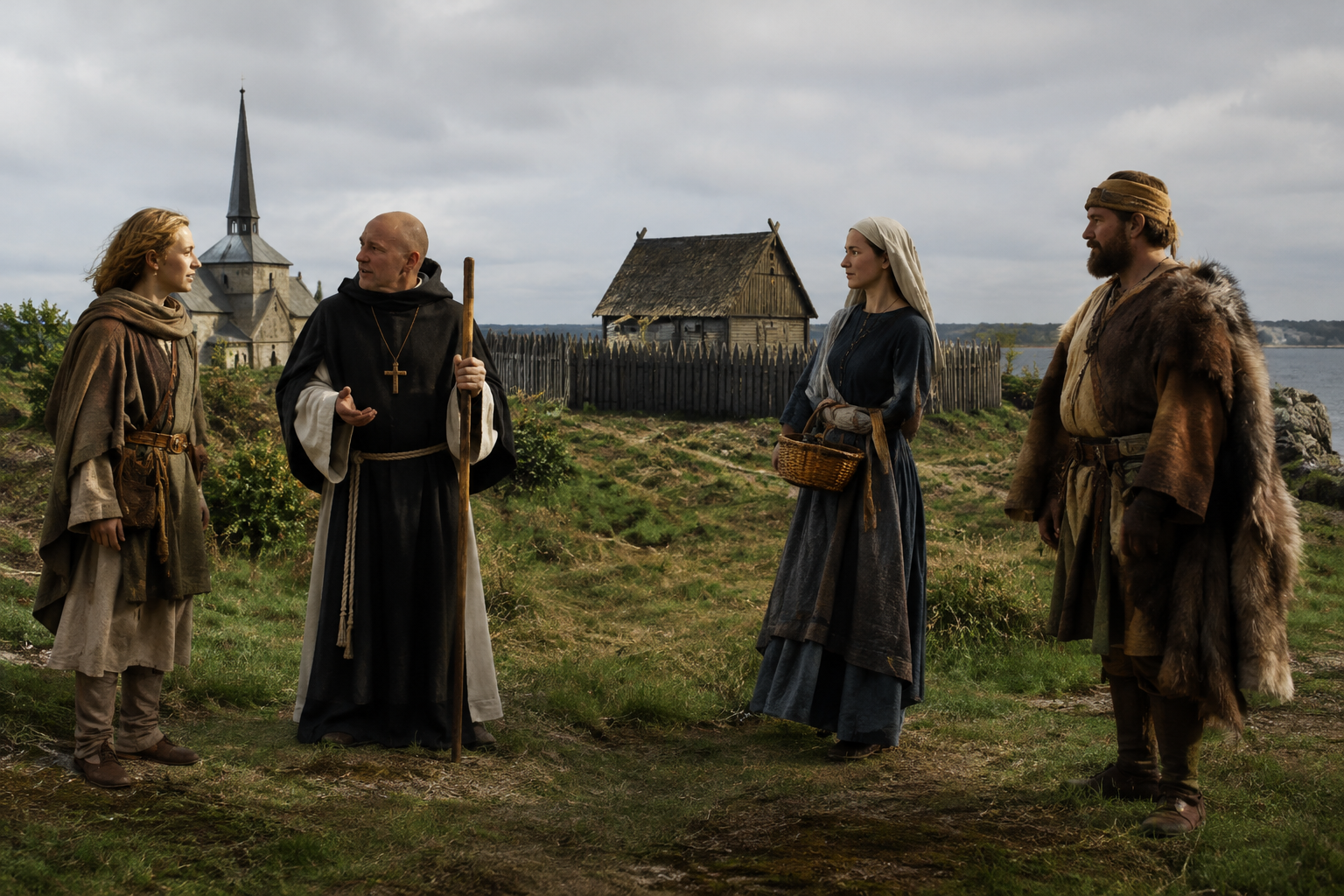
One of the most striking features of this R1a1a set is how far north and east it reaches without losing contact with the steppe zone. In Scandinavia there is VK421 from Viking Age Oppland in Norway, dated around AD 950. In Poland there is VK153, the so-called Axe Warrior from Bodzia, dated to about AD 997, a burial long discussed in connection with far-flung Viking Age networks. In medieval Russia the lineage appears in SHE005 from Shekshovo, around AD 1000.
Then there are the steppe and Central Asian cases: MJ51 from eastern Scythian Kazakhstan, around 650 BC; DA94 from a Turkic tribe context on the steppes, around AD 732; and L5139 plus L8629 from the late Kushan Empire in Central Asia, around AD 220. No serious historian would claim that all these men belonged to one coherent people. But taken together, they show that R1a1a could travel, persist, and be absorbed into very different political and cultural worlds: Scythian, Turkic, Slavic, Viking, and medieval Christian.
That breadth is, really, the point. Some paternal lines become historically interesting not because they belong to a single famous dynasty, but because they keep resurfacing in the places where Eurasian history was being made through movement and contact.
For someone researching R1a1a today, the strongest lesson from these ancient cases is not a tidy ethnic label. It is range and durability. This branch appears in Bronze Age central Europe, in the North Pontic world before and during the Scythian era, in post-Roman Pannonia, in medieval Poland, and in Viking Age-connected burials. That makes it a lineage with a long archaeological footprint across the heart of Eurasia.
If your paternal line falls somewhere under R1a1a, ancient DNA suggests that your direct male ancestry may connect to populations involved in some of Europe's and the steppe's most important long-term historical zones. The next step, as ever, is finer resolution: the deeper subclade usually matters far more for genealogy than the broad parent name alone.

Comments