Haplogroup R1a

– 5 min read


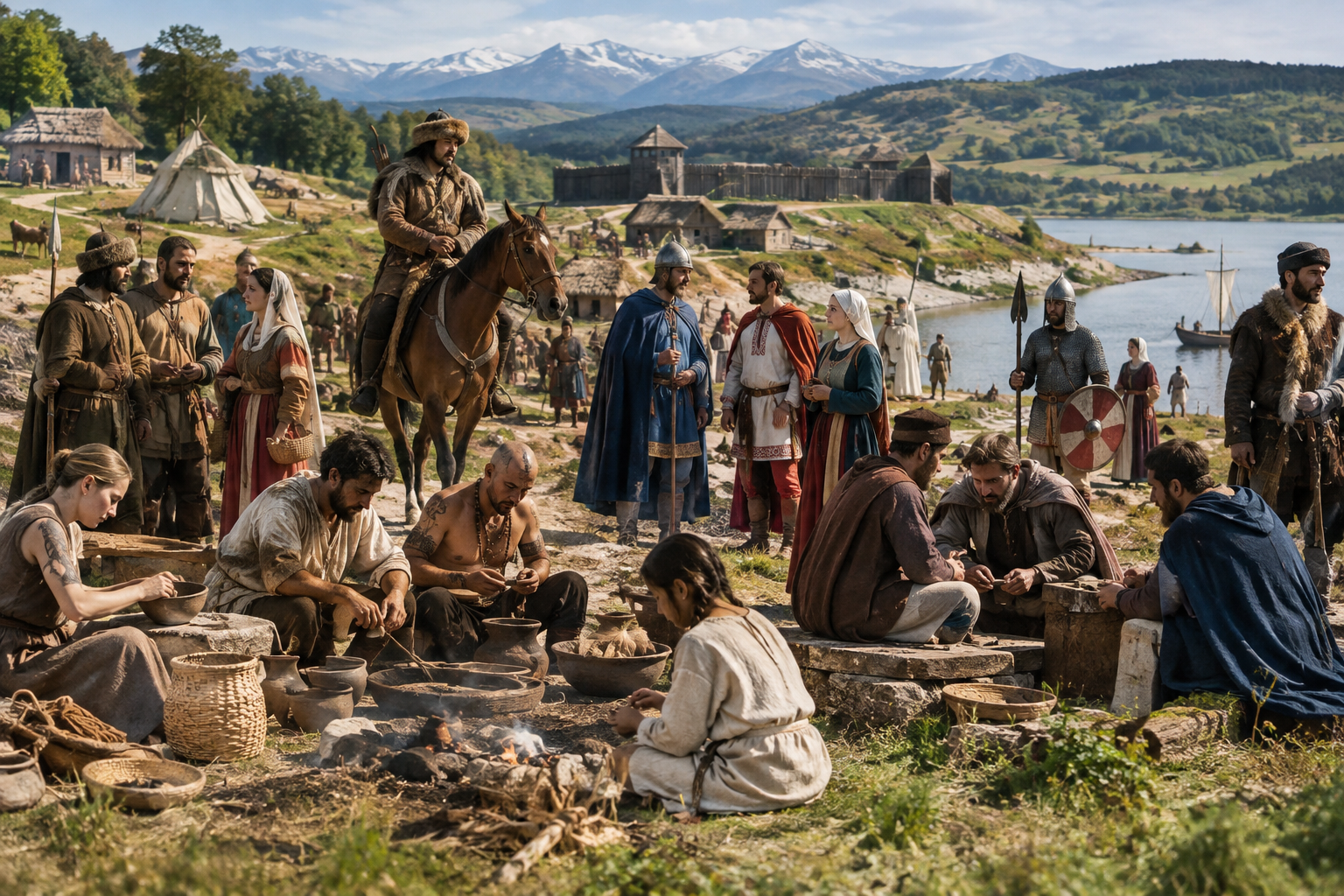
At Medvyn Tract Girchakiv Lis in Ukraine, one of the more striking Y-DNA signals in this set appears in a man dated to around 600 BC: sample UKR039, identified here within haplogroup R1a. That matters not because one grave can explain a whole people - it cannot - but because this is exactly the sort of find that places a paternal line inside a real archaeological landscape: the forest-steppe edge, the world of early Scythian power, and a region that kept drawing in new groups while also preserving older local continuities.
R1a is one of the best-known paternal lineages in Eurasian archaeogenetics, but it is easy to talk about it too vaguely. Y-DNA follows one direct male line only: father to son to son. It does not describe a person's entire ancestry, language, or identity. What the ancient evidence here does show is that men assigned to R1a appear in very different settings over an immense span of time - from prehistoric eastern Europe to Bronze Age Scandinavia, from steppe-linked contexts to medieval dynastic Poland.
UKR039 comes from the Ukrainian site of Medvyn Tract Girchakiv Lis, dated around 600 BC, in a period commonly associated with Scythian-era societies in the North Pontic region. This was not a static frontier. It was a meeting zone between steppe pastoral worlds, forest-steppe communities, and the routes that linked the Black Sea to the deep interior of eastern Europe.
That wider regional picture is important. A study of mobility and population history in Ukraine, focused on the North Pontic crossroads, helps frame why a haplogroup like R1a keeps turning up in these landscapes. The point is not that every bearer belonged to the same tribe or political confederation, but that paternal lines associated with steppe and post-steppe populations were repeatedly present in the region across long stretches of time.
The same broad zone is represented here by other earlier Ukrainian and steppe-related finds: NEO497 from Vasilevka, dated around 8705 BC; NEO518 from Bronze Age Igren in Ukraine, around 2114 BC; and NEO81 from Borovjanka XVII in the central steppes of Russia, around 1347 BC. Taken together, they do not give us one simple origin story. They do something more useful: they show that the paternal history behind later steppe societies was already deep, layered, and regionally varied.
Some of the oldest samples in this set are particularly interesting because they sit far earlier than the famous Late Neolithic and Bronze Age expansions usually discussed with R1a. NEO202 from Peschanitsa in Russia is dated to about 8903 BC. NEO558 from Karavaikha, at around 6327 BC, and NEO209 from Golubaya Krinitsa, at around 5278 BC, extend that picture into the Mesolithic and early Neolithic of northern and eastern Europe.
These are not the horse-riding warriors of popular imagination. They belong to worlds of foragers, river corridors, and early regional transitions. Another key sample, NEO189 from Sakhtish II in Russia, dated around 3318 BC, sits in a zone where forest hunter-gatherer ancestry and later cultural changes have been closely studied. The importance of such finds is not that they make every early forager "typically R1a," but that they remind us the lineage's history in eastern Europe cannot be reduced to a single migration episode.
Research on prehistoric genomes from the broader region, including a major Nature study on the North Pontic and neighboring populations, has sharpened exactly this point: eastern Europe before and during the Bronze Age was full of population interaction, persistence, and reshaping. The R1a label survives in our modern summaries, but the men carrying it lived in societies that were changing profoundly from one millennium to the next.
By the Bronze Age, the evidence becomes easier to place within better-known archaeological horizons. I10439 from Crihana Veche in Moldova, dated around 2000 BC, is associated with the Corded Ware world. TRM001, dated around 2100 BC from Prague and described here as an Axe Grave or Corded Ware context, points in the same broad direction: R1a appearing within the networks that linked the eastern European steppe-derived horizon to central Europe.
This matters because Corded Ware was not just a pottery style. It marked a transformation in mobility, burial customs, and ancestry across large parts of Europe. When R1a appears in such settings, it helps explain why the lineage became so prominent later across parts of central, eastern, and northern Europe.
The Scandinavian evidence adds another chapter. NEO876 from Toftum Mose in Denmark, dated around 2036 BC, and NEO221 from Falkoping 5 in Sweden, dated around 1750 BC, place R1a firmly in the Nordic Bronze Age sphere. So do the Baltic-zone samples from Estonia: X16 from Vao around 1000 BC, X11 around 960 BC, and X20 around 850 BC. These are different local societies, of course, but together they show that R1a was not confined to the steppe. It had become part of the paternal landscape around the Baltic as well.
The later samples show how stubbornly durable a paternal branch can be even while everything around it changes. DA100, from Jeti Oguz in the Tian Shan region of Kyrgyzstan and dated around AD 330, comes from a Hunnic-period context. That does not make R1a a uniquely "Hunnic" lineage, but it does show the branch present in Inner Asian and steppe-connected worlds that were politically and culturally very fluid.
Further west, 2426 from Malles Burgusio Santo Stefano in South Tyrol, dated around AD 450, places R1a in Dark Age northern Italy. By this period, the old Roman order was fragmenting, military movement was constant, and local communities could include people with very different ancestry histories. A Y-chromosome label alone cannot tell us whether this man's paternal line had arrived recently or had deeper roots in Europe, but it is a useful reminder that post-Roman society was anything but biologically uniform.
The Scandinavian medieval samples continue the story into the Christian centuries: wes009 from Late Viking Age Vasterhus in Jamtland, dated around AD 1016, and mbv211 from medieval Vasterhus, dated around AD 1313. R1a here is no exotic newcomer. It is part of the ordinary paternal fabric of northern Europe by the Middle Ages.
Early Medieval Baltic Connections
The most historically specific cluster in this list is medieval Poland. Several samples are explicitly associated with the Piast dynasty: PCA0186 and PCA0189 from Lad, around AD 950; PCA0200 from Lad, around AD 1100; PCA0247 from Rumin-Lad in Greater Poland, around AD 1100; and PCA0314 from Plonsk in Masovia, also around AD 1100. This is not merely regional background noise. It is a case where R1a appears in burials tied to the ruling house of early medieval Poland.
That does not mean every Piast male everywhere has been genetically solved, nor that one broad haplogroup settles every debate about origin. But it does mean that R1a belongs to the documented paternal story of the dynasty that oversaw the making of the first Polish state. In historical terms, that is a large step from the prehistoric and protohistoric examples: here the lineage enters named politics, Christian rulership, and written history.
The Piast samples also sit well beside older Polish evidence, such as poz533 from Swiniary Stare near Sandomierz, dated around 1950 BC. The attraction of this comparison is not to claim an unbroken line from one excavated Bronze Age grave to medieval rulers. It is to notice that the same broad paternal haplogroup is repeatedly present in Polish lands across very different archaeological and political eras.
If your Y-DNA falls within R1a, the most responsible reading is not that you "come from the Scythians" or "descend from the Piasts" in any simple sense. It is that your direct paternal line belongs to a branch with a long and very visible archaeological history across eastern Europe, the Baltic, parts of Scandinavia, and steppe-connected regions beyond. What stands out in this sample set is the sheer range: Mesolithic and Neolithic Russia, Bronze Age Corded Ware horizons, Scythian Ukraine, Hunnic-period Central Asia, medieval Sweden, and dynastic Poland.
That breadth is why R1a remains such an important haplogroup in ancient DNA. It is not attached to one single people. It is a recurring paternal thread through many societies that shaped Eurasian history.

Comments