Haplogroup R1

– 5 min read


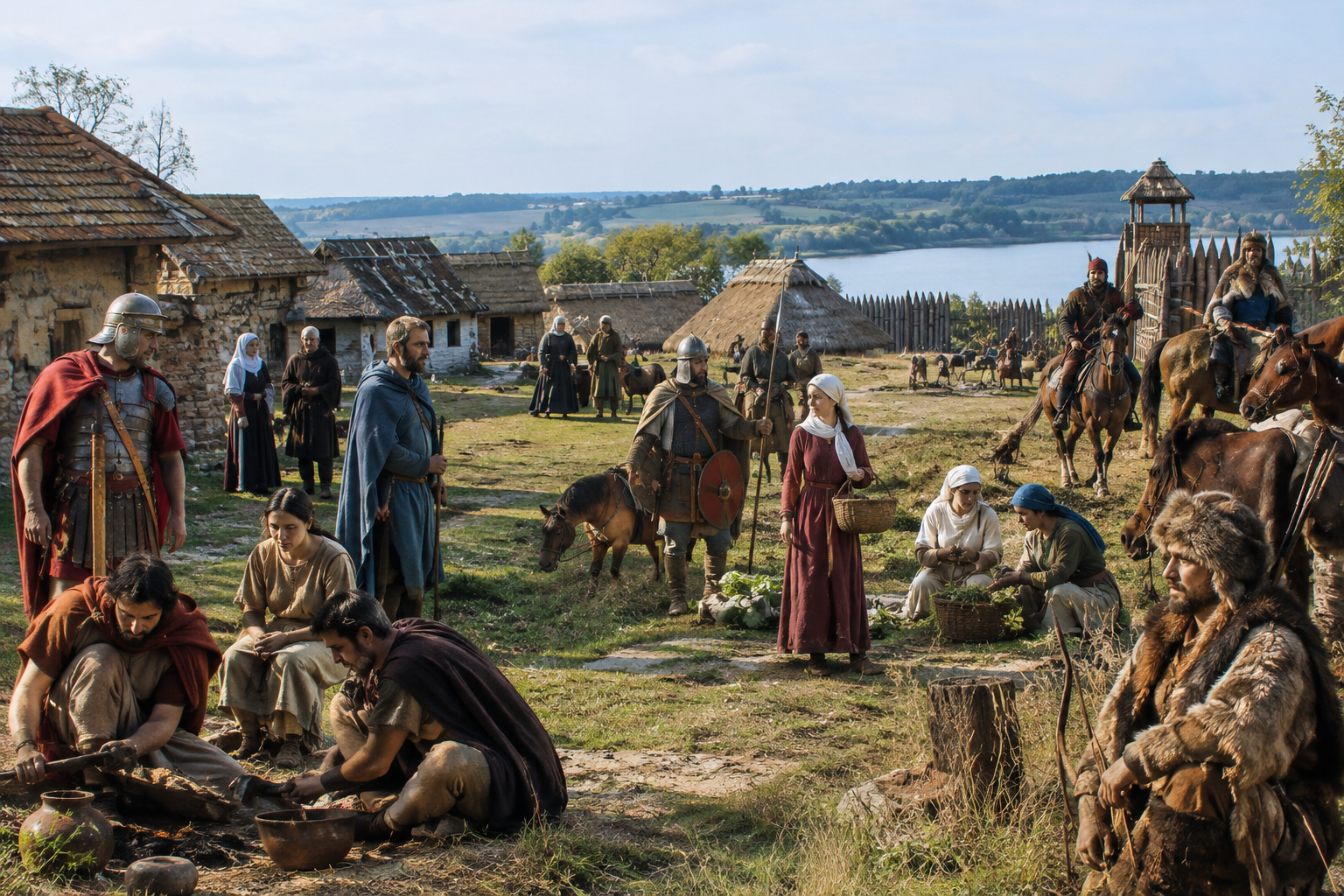
At Vicars Farm near Cambridge, one Roman-period burial stands out simply by how it has been described: an "outsider". Sample VIC003, dated to around AD 200, comes from a landscape that sat inside Roman Britain but never ceased to be connected to people moving through it. That is a good place to begin with R1, because this is not a neat, single-country lineage in the evidence here. It appears instead in men buried across very different worlds: Mesolithic and Neolithic eastern Europe, Bronze Age Scotland, Iron Age steppe zones, Roman and post-Roman frontier communities, and medieval towns.
That breadth needs one immediate caution. R1 is a broad Y-DNA label, not a finely resolved terminal branch, and Y-DNA traces only one direct paternal line out of the many ancestors any person has. Still, broad branches matter archaeologically. In this case, the samples suggest that R1 was present in a long chain of mobile, often frontier-facing populations, and that by historical times it could turn up in settings as different as a Roman-era cemetery in Cambridgeshire and a Tarim Basin mummy.
The deepest time depth in this set comes from eastern Europe. Sample NEO494 from Vasilevka, Ukraine, dated to about 8705 BC, places R1 in a Mesolithic hunter-gatherer context. Another early example, NEO210 from Golubaya Krinitsa in Russia, dated to about 5278 BC, shows that the lineage was still present far to the northeast in the Neolithic.
These very early appearances matter because they stop us telling a lazy story in which every R1 man must be explained by later Bronze Age migrations. Some R1 paternal lines were already part of the human landscape of eastern Europe long before chariots, Scythians, or Roman frontiers. Research on the broader North Pontic region has repeatedly shown how complex this zone was, with hunter-gatherer persistence, incoming farmers, and later steppe expansions layered over one another rather than replacing everything in a single sweep. For readers interested in that wider background, this MyTrueAncestry article is a useful companion.
The point is not that Vasilevka and Golubaya Krinitsa were somehow the sole "origin" of R1 in any final sense. It is that the branch is already visible in the old hunter-fisher and early farming worlds of the east European plain. That gives the later evidence a deeper backdrop: when R1 turns up in Iron Age horse cultures or medieval towns, it is part of a paternal story already thousands of years old.
Several of the most striking R1 cases belong to the great corridor of steppe and steppe-edge mobility. Sample MJ53 from eastern Scythian Kazakhstan, dated to around 650 BC, and DA194 from western Scythian Hungary, around 550 BC, show the lineage on both eastern and western sides of the Scythian world. Add DA144, a Sarmatian individual from the Black Sea dated to around AD 50, and BRE026 from Berel, Kazakhstan, around AD 330 in a Saka-period context, and a pattern emerges: R1 appears repeatedly in societies that linked the Eurasian grasslands from the Pontic zone to Inner Asia.
Then there is 11KBM1, the Xiaohe mummy from the Tarim Basin, dated to about 1900 BC. This is one of those finds that instantly pulls the discussion out of any narrow European frame. The Tarim Basin has long fascinated archaeologists because its burials sit at the meeting point of desert ecology, long-distance movement, and the deep prehistory of Inner Asia. An ancient DNA study of the region, published in Nature, helped sharpen just how distinctive some of these Bronze Age populations were, even when later historical narratives tried to fold them into simpler migration stories.
It would be rash to pretend that all these steppe and desert-edge men belonged to one close paternal family. They did not. But they do show that R1 had a real presence in mobile societies often associated with herding, exchange, warfare, and long-distance contact. That makes R1 one of those branches which, in archaeological terms, keeps appearing where worlds meet rather than where they stay comfortably separate.
Return now to VIC003 at Roman-era Cambridge. What makes this sample interesting is not simply its haplogroup, but its setting in a provincial Roman landscape shaped by movement. Roman Britain was full of such movements: soldiers, merchants, enslaved people, administrators, craftspeople, and families with roots all over Europe and beyond. A broad lineage like R1 cannot tell us which route brought any one man there, but it does fit the bigger picture of a connected empire in which local and non-local people ended up buried side by side.
The same frontier complexity appears again after Rome. At Malles Burgusio Santo Stefano in South Tyrol, three samples - 2428, 2428a, and 2428b - are dated around AD 450. In the Little Hungarian Plain, KMU003 from Arrabona Kony Barbaricum, dated around AD 550, places R1 in post-Roman Pannonia. And TGH010, dated around AD 450 in Hungary's Danube-Tisza region, is labeled as a Hun invader, reminding us how often post-imperial identities are historical and archaeological labels layered onto genetically mixed communities.
A recent study of Roman and early medieval Britain in Molecular Biology and Evolution has shown just how revealing these transitional cemeteries can be when genetics and archaeology are read together. The lesson travels well beyond Britain. In South Tyrol, Pannonia, and the western provinces, the centuries around Rome's collapse were not a simple handover from "Romans" to "barbarians". They were full of blending, resettlement, and new local societies built from older imperial pieces.
Even later, L014 from La Sagrera, Barcelona, dated to AD 1652 and identified as a Spanish soldier from the time of the Catalan Revolt, shows how this paternal branch continues to surface in explicitly historical individuals rather than only prehistoric abstractions. By that date, of course, R1 tells us nothing straightforward about language or nationality. It tells us that one male line, far older than the Spanish monarchy or the city of Barcelona itself, had found its way into an early modern military burial.
The medieval evidence is quieter than the steppe material, but in some ways more familiar. In England, R1 appears in ATP_PSN_104 and ATP_PSN_19 from Cambridge St John's Hospital, both dated around AD 1250, and in ATP_PSN_934 from Cherry Hinton, around AD 1055. Another English case, SED011 from Sedgeford, Norfolk, is dated to about AD 600 in an Anglo-Saxon context.
None of these individuals should be flattened into a single "English R1 type". Early medieval and medieval England were made from Romano-British survival, North Sea migration, later Scandinavian settlement, and constant regional variation. What these samples do show is that R1 was one of the paternal threads present in the making of medieval society, from village cemeteries to hospital burials.
Farther north and east, mbv330 from Vasterhus, Sweden, dated to around AD 1313, and the Polish samples PCA0559 from Silesia Milicz, PCA0571 from Zielonka Poznan, and PCA0238 from Poznan, all around AD 1100, place the haplogroup in medieval Christian communities on the Baltic and central European fringe. Still earlier, Tamula3 from Tamula, Estonia, dated to about 3700 BC, reminds us that the Baltic story too has very long roots, stretching back well before medieval polities. For more on that northern world, the Baltic-Finnic angle is worth exploring.
If your paternal line falls under R1, the strongest lesson from these ancient samples is not a single homeland badge. It is range. This broad lineage appears among eastern European hunter-gatherers, Bronze and Iron Age steppe populations, Roman and post-Roman frontier communities, and medieval northern Europeans. In other words, the archaeological record presented here makes R1 look less like a marker of one people and more like a durable paternal branch that repeatedly turns up in zones of movement, contact, and historical change.
For family historians, that is still valuable. It means an R1 result may connect your direct male line to very old processes in Eurasia, but the meaningful detail will usually come from deeper downstream subclades, documented genealogy, and matches to better-resolved ancient and modern lineages. The ancient men here do not give one simple answer. They give something more interesting: a paternal branch that kept reappearing wherever Eurasian history was being made.
Comments