Haplogroup Q2a1a
– 5 min read


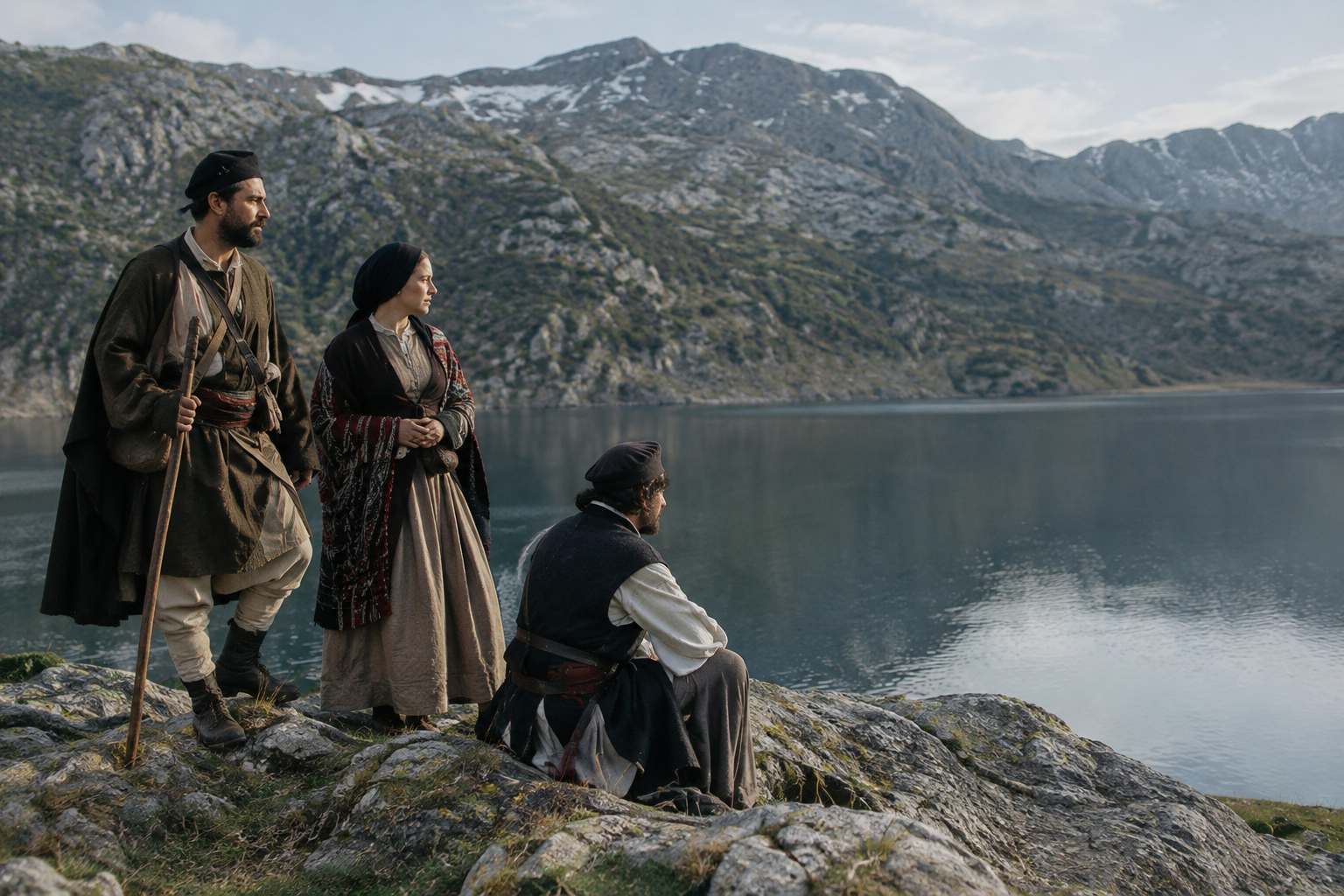
One of the more arresting clues for haplogroup Q2a1a is also one of the most recent. A man identified as I6939, described as the Skeleton Lake Traveller and dated to around AD 1810, appears in a Hellenic setting. That is not the sort of place many readers instinctively expect to meet a branch of Y-DNA Q. Yet that is exactly why the sample matters: it reminds us that paternal lineages do not stay politely inside the historical boxes we build for them.
Q2a1a is a paternal-line marker, tracing one direct male line only rather than a person's whole ancestry. Even so, a lineage like this can be historically illuminating. When a branch better known from wider Eurasian and, in some cases, trans-Eurasian discussions turns up in a relatively late individual in the Greek world, the interesting question is not "how can this be?" so much as "which layers of movement, soldiering, trade, migration, conversion, empire, and local settlement brought it there?"
The label "Skeleton Lake Traveller - Hellenic" already suggests mobility. We should be careful here: a striking nickname is not the same thing as a full biography, and the available details do not license invented tales of caravans, mercenary service, or shipwrecks. But the basic fact is interesting enough on its own. A man in the early 19th century, associated with a Hellenic context and carrying Q2a1a, stands as evidence that this paternal branch had entered the eastern Mediterranean historical world by that date.
That matters because the eastern Mediterranean was, for centuries, a zone of relentless human circulation. Greeks, Albanians, Slavs, Vlachs, Anatolians, Armenians, Jews, steppe-descended groups, Ottoman officials, sailors, pilgrims, and soldiers all moved through overlapping networks. A single Y-chromosome lineage found there in about AD 1810 does not tell us which one of those routes applies to I6939. It does, however, place Q2a1a firmly inside that crowded historical landscape.
A broad ancient DNA study connected with this sample's research context can be found here. For this article, the important point is modest but solid: the sample gives us a real, dated person in a real historical setting, not a purely abstract phylogenetic branch on a tree.
Greek-speaking communities in southern Italy
Haplogroup Q as a whole has a deep and complicated history across northern Eurasia and beyond. But one must not lazily pour the entire history of haplogroup Q into the narrower vessel of Q2a1a. The article haplogroup is a specific downstream branch, and without a fuller sequence of intermediate ancient samples from this exact line, we should resist grand claims about its precise origin point or a single heroic migration route.
Still, even a cautious reading tells us something important. Q lineages are unusual enough in most of Europe and the Mediterranean that their appearance tends to signal either older eastern inputs preserved in later populations, or more recent male-mediated movement. In plain English: when Q2a1a turns up in a Hellenic-era or Hellenic-region context, it encourages us to think about contact zones rather than isolated villages.
This is where genetics and history usefully check one another. Historians already know the Balkans and the Aegean were full of newcomers and returnees. Genetics does not abolish that history; it sharpens it by showing that some paternal lines circulating there were less locally common than one might guess from language or religion alone.
The great temptation with a lineage like Q2a1a is to leap straight to distant steppe nomads or dramatic imperial episodes. Sometimes that may be relevant. But the eastern Mediterranean has its own quieter mechanisms of diversity: merchant movement, Ottoman military service, resettlement, seasonal labour, enslavement and manumission, island-to-mainland marriage, and the constant trickle of men passing through ports and garrisons.
By the late Ottoman and early modern periods, communities in Greek lands could carry paternal lines with very different older origins while sharing language, faith, and local custom. That is precisely why a single Y-DNA result cannot be translated into a neat ethnic label. I6939 may have lived in a Greek-speaking or Hellenic cultural environment, but his paternal line could preserve a much longer and less local story.
Readers interested in how ancient DNA is complicating simple ideas of Greek continuity and colonisation may want to look at other eastern Mediterranean cases, including MyTrueAncestry's discussion of Corinth and its colonial links.
There is a habit in popular genetics of treating the oldest sample as automatically the best sample. Archaeologically, that is not always so. A relatively recent individual like I6939 can be very useful because he sits close to documented historical worlds: empires, confessional communities, named routes, recorded wars, and known patterns of migration. In other words, he belongs to a period where DNA can more plausibly converse with history.
An AD 1810 individual from a Hellenic context is living after centuries of Byzantine collapse, Ottoman rule, Venetian maritime contact, Balkan population reshuffling, and repeated military upheaval. Any one of those long processes might help explain how Q2a1a came to be present there. The value of the sample is that it anchors the lineage in a recognisable human landscape shaped by these forces.
That sort of evidence sits well beside broader MyTrueAncestry work on Mediterranean and post-Roman mobility, where populations that look culturally familiar often turn out to be genetically more mixed and historically more mobile than older national narratives allowed.
Balkan roots and medieval admixture
For someone researching Q2a1a today, the hardest lesson may also be the most useful one: unusual lineages in Europe are often histories of arrival, survival, and absorption. Men carrying such lines could become entirely local in language and identity while preserving a paternal signature that hints at older movement from elsewhere. By the time we meet them in the record, they are not strangers passing through; they are part of the population.
The Hellenic example is therefore not a curiosity to be filed away under "exotic exception." It is better understood as a small but telling sign of how Mediterranean societies actually worked. Ports, frontiers, mountain corridors, military zones, and trading towns did not merely exchange goods. They accumulated people, and with them accumulated lineages.
That wider pattern can also be seen in studies of mixed communities around frontiers and imperial contact zones, where archaeology and genetics increasingly show that ancestry, culture, and political allegiance rarely marched in perfect step.
Q2a1a is not, on present evidence here, a grand royal signature or a neatly bounded ethnic marker. What the sample I6939 gives us instead is something more historically satisfying: proof that this paternal branch was present in a Hellenic setting around AD 1810, inside one of the most interconnected regions on earth. For descendants exploring this haplogroup, that should encourage a search not for a single dramatic origin story, but for layered histories of movement, settlement, and belonging across Eurasia and the Mediterranean.

Comments