Haplogroup Q1b2a1a
– 5 min read


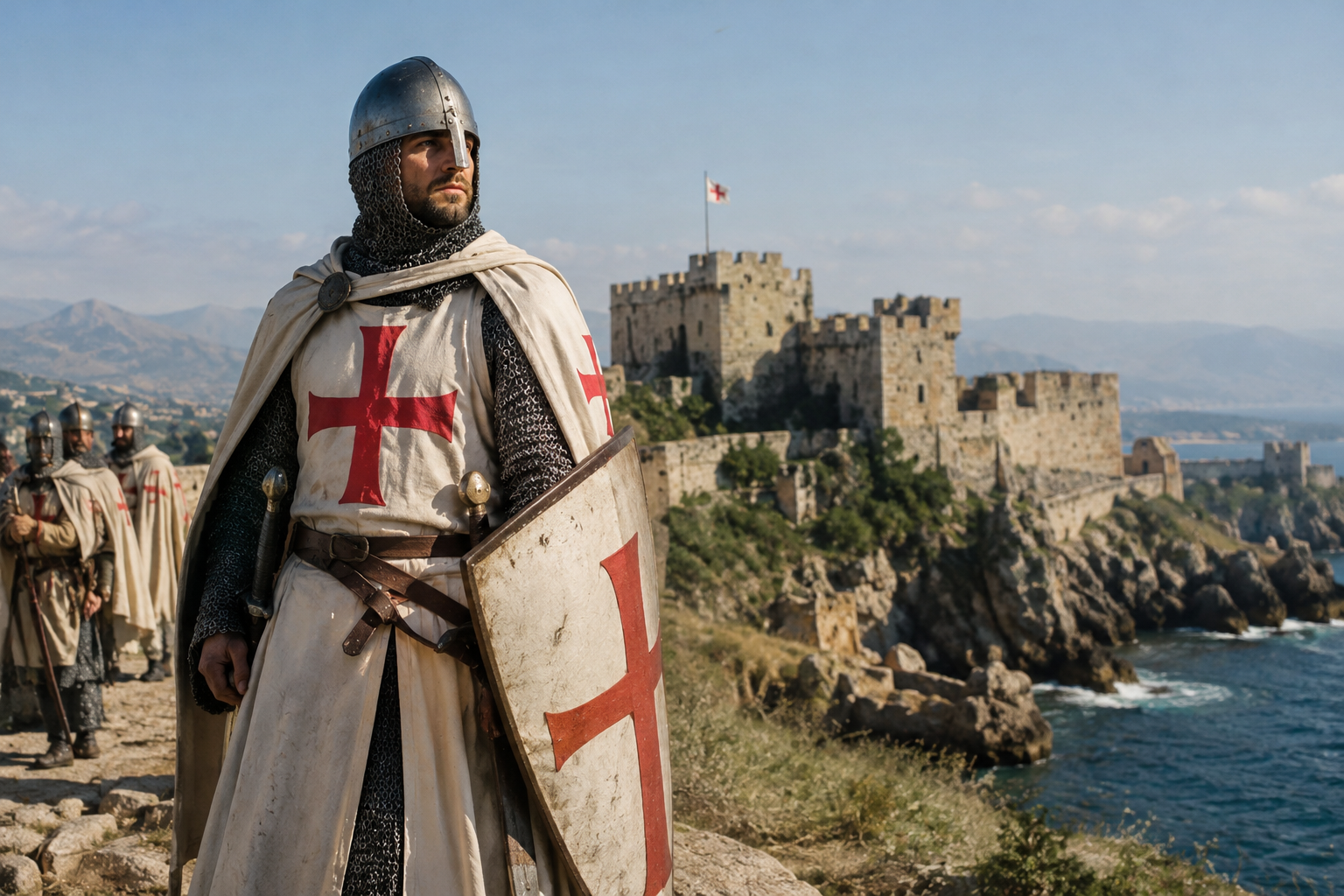
In the middle of the 13th century, somewhere in Crusader-era Lebanon, a man labelled today as SI-45 entered the genetic record with an ancestry profile striking enough to be described as a "Crusader Knight Mix." That is already a rather arresting phrase. It evokes not a tidy, sealed-off medieval community, but a frontier world of ports, castles, pilgrim routes, armies, merchants, and marriages, where people from very different backgrounds could end up buried in the same landscape.
For the Y-DNA haplogroup Q1b2a1a, this matters because lineages in the broader haplogroup Q family are far better known from North Eurasia, Central Asia, and the Indigenous Americas than from medieval Latin Christian contexts in the Levant. A single Crusader-period man in Lebanon does not rewrite the map. But it does show, very concretely, that paternal lines associated with the wider Q family could appear in the eastern Mediterranean's most entangled historical setting of all.
The sample record gives us only a compact description: Lebanon, around 1250 AD, individual SI-45, classified as Crusader Knight Mix. Even with limited detail, that is enough to place him in a turbulent and highly connected era. By the mid-13th century, the remaining Crusader polities on the Levantine coast were politically fragile but still deeply plugged into Mediterranean traffic. People moved in and out through warfare, pilgrimage, trade, diplomacy, and settlement.
That mobility is the real historical key. A paternal lineage like Q1b2a1a, traced along the direct male line only, tells us nothing like the whole of this man's ancestry, language, or identity. But it does point to one strand in a family history that may have reached the Levant by a route less familiar than the classic textbook story of "Franks from western Europe." Medieval crusading society was never just one thing, and the genetics increasingly support that complication.
A useful point of comparison comes from broader work on mixed and mobile medieval populations in the region. Research on Crusader-period genomes published in the American Journal of Human Genetics helped establish that the Levant during this period included individuals with both local and European-related ancestry, as well as people whose family histories were already admixed. That larger pattern makes SI-45 more interesting, not less: he belongs to a world where neat ethnic boxes begin to fall apart under archaeological and genetic scrutiny.
Medieval Sicily's DNA diversity
Q1b2a1a is a narrow branch within haplogroup Q, a paternal lineage with a very wide and complicated history across Eurasia. The important thing is not to flatten that complexity. The deep history of haplogroup Q as a whole cannot simply be pasted onto this specific subclade, and still less onto one medieval individual from Lebanon.
What we can say is more modest and more historically useful. When a branch of Q appears in a Crusader-period burial context, it reminds us that the armies and communities of the eastern Mediterranean were not composed solely of men whose paternal lines fit modern expectations of western European frequency patterns. Medieval identities were made through religion, lordship, language, law, and allegiance, not by Y-DNA labels. Yet Y-DNA can reveal family histories that the written sources either ignored or never knew.
This is especially relevant in frontier settings. A "Crusader" was not necessarily a first-generation newcomer from France or England. He might be locally born, the child of mixed ancestry, connected to Armenian, Syriac, Greek, or other eastern Christian communities, or descended from earlier movements through the steppe and Near East. Genetics does not let us choose among those possibilities without more evidence, but it does warn us off overly simple answers.
It is worth dwelling on the place as much as the lineage. Lebanon in the 13th century sat inside a dense historical corridor. Coastal strongholds and inland routes connected the Latin East with Cyprus, Anatolia, Armenia, Egypt, Italy, and beyond. The men who fought, traded, prayed, governed, and married there were often participants in several worlds at once.
That is why a paternal lineage like Q1b2a1a can appear entirely plausible in context without needing any melodrama attached to it. The eastern Mediterranean had long absorbed movements from the Caucasus, Iran, the steppe, and inner Asia, whether through imperial armies, merchant networks, enslavement, pilgrimage, or local dynastic politics. By the Crusader period, those older layers of mobility had not vanished; they had become part of the background fabric into which new western arrivals were woven.
Archaeogenetics has been especially good at forcing historians to acknowledge these layered histories. The old habit was to describe medieval societies as if each burial ground corresponded neatly to a single people. The DNA keeps spoiling that tidy picture. One cemetery may contain locals, incomers, and children of mixed unions. One label in a chronicle may conceal several biological histories.
There is a temptation, when evidence is sparse, to dismiss a single ancient sample as a curiosity. But in medieval archaeology, one securely placed individual can do something rather important: he can prove that a possibility was real. SI-45 shows that a paternal line reported here as Q1b2a1a was present in a man associated with the Crusader world of Lebanon around 1250 AD. That is already enough to broaden the conversation.
It broadens it in two directions at once. First, it speaks to the diversity of the Crusader states themselves, where ancestry and affiliation did not always align in predictable ways. Second, it offers people with this haplogroup today a reminder that paternal heritage may pass through unexpected historical theaters. A lineage now found in one population may have surfaced centuries ago in a very different social setting.
There is an echo here of other medieval genetic work showing movement across political and cultural frontiers rather than along neat national lines. Studies of frontier populations in Europe repeatedly reveal the same basic truth: soldiers, settlers, traders, and their descendants were often genetically mixed before chroniclers ever began naming them. That is as true for the Levant as for the Rhineland or the North Sea world.
So how should someone approach Q1b2a1a historically? Not as a badge of one medieval ethnicity, and certainly not as proof of descent from a crusader knight in any straightforward sense. Rather, it is a paternal branch whose appearance in SI-45 places it inside a documented world of long-distance contact in the eastern Mediterranean.
That is a valuable kind of evidence. It suggests that the history of this line may intersect with regions and communities shaped by steppe connections, Near Eastern exchange, and medieval frontier society. In other words, the interesting part is not that Q1b2a1a belongs to one simple story, but that it does not. Its presence in Crusader-era Lebanon points to the mixed, mobile, and stubbornly untidy human reality behind medieval labels.
The most distinctive clue for Q1b2a1a here is not an ancient king or a grand dynasty, but one medieval man from Lebanon, SI-45, living in a place where Europe, the Near East, and older Eurasian connections met face to face. For anyone researching this paternal line, that is the useful lesson: your direct male ancestry may belong to a history of crossings, mixtures, and frontier societies that written history only partly captured.
Comments