Haplogroup Q1b2

– 5 min read


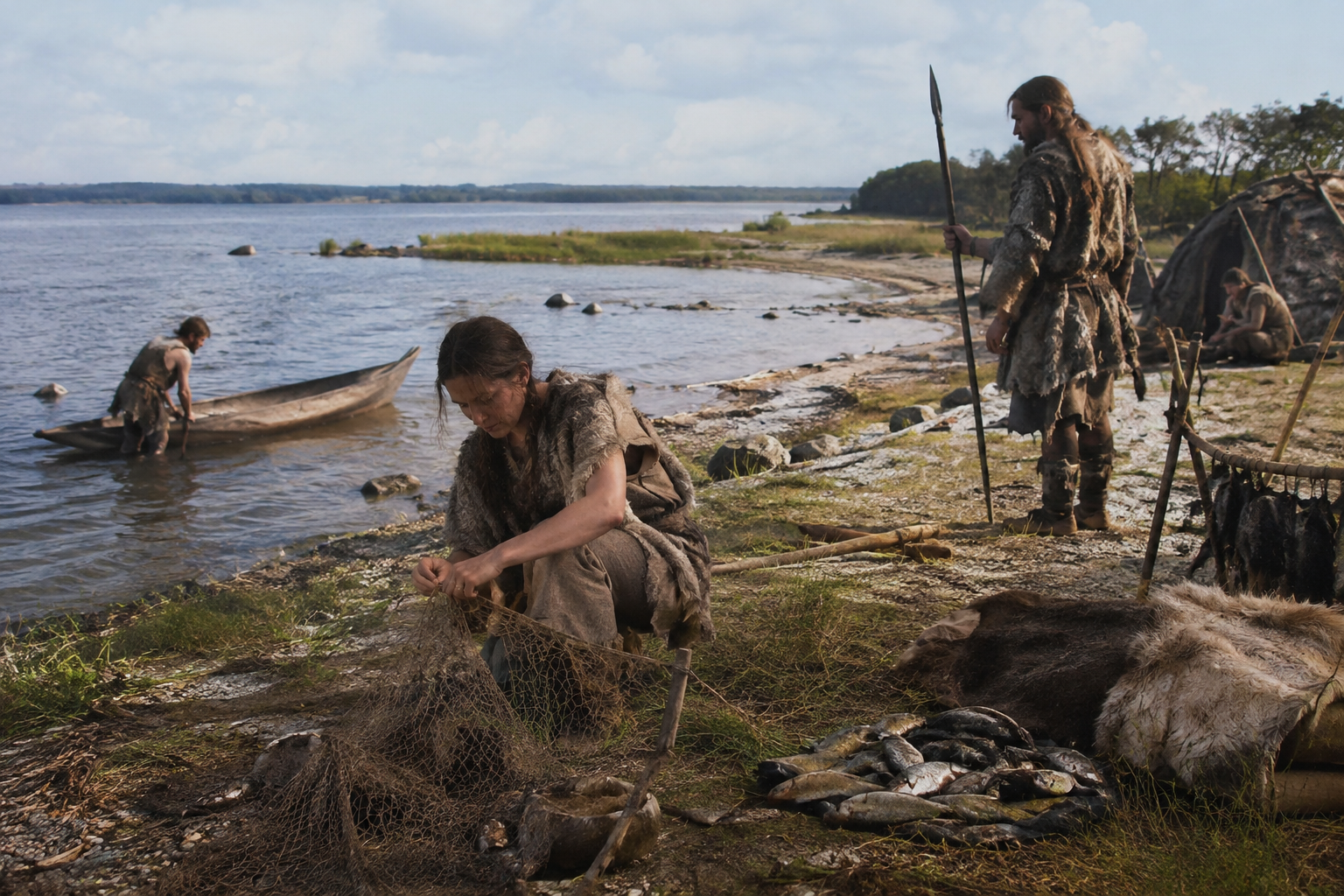
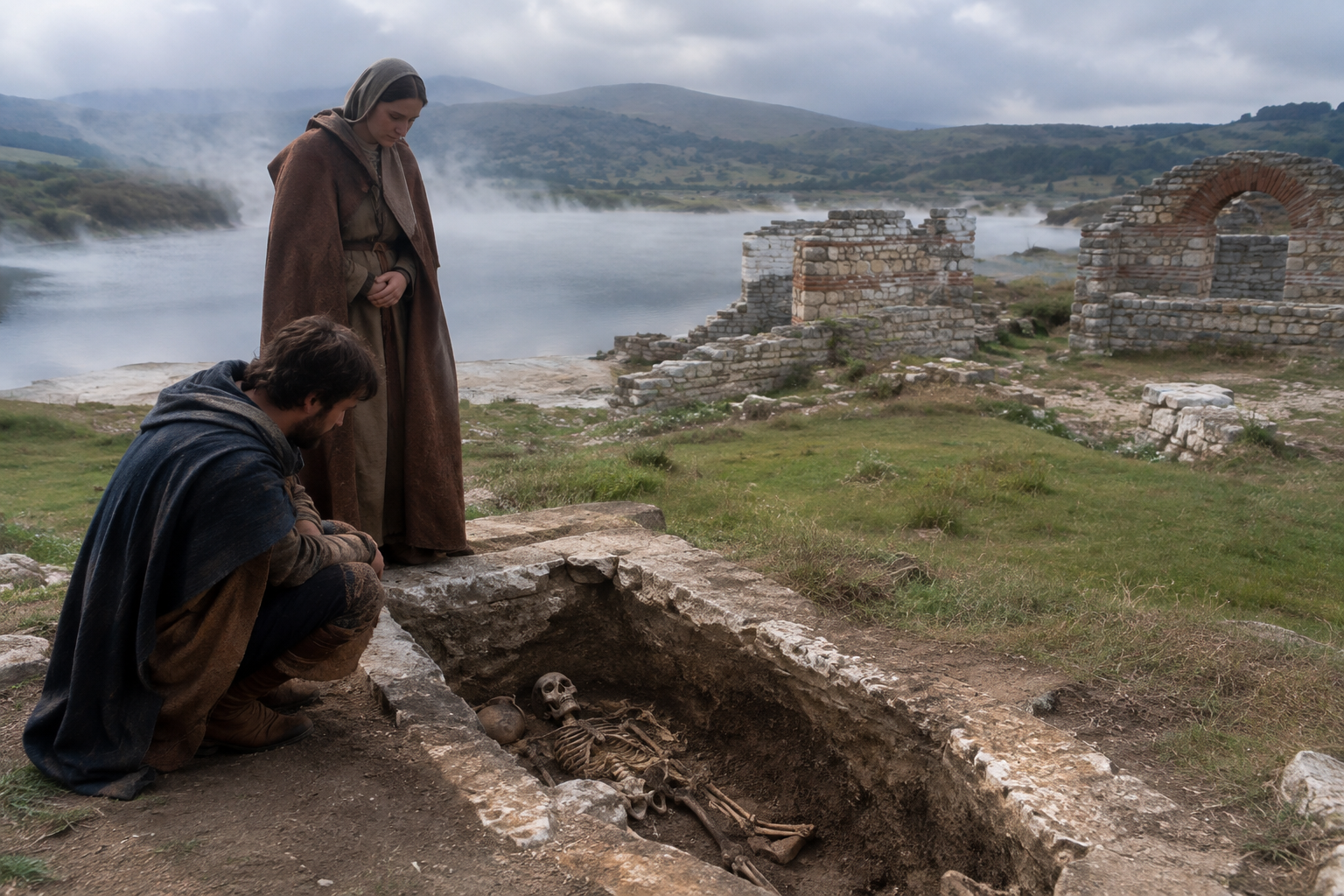
At Zvejnieki in Latvia, on the shores of ancient Lake Burtnieks, archaeologists uncovered one of northern Europe's great Mesolithic cemeteries. Among the burials was individual I4550, dated to about 6539 BC, a man from a world of foragers, fisher-hunters, and river-lake mobility. His reported association with Y-DNA haplogroup Q1b2 is striking precisely because it is not the paternal line most readers expect to meet in Mesolithic northeastern Europe.
That surprise is what makes Q1b2 worth pausing over. Y-DNA follows one direct paternal line only, not a person's full ancestry, but even a single male line can illuminate how varied prehistoric populations really were. In this case, the interest lies less in grand claims about dynasties or tribes and more in the stubborn fact that a lineage within haplogroup Q appears in a well-known Baltic Mesolithic cemetery long before later historical identities existed.
Zvejnieki is not an isolated curiosity but a major archaeological site for understanding the peoples of the eastern Baltic after the Ice Age. Its cemetery and settlement evidence span long stretches of prehistory, making it one of those rare places where we can watch communities return to the same landscape again and again. Individual I4550 belongs to the earlier, hunter-gatherer side of that story, before farming reshaped much of Europe.
That matters because the eastern Baltic did not simply receive influences from elsewhere and passively change. It was home to durable forager traditions with their own local histories. When a paternal lineage such as Q1b2 appears here, it should be read first in that local setting: not as a label for an ethnicity, and not as proof of some neat migration tale, but as evidence that Mesolithic male lines in the Baltic could be more diverse than simplified textbook sketches suggest.
A genetic study associated with this ancient population can be traced through research linked to the Zvejnieki data. Even without overloading the archaeology with technical claims, the broader lesson is clear enough: the eastern Baltic sat within a deep northern Eurasian human landscape whose paternal history was not monopolized by a single lineage.
Haplogroup Q is a wide and ancient paternal branch with an important history across northern Eurasia and, in other branches, the Indigenous Americas. But that broad fame can be misleading. One cannot simply take the best-known story of haplogroup Q as a whole and paste it onto Q1b2 in a Latvian Mesolithic burial. The narrower branch has to be handled carefully, especially when the available ancient evidence here is sparse.
So the responsible way to frame I4550 is modest but meaningful. He shows that a man associated with Q1b2, or with a very closely related reported placement within that branch, was present in the eastern Baltic in the 7th millennium BC. That is already important. It places this paternal signal in a forager community thousands of years before the Bronze Age expansions that often dominate discussions of European Y-DNA.
There is also a useful historical discipline in resisting the temptation to over-explain. Q1b2 in this context does not automatically identify language, culture, or a precise homeland. What it does provide is a fixed point: a direct paternal line embedded in a real Mesolithic burial community at Zvejnieki.
Ancient DNA often works like archaeology itself: one carefully dated context can matter more than a hundred guesses. I4550 is valuable because he is not a floating modern test result or an unattached medieval skeleton. He comes from a famous site with strong archaeological significance, allowing the haplogroup to be anchored in time and place.
And the time is crucial. Around 6539 BC, this was a northern world of waterways, seasonal movement, and intensive use of aquatic and forest resources. The paternal line seen in I4550 reminds us that Mesolithic Europe was not genetically uniform. By the time later Neolithic farmers and, much later, Bronze Age pastoralist-derived groups moved across parts of Europe, they encountered landscapes already populated by communities with long local histories and their own genetic variety.
That bigger theme has become increasingly clear across archaeogenetics: local hunter-gatherers were not a single block. Regional distinctions mattered. The eastern Baltic, like other northern zones, preserved ancient ancestry patterns longer than some farming regions farther south and west.
It is easy to think of Latvia's Mesolithic as peripheral. In fact, it was connected, just not in the way Roman roads or medieval chronicles would later define connection. Rivers, lakes, coastlines, and forest corridors linked people over broad distances. Materials, marriage networks, and inherited lineages could move through these landscapes even when population densities were low.
That is one reason a lineage such as Q1b2 should not be treated as bizarre or accidental merely because it is uncommon in present-day western European discussions. Prehistoric Eurasia was full of lineages that were once locally present, later diminished, regionally displaced, or simply swamped in frequency by later male-line expansions. Ancient DNA has repeatedly shown that today's map is not yesterday's map.
For the eastern Baltic in particular, the long persistence of forager ancestry has made the region essential for reconstructing Europe's deeper past. Studies of Finland and the wider Baltic zone, for example, continue to show how northern populations retained distinctive ancestry profiles and historical connections not reducible to the better-known stories of Mediterranean farmers or steppe chiefs.
There is a great temptation, when a haplogroup feels unusual, to turn it into a heroic remnant of some vanished people. Archaeology is healthier when it resists that urge. We do not need to invent chiefs, lost tribes, or epic migrations to make I4550 interesting. The site is important enough, and the date is early enough, that the evidence carries its own weight.
What we can say is that Zvejnieki preserves a human record from a formative period in northeastern European prehistory, and that I4550 contributes a paternal line reported as Q1b2 to that record. For anyone exploring this haplogroup today, that is a rare and valuable kind of anchor: not a vague regional association, but an ancient man from a known Mesolithic cemetery.
It also offers a useful corrective to the habit of reading later history backwards. Baltic, Finnic, Indo-European, and medieval identities all belong to much later chapters. In the age of I4550, we are looking at something older and less text-bound: communities whose histories survive in graves, landscapes, and genomes rather than names preserved in writing.
The distinctive lesson of Q1b2 here is not prestige but depth. With I4550 at Zvejnieki, this paternal branch is tied to a real Mesolithic setting in the eastern Baltic, showing that part of its history reaches into Europe's northern forager world. For a modern tester, that does not define complete ancestry or guarantee a direct route from Latvia to the present, but it does place the lineage in a remarkably early and archaeologically significant human landscape.
Comments