Haplogroup Q1a2a1c1
– 5 min read


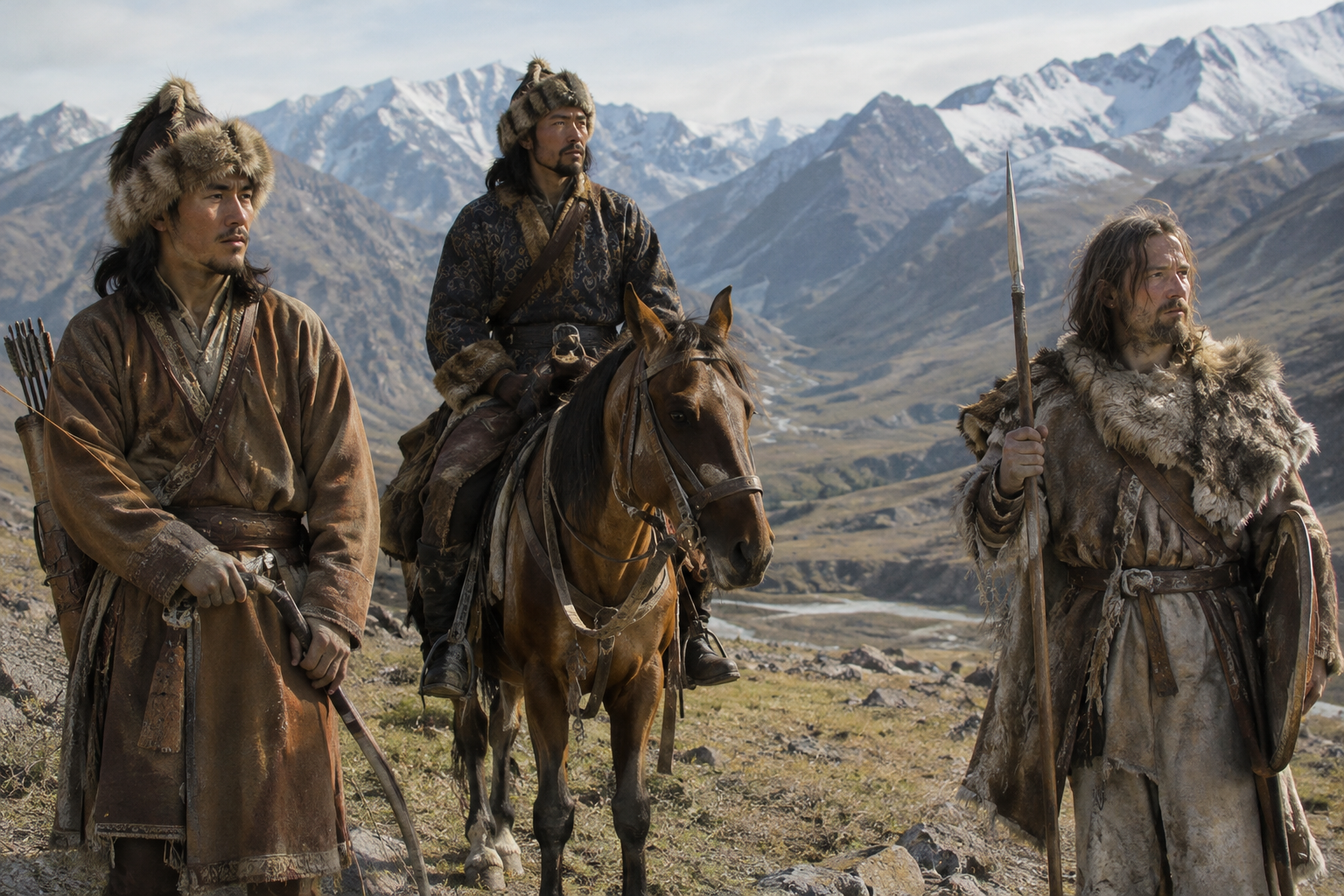
At Chandman Mountain in the Uyuk-Sagly region, two men dated to around AD 25 - samples CHN007 and CHN016 - offer one of those sharp little glimpses that ancient DNA occasionally gives us. They are linked here with the Y-DNA haplogroup Q1a2a1c1, a paternal branch turning up not in some neatly bounded kingdom, but in the mobile world of the eastern steppe, where burial grounds, horse cultures, and political identities rarely match the tidy boxes of later history.
That matters because Q lineages have deep roots in northern Eurasia and the Americas, yet any one narrow branch has its own much more local and historically specific story. In this case, the evidence in hand places Q1a2a1c1 in Iron Age and early historic steppe settings associated with Scythian and Wusun-era populations. That is already more interesting than any vague claim about "nomad ancestry": it puts this paternal line in the real archaeological landscapes of eastern Kazakhstan, the Altai-Sayan world, and the broad corridor between them.
The two Chandman Mountain samples are the strongest clue in this small dossier because they come from the same place and the same rough period. Both CHN007 and CHN016 are identified as Wusun-associated individuals from around AD 25. Even without embellishing their graves beyond what is actually given, their importance is plain enough: this is a repeated paternal signal in an early historic population often discussed in connection with the Ili Valley and the wider Inner Asian steppe.
The Wusun are awkward, in the best historical sense. Chinese historical texts describe them as a political people, but archaeology and genetics remind us that such groups were rarely biologically uniform. Ancient DNA has steadily shown that steppe confederations were mixtures of lineages, ancestries, and local traditions. So two men at Chandman Mountain carrying or being associated with Q1a2a1c1 do not define "the Wusun" as a whole. What they do suggest is that this branch belonged within the paternal repertoire of that world.
That makes Chandman Mountain a useful anchor point for anyone with this haplogroup today. It ties the branch not to mythic origin stories, but to a real early historic setting in the eastern steppe, where mounted mobility and long-distance connections shaped both politics and kinship.
The older sample in this set is IS2, dated to around 800 BC and described as Eastern Scythian from Zevakino-Chilikta. This pushes the branch back into the early Iron Age. In other words, before we meet Q1a2a1c1 in a Wusun-era context, we already see it - or at least a reported association with it - in the world usually labeled Scythian.
That label needs handling with care. "Scythian" can mean different things: a classical ethnonym, an archaeological horizon of mounted pastoral elites, or a broader genetic pattern spread across the steppe. Still, the Chilikta area is well known within the eastern steppe zone, and an early Iron Age male from this region associated with Q1a2a1c1 fits a wider picture in which eastern Scythian populations were far from genetically uniform. Some paternal lines were western steppe mainstays; others pointed eastward. Q belongs firmly in that second conversation.
So the pattern here is not a single isolated grave, but a branch appearing in two historically connected settings: first in an eastern Scythian context around 800 BC, then again centuries later in men linked to the Wusun horizon. That continuity across changing political names is exactly the kind of thing Y-DNA can illuminate. The paternal line persists while the historical labels around it shift.
A useful comparison here is the broader picture of Saka and related steppe groups in Central Asia, where archaeology and ancient genomics increasingly show mixed eastern and western components rather than one simple tribal ancestry. MyTrueAncestry readers who want that larger setting may enjoy this piece on Iron Age Saka culture through ancient DNA in Kyrgyzstan.
Y-DNA follows one line only: father to father to father. That is why it can be so historically sharp and so personally misleading at the same time. A man with Q1a2a1c1 today does not inherit his whole ancestry from Iron Age steppe riders; he inherits one direct paternal strand that, in the evidence here, was present among some of them.
It is also important not to pour the entire history of haplogroup Q into this much narrower branch. Haplogroup Q as a whole is old and widespread, with major histories in Siberia, Central Asia, and the Indigenous Americas. Q1a2a1c1 is not a synonym for all of that. The ancient samples here suggest a more specific eastern Eurasian steppe context, especially in the first millennium BC and the early centuries AD.
This is where ancient DNA has been particularly valuable. Research on steppe populations has repeatedly shown that political cultures such as the Scythians were not single-lineage peoples. One ancient DNA study of the region, published in Nature Communications, helped establish just how varied the genetic background of Iron Age steppe groups could be. That broader lesson fits these Q-associated males very well: continuity in some paternal lines, diversity across the wider population.
One reason these samples matter is geographical. Chandman Mountain and Zevakino-Chilikta sit within a vast interaction zone linking the Altai, eastern Kazakhstan, Mongolia, and the Tianshan approaches. For archaeologists, this is not a fringe. It is one of Eurasia's great connective tissues, where animals, technologies, styles, and people moved over long distances.
A paternal branch found in this corridor may have travelled with herding communities, elite clans, or ordinary local populations folded into larger steppe confederations. The evidence here does not let us choose among those options with confidence. But it does support something more modest and more defensible: Q1a2a1c1 belonged to the human landscape of Inner Asia during periods when steppe societies were expanding, reorganizing, and linking east and west.
That broader setting also helps explain why historical names can mislead. "Eastern Scythian" and "Wusun" sound like separate chapters, yet archaeologically they belong to overlapping traditions of mobility, animal husbandry, exchange, and regional mixture. Y-DNA sometimes cuts through the noise by showing that one paternal line can survive the collapse of one cultural label and the rise of another.
For a wider view of how those eastern and western worlds met in burial populations, see this related article on genetic mixing along the eastern Tianshan corridor.
The pairing of CHN007 and CHN016 deserves one more look. Two males from the same site and period associated with the same haplogroup branch do not prove a dynasty, a clan cemetery, or a close family tie. Ancient cemeteries can contain relatives, non-relatives, retainers, and newcomers all together. But repetition still matters.
In practical terms, repeated detection makes the branch harder to dismiss as a stray individual anomaly. It suggests that Q1a2a1c1 was not merely passing through the Chandman Mountain population as a one-off paternal line. Even with sparse details, that strengthens the case for treating this branch as part of the local or regional male ancestry pool in that Wusun-era setting.
That is one of the quiet strengths of ancient DNA supplements and site-based population studies. Even when the headline findings concern ancestry mixture or regional structure, the repeated appearance of the same paternal line at one cemetery can add texture to the historical picture. A research dataset associated with eastern steppe populations, available through this supplementary material, has helped expand that kind of finer-grained context across Inner Asia.
For Q1a2a1c1, the clearest supported picture is not one of royal houses or named dynasties, but of steppe durability. This branch appears in an eastern Scythian individual around 800 BC and reappears centuries later in Wusun-associated men at Chandman Mountain around AD 25. That is a modest sample set, but it is historically meaningful: one paternal line persisting across major changes in political identity within Inner Asia.
If this is your haplogroup, the most responsible takeaway is that your direct paternal line has credible ancient links to the eastern Eurasian steppe, especially among Iron Age and early historic populations moving within the Scythian-Wusun world. It is not a complete biography of your ancestry, but it is a remarkably specific thread - one tied to real men, real cemeteries, and one of the most dynamic regions in ancient Eurasia.
Comments