Haplogroup E1b1b1a1b1a14

– 5 min read


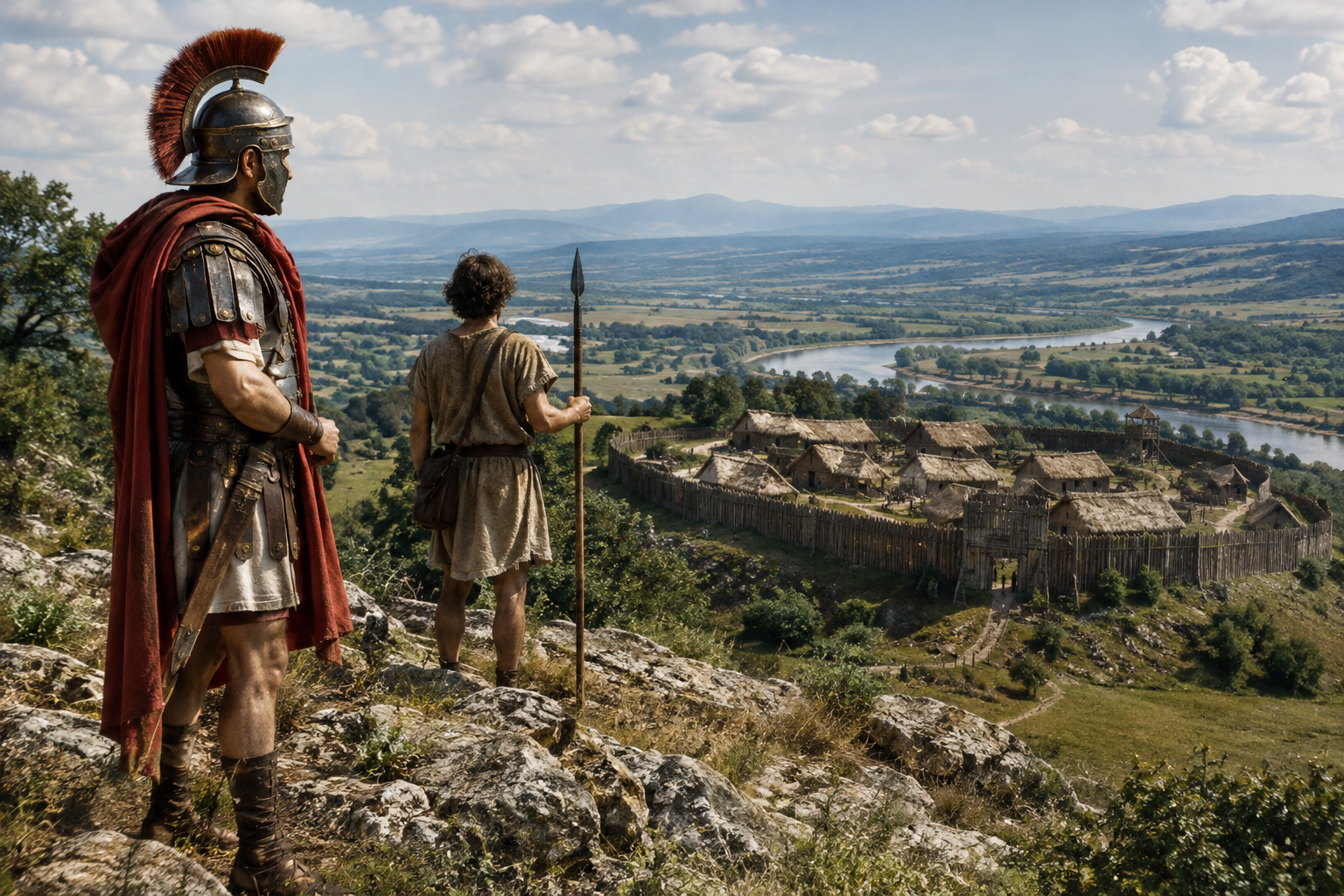
At Trogir-Dragulin on the Dalmatian coast of Croatia, one man buried in the Imperial Roman period, sample I26702, offers a particularly sharp glimpse of how paternal lines can sit inside much larger histories of movement and empire. Dated here to around AD 100, he belonged to a world that was unmistakably Roman in politics and infrastructure, yet locally rooted in a region that had long been a meeting ground between the Adriatic, the Balkans, and the wider Mediterranean. His reported association with the Y-DNA haplogroup E1b1b1a1b1a14 matters because it places this very specific paternal branch in a documented ancient context on the eastern Adriatic.
The second clue comes from a very different setting: the Iron Age hillfort at Križ Brdovečki in Croatia's Sava Valley, where sample I5724 is dated here to around 290 BC. Taken together, these two finds do not tell us everything about the branch, but they do show something important and concrete: a paternal line associated with E1b1b1a1b1a14 appears in Croatia in both pre-Roman and Roman contexts. That is a useful historical pattern, and a more interesting one than any attempt to force a single dramatic origin story.
The earlier of the two samples, I5724, comes from an Iron Age hillfort landscape in the Sava Valley. Hillforts in this part of southeastern Europe were not isolated little redoubts at the edge of history. They sat within active networks of exchange, local power, and regional mobility, linking upland settlements, river corridors, and the wider cultural worlds of the Balkans and the Carpathian Basin.
That makes the presence of this paternal lineage in an Iron Age individual especially useful. It suggests that the branch was not simply introduced by Roman rule into Croatia, because it was already present in the region generations earlier. A wider ancient DNA study of southeastern Europe and neighboring regions has helped show just how deep and complex Balkan population history is, with layers of continuity and mixture rather than a neat replacement of one people by another; that broader context is explored in research published in Science.
For anyone thinking historically, that distinction matters. If a lineage appears in an Iron Age hillfort community and again in the Roman era, we are probably looking at some degree of local persistence through political change. Not the survival of a "tribe" in some crude nineteenth-century sense, and certainly not proof that every later bearer descends from one excavated man, but evidence that a paternal branch could remain part of the human landscape as states, armies, and identities shifted around it.
By the time of I26702, the eastern Adriatic had been drawn firmly into the Roman imperial system. Trogir, ancient Tragurium, belonged to a coastal zone tied into shipping, military logistics, urban life, and the constant circulation of goods and people. Roman Dalmatia was never a sealed provincial box; it was part of a maritime and overland network stretching across the Mediterranean and deep into the Balkans.
That is why this sample is so revealing. A man associated with E1b1b1a1b1a14 in Roman-period Trogir does not automatically represent an immigrant, a soldier, or a colonist. He may equally reflect the persistence of local Adriatic and Balkan paternal lines under Roman administration. One of the great lessons of Roman archaeogenetics is precisely this: empire created mobility, but it did not erase local population histories. An ancient DNA study of the Roman world, published in Cell, has emphasized how varied and regionally specific these patterns could be.
So the Trogir individual is historically valuable not because he can be made to stand for "the Romans" in general, but because he anchors this haplogroup in a particular provincial setting. Roman rule changed roads, law, taxation, language use, and military structures; it did not require everyone to share the same ancestry. The archaeology of Dalmatia is full of that tension between imperial framework and local continuity.
With a lineage as specific as E1b1b1a1b1a14, caution is essential. The wider E1b1b1 family has a long and geographically broad history across parts of Africa, the Mediterranean, and Europe, but that does not give us permission to assign all of that history to this narrower branch. A terminal or near-terminal label can be very informative, yet it only becomes historically meaningful when it is tied to actual dated people and places.
Here, the dated anchors are Croatian: one in the Iron Age, one in the Imperial Roman period. That is enough to say that this paternal line, or a lineage reported as associated with it, was present in the eastern Adriatic-Balkan zone across several centuries. It is not enough to claim a single point of origin, a tribal identity, or a precise migration route for the branch.
This is also the point where it helps to remember what Y-DNA does and does not do. It tracks one direct paternal line out of the many thousands of ancestral lines each person has. Historically, though, that one line can still be illuminating, because political systems often shifted faster than family lines did.
Both sites sit within a landscape that has repeatedly connected rather than separated populations. The Sava Valley was a corridor into the interior, while Dalmatia linked the Balkans to the Adriatic sea-lanes. Over the long term, that means lineages found in Croatia may reflect deep local roots, regional Balkan connections, or older Mediterranean movements folded into later communities.
What makes these two samples useful is that they show continuity of presence across two quite different archaeological worlds. One belongs to an Iron Age fortified setting inland; the other to a Roman-period coastal environment shaped by empire. That does not prove uninterrupted descent from one excavated individual to the other, of course. But it does suggest that this paternal branch was not a fleeting episode in the region.
In that sense, the evidence fits a broader picture emerging from Balkan archaeogenetics: continuity often survives within change. Populations can absorb newcomers, adapt to new political orders, and adopt new material cultures while still preserving older paternal and maternal threads.
It is easy to let the Roman Empire dominate the narrative, because Rome left so much archaeology and so many written labels. But the earlier hillfort sample reminds us that the story did not begin with conquest. Pre-Roman communities in what is now Croatia were already part of complex regional systems, and their descendants did not vanish when the empire arrived.
That is one reason ancient DNA is so valuable in this region. It helps break the habit of treating Romanization as a total reset. In some places, Roman-period individuals really do reflect remarkable long-distance mobility; in others, they look more like local people living under a new political regime. For a branch like E1b1b1a1b1a14, the Croatian evidence currently points most clearly toward that second possibility: a paternal line present before Rome and still present within Roman Dalmatia.
The distinctive insight for E1b1b1a1b1a14 is not grand imperial glamour or a claim to some single legendary ancestor. It is the quieter, sturdier fact that this paternal branch appears in ancient Croatia on both sides of the Roman conquest: once in an Iron Age hillfort setting, and again in an Imperial Roman coastal burial. For someone researching this haplogroup today, that is a meaningful clue that at least part of its documented ancient footprint lies in the long-lived human networks of the Balkans and the eastern Adriatic.






Comments