Haplogroup E1b1b1a1a1b

– 5 min read


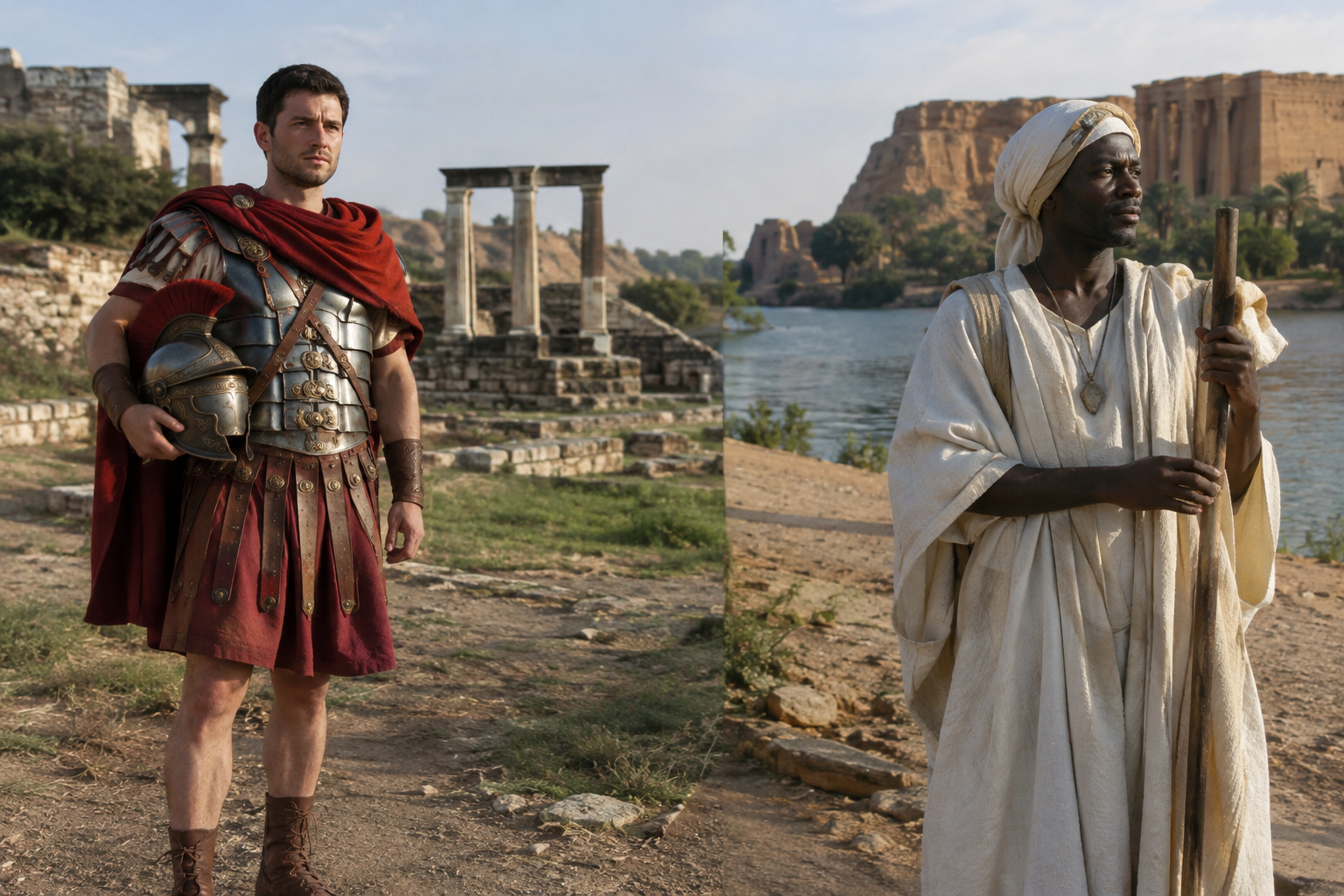
At Viminacium in Serbia, one of the great cities of the Roman Danube frontier, archaeologists and geneticists recovered an individual from the Pirivoj necropolis dated to around AD 225: sample I15499. This was a world of soldiers, merchants, officials, families, and travelers moving through a provincial capital that linked the Balkans to the wider empire. For a Y-DNA lineage such as E1b1b1a1a1b, that is exactly the sort of place where history stops being tidy.
The interest here is not that one paternal line can explain an empire. It cannot. Y-DNA traces only one direct male line among thousands of ancestors. But when a branch like E1b1b1a1a1b turns up in both a Late Roman burial on the middle Danube and, centuries later, in medieval Nubia at Kulubnarti, it reminds us how often the ancient world was knitted together by movement, contact, and local continuity rather than by neat ethnic boxes.
Viminacium was no backwater. It served as a legionary base and a major urban center in the province of Moesia, near the Danube frontier. By the 3rd century AD, when I15499 was buried at Pirivoj, this was a politically tense but intensely connected landscape, shaped by imperial administration, frontier warfare, trade, and migration.
That setting matters for understanding E1b1b1a1a1b. The broader haplogroup E1b1b has a long and complicated history across parts of Africa, the Mediterranean, and southeastern Europe, but one must be careful not to pour the whole history of the parent clade into a narrower branch. What the Viminacium sample shows securely is something more modest and more interesting: this paternal line was present in a Roman imperial population on the Balkans frontier during Late Antiquity.
A major genetic study of the region, published in Cell, helped demonstrate just how mixed many Roman-period communities could be, especially in military and urban zones. Even without turning one grave into a grand migration saga, I15499 fits the broader archaeological picture of the Roman Balkans as a place where ancestry, language, citizenship, and family origin did not always line up in simple ways.
It is also worth pausing over the burial context itself. Pirivoj is a necropolis, not a parade ground or a barracks list. The presence of E1b1b1a1a1b here does not mean this was a "foreign soldier" or a newcomer from some single homeland. He may have been local, recently arrived, or descended from earlier migrants whose family had already been in the Balkans for generations. Roman cemeteries often frustrate our desire for tidy labels, and that is precisely why they are so revealing.
If you carry E1b1b1a1a1b today, the ancient evidence here points toward a paternal story with strong Mediterranean and northeastern African relevance, but not a single origin tale that can be read straight off two burials. Ancient Y-DNA works best when it is used as a line of evidence about related male-line histories, not as a shortcut to identity.
In practical terms, this means the branch is historically compatible with populations moving around the eastern and central Mediterranean worlds, the Balkans, and the Nile corridor. That is not a romantic flourish; it is simply what the present evidence suggests when one sample appears in a Roman Danubian city and another in Christian Nubia centuries later. The pattern is one of connectivity across very different political worlds.
The second ancient individual linked here is I19014 from Kulubnarti in Makurian Nubia, dated to around AD 825. Kulubnarti, on the Nile in what is now Sudan, belongs to the world of medieval Christian Nubia, not the Roman Empire. By this date, the kingdom of Makuria was a major regional power, participating in long-distance exchange while maintaining its own political and religious traditions.
This is where E1b1b1a1a1b becomes especially interesting. The branch is not confined, in this evidence, to one imperial horizon or one cultural label. Instead it appears in two very different settings: a Late Roman cemetery in Serbia and a medieval Nubian community along the Nile. That does not mean the two men were closely related in any recent genealogical sense; over six centuries, the paternal line could have split into many sub-branches. But it does show that this lineage belonged to historical populations living in both southeastern Europe and northeastern Africa.
Research on medieval Nubian burials, including work shared through bioRxiv, has drawn attention to the complexity of ancestry, health, and kinship in these Nile Valley communities. Kulubnarti is especially valuable because it lets us place genetic evidence inside a real archaeological landscape rather than in vague continental categories. A haplogroup found there is not an abstraction; it belonged to a person living in a medieval riverine society with its own churches, cemeteries, households, and local history.
African DNA Population History
It is tempting to draw a bold arrow from one map point to another. Better to resist. The evidence does not justify claiming that E1b1b1a1a1b "migrated from Serbia to Nubia" or the reverse. What it does justify is a more historically literate point: the Roman and post-Roman worlds were linked by overlapping corridors of mobility, and paternal lines could persist across them in different regional populations.
Those corridors were many. In the Roman period, the Balkans were tied to the Aegean, Anatolia, the Levant, Egypt, and North Africa through military service, taxation, trade, enslavement, and voluntary migration. In the medieval Nile Valley, Nubia was connected northward to Egypt and the eastern Mediterranean while also maintaining distinctly local African traditions. A lineage found in both worlds need not represent one dramatic trek. It may instead reflect the long, braided history of interconnected populations around the Mediterranean and northeast Africa.
That broader picture is increasingly familiar from archaeogenetics. Roman-era cemeteries in particular have repeatedly shown that local burial grounds can contain people with very different ancestry profiles and family histories. The old habit of equating a burial site with a single "people" has become much harder to maintain.
Roman Hispania's Genetic Legacy
The strength of this small dataset is not quantity but contrast. I15499 anchors E1b1b1a1a1b in a Late Roman urban-funerary context on the Danube frontier. I19014 places the same named branch in an early medieval Nubian context along the Nile. Together they show that this paternal lineage belongs to a history larger than any one modern nation or identity claim.
For MyTrueAncestry users, that is often the most useful lesson. If your direct paternal line belongs to E1b1b1a1a1b, the ancient record currently points toward a branch with real presence in historically connected zones spanning the Balkans and northeastern Africa. It does not award you a single ethnicity, dynasty, or heroic migration route. What it offers instead is something better: a grounded glimpse of male-line continuity inside two richly documented ancient societies.
E1b1b1a1a1b enters the ancient record here not as a mythic founder's signature, but as the paternal line of real men buried in very different worlds: one in Roman Viminacium, one in medieval Kulubnarti. That combination makes the haplogroup especially evocative. It suggests a lineage at home in the old zones of contact between the Balkans, the Mediterranean, and the Nile, where empire, faith, trade, and family history overlapped for centuries.






Comments