Haplogroup R1a1a1b1a2b3a3a2g2b1

– 5 min read


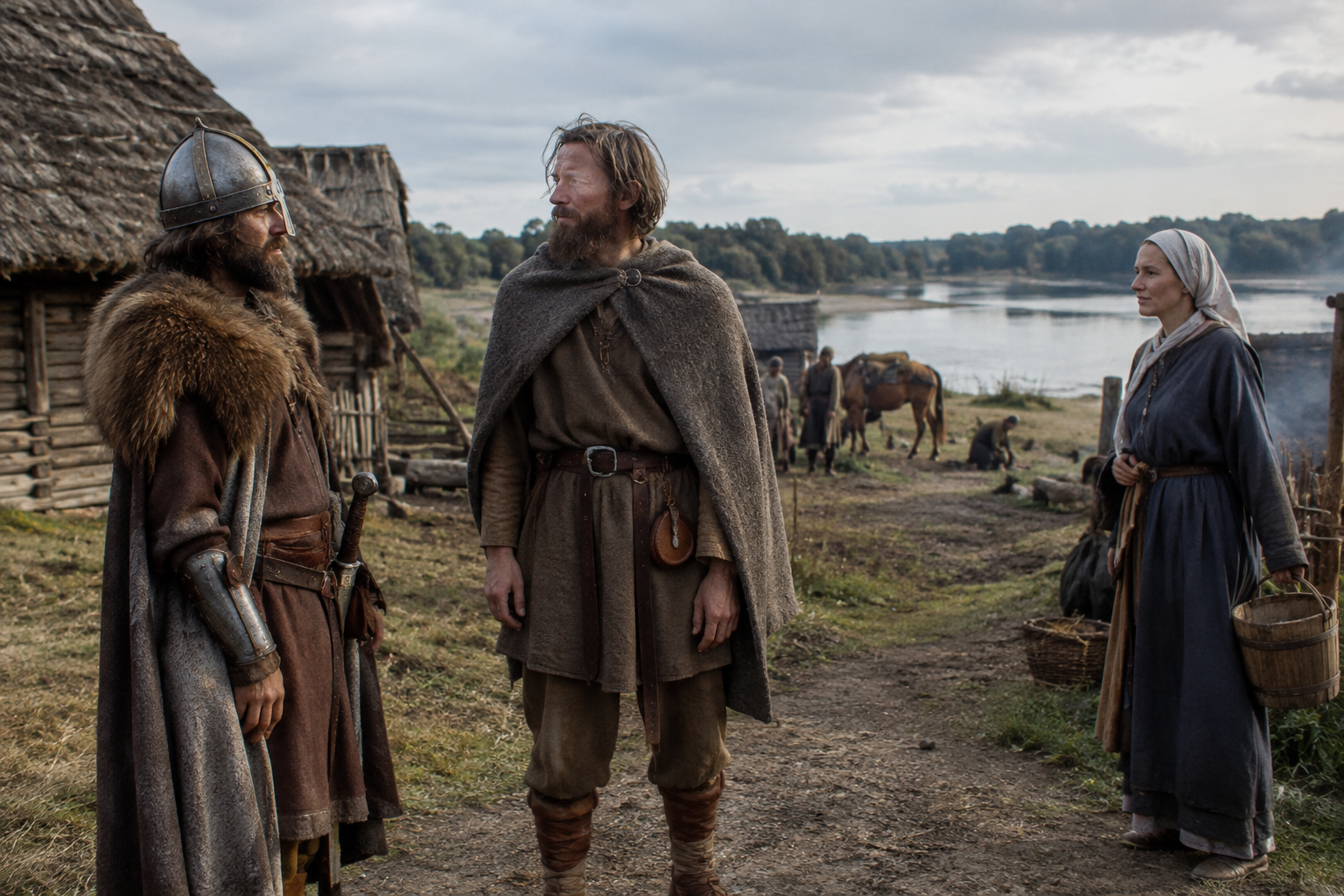
At Grodek nad Bugiem in eastern Poland, one early medieval man has become a small but telling witness to a much larger story. The individual labelled GRK010, dated to about AD 750, belongs to the very centuries when new political communities were taking shape across Slavic Europe. His reported association with the Y-DNA haplogroup R1a1a1b1a2b3a3a2g2b1 matters not because a single burial can stand for a whole people, but because it fixes this paternal line in a real place, at a real moment, during the formation of the early medieval world.
A second clue comes from the Adriatic side of the same broad historical zone: I26766 from early medieval Sipar in Croatia, dated around AD 700. Put those two finds together and the interesting thing is not grandeur but geography. This is a lineage turning up at opposite ends of the Slavic-speaking and post-Roman frontier world, from the eastern Adriatic to the Bug basin, in the centuries after the collapse of Roman authority in much of Europe.
R1a1a1b1a2b3a3a2g2b1 is a very specific downstream branch within the wider R1a family, a major Y-chromosome lineage found across large parts of Eurasia. Y-DNA follows one direct paternal line only: father to son to son. That makes it extremely useful for tracing male-line continuity, but it does not describe a person's whole ancestry, language, or identity.
That distinction is especially important here. The ancient evidence supplied for this article is not a sweeping map of the haplogroup's entire past. It is a focused glimpse of a narrow branch appearing in two early medieval contexts, both in regions central to the history of Slavic expansions, local continuity, and the reshaping of communities after Rome.
A wider ancient DNA study of the region, published at this research article, helped frame these centuries as a time of striking population movement and mixture in southeastern Europe. For a lineage like this one, that wider setting matters: the Y-chromosome result is most informative when read alongside the archaeological and historical transformation of the 7th and 8th centuries.
GRK010 comes from Grodek nad Bugiem, a site in the Bug River region, an area that sat within an important corridor between the Baltic, the forest zone, and the lands farther south and west. By around AD 750, this was a landscape of settlement growth, shifting power, and regional consolidation. Archaeologically, eastern Poland in this period belongs to the difficult but fascinating world before strong written documentation becomes routine.
That is precisely why a Y-DNA assignment is useful here. It gives us a named paternal line attached to a community that lived during the emergence of early medieval societies in the region. It does not mean all men nearby carried the same branch, nor does it prove a dynastic founder. But it does show that this particular branch of R1a was present in a population living in the historical zone from which later Polish state formation would emerge.
There is another reason not to rush past eastern Poland. This borderland was not marginal in the early Middle Ages. River systems connected communities, goods, and people over long distances, and paternal lineages could spread through ordinary mechanisms: family growth, village fission, marriage networks, and migration over a few generations rather than one dramatic invasion. GRK010 belongs in that quieter, more realistic history.
The Croatian sample I26766, dated to around AD 700, comes from Sipar, on the Istrian peninsula. Here the historical background is rather different from inland Poland. Early medieval Croatia stood at the meeting point of the post-Roman Adriatic, Byzantine influence, local late antique populations, and incoming Slavic-speaking groups. It was a frontier in the old Roman sense, but also a place of endurance, reuse, and adaptation.
That makes I26766 especially interesting. The presence of the same highly specific paternal branch in this Adriatic setting suggests that R1a1a1b1a2b3a3a2g2b1 was not confined to one local pocket. Instead, it appears across a broad band of early medieval Europe shaped by mobility and reorganization. The branch may have moved through networks tied to Slavic expansion, or it may reflect related paternal lines already distributed across connected regions before states hardened their borders. The present evidence cannot choose neatly between those possibilities, but it does anchor the branch in both settings.
Research on ancient Croatia has increasingly shown how useful Y-chromosome evidence can be when set against long-term regional continuity and change. A related MyTrueAncestry discussion on the area is worth exploring here.
Croatia's shifting paternal lineages
One ancient sample can be an anecdote. Two samples, from different regions but the same broad period, begin to look like pattern. The gap between Sipar and Grodek nad Bugiem is not trivial. One lies on the northeastern Adriatic; the other in eastern Poland near the Bug basin. Yet both belong to the early medieval centuries when political landscapes were being rebuilt across central and southeastern Europe.
That does not make this haplogroup a badge of any single ethnicity. Early medieval identities were layered and local. A man's Y-line could persist through language shifts, political allegiance, religious conversion, and movement across imperial frontiers. Still, for someone carrying R1a1a1b1a2b3a3a2g2b1 today, these two burials suggest that the branch was already established in the historical world of early medieval Slavic Europe by about AD 700-750.
The underlying project data are also associated with this ancient DNA dataset, which reflects the growing scale of work now possible in medieval archaeogenetics. What matters for readers is simple: lineages once invisible in the ground can now be placed in time and space with far greater precision than older historical guesswork allowed.
It is tempting to talk about migrations as if whole populations marched about in lockstep carrying identical genes. Ancient DNA has made that picture harder to sustain. Early medieval Europe was full of mixtures: newcomers and locals, frontier soldiers and villagers, coastal survivors of Roman worlds and inland communities reorganizing after political breakdown. Paternal lines survive through all of that, but not in tidy cultural packages.
That is why these two samples are more useful than any grand claim about heroic ancestors. They show a direct male line present in communities living through the remaking of Europe after antiquity. In that sense, this haplogroup belongs not to legend but to settlement history: households, sons, inheritance, and the ordinary stubborn continuity of family lines.
Ancient DNA and Slavic populations
There is also a wider Balkan angle. Early medieval southeastern Europe was not empty land waiting for a single people to arrive. It was already peopled, regionally varied, and historically entangled. Genetic findings from Croatia and neighboring regions fit that complexity rather well: some lines persist, some shift, and some appear in ways that reflect movement without erasing local continuities.
Deep Balkan roots and medieval admixture
The best supported insight for R1a1a1b1a2b3a3a2g2b1 is a modest but solid one. This paternal branch is attested in two early medieval individuals, I26766 from Sipar in Croatia and GRK010 from Grodek nad Bugiem in Poland, placing it in the broad Slavic and post-Roman world of about AD 700-750. That does not identify a tribe, dynasty, or famous founder. It does something better: it gives your direct paternal line a documented foothold in the lived history of early medieval Europe.
For family historians, that is often the most valuable kind of result. Not a myth of certainty, but a traceable male-line presence in real communities at a time when Europe was being remade.






Comments