Haplogroup E1b1b1a1b1a6a

– 5 min read


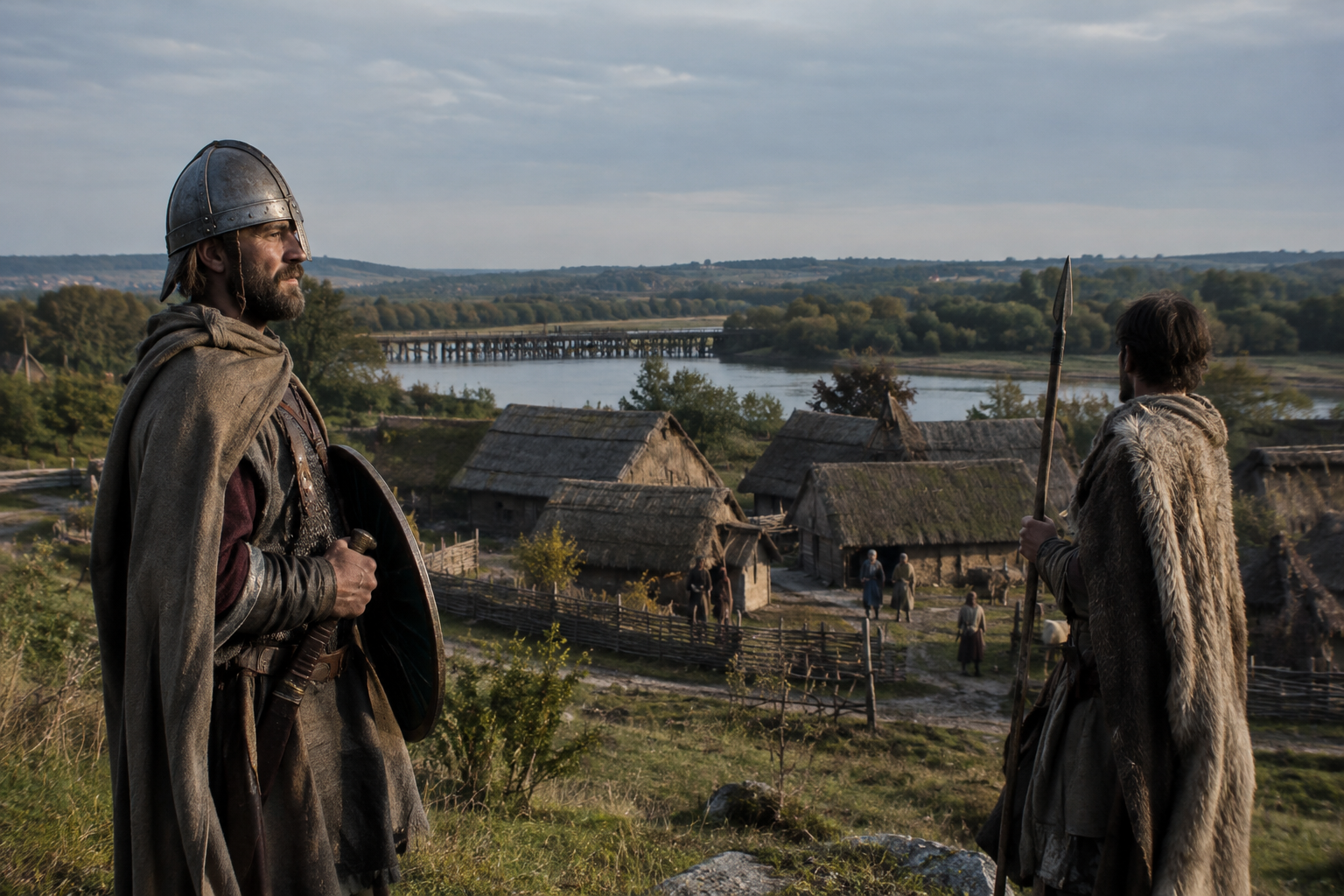
At Timacum Kuline, near Ravna in eastern Serbia, one man buried around AD 900 carries a surprisingly precise paternal signal into the record: sample I15537, associated here with Y-DNA haplogroup E1b1b1a1b1a6a. That matters because this is not one of the lineages people instinctively label "typically medieval Serbian" in a narrow modern sense. Instead, it points to a deeper Balkan and Mediterranean story, one in which local continuity, imperial movement, and shifting frontiers all overlap.
The intrigue becomes sharper when I15537 is set beside an earlier individual from central Germany: BRC043x, a Migration Period "Roman outlier" from Bruecken in Saxony-Anhalt, dated to around AD 500. Two men, two regions, four centuries apart, and both associated with the same narrow paternal branch in the MyTrueAncestry classification. That does not prove a direct chain of descent between them, of course, but it does place this lineage in two very different archaeological worlds: the post-Roman Balkans and the mixed societies of the former Roman frontier.
E1b1b1a1b1a6a is a fine-grained subclade within the much broader E1b1b paternal family, a lineage with deep roots in parts of Africa, the Mediterranean, and western Eurasia. The crucial point is that a narrow branch like this should not simply inherit every grand migration story ever told about its parent haplogroup. The wider family is ancient and widespread; this particular twig on that tree is much more specific, and our article's evidence comes from only a small number of ancient men.
Y-DNA tracks one direct paternal line only: father to father to father. It can therefore illuminate surname-like lines in the deep past, but it does not sum up a person's whole ancestry, language, or identity. A man buried in medieval Serbia with this Y-line was not "nothing but" that paternal branch; he was a complete individual living in a particular local community, shaped by many ancestors and by the politics of his own day.
For readers interested in the broader backdrop of long-term ancestry in the peninsula, this related piece gives useful context.
Timacum Minus, the Roman predecessor of the Ravna area, had already lived several lives before AD 900. It began as a Roman site in the Timok valley, part of the infrastructure that tied the Balkans into the empire's roads, military routes, and market systems. By the early medieval centuries, the region had been transformed repeatedly by imperial contraction, local continuity, Slavic settlement, and the power struggles of Byzantines, Bulgarians, and emerging Serbian polities.
That is the setting in which I15537 becomes especially interesting. A paternal lineage classified here as E1b1b1a1b1a6a turns up not in a timeless vacuum, but in a landscape where Roman provincial populations and newer medieval communities had long been mixing. Eastern Serbia was never an isolated pocket. It sat within a corridor linking the central Balkans, the lower Danube, and the wider eastern Mediterranean.
So the significance of I15537 is not that he "proves" one migration event. It is that he fits a broader pattern in which some Balkan male lines show durability across enormous political change. The Roman world disappears as a state structure; the paternal line does not. New identities appear in texts and archaeology; the underlying biological history remains more entangled than the labels suggest.
A large ancient DNA study of southeastern Europe and neighboring regions, published in research on ancient populations across the Balkans and adjacent zones, has helped establish just how complex that entanglement was. Even where historical narratives like to separate "Roman," "post-Roman," and "medieval" populations into neat blocks, the genetics often show overlapping ancestries and long regional continuities.
The second anchor point is very different. Sample BRC043x, dated to around AD 500, comes from Bruecken in Saxony-Anhalt and is described as a Migration Period Roman outlier. That phrase is wonderfully revealing. It tells us at once that the burial belongs to the centuries after the western Roman Empire's collapse, and that genetically or historically this person stood out against the local background.
To find a paternal line associated here with E1b1b1a1b1a6a in that setting is a reminder that the old Roman frontier never contained people neatly. Soldiers, traders, dependants, migrants, and families had been moving between provinces for centuries. When imperial institutions weakened, the people did not simply vanish back into tidy ethnic boxes. Some remained where they were; others moved within successor societies that were themselves mixtures of local and incomer populations.
In other words, a "Roman outlier" in Germany is not necessarily a foreigner fresh off a road from the Mediterranean. He may represent descendants of earlier mobility, or a community already shaped by imperial-era circulation. The haplogroup adds one paternal clue to that puzzle, but the archaeological label does much of the interpretive work: this was a world of blended post-Roman lives.
That frontier complexity is explored from another angle here.
If we place these two men side by side, the safest historical picture is not a dramatic one-way trek but a zone of repeated contact. Haplogroups within the wider E1b1b family are well known in parts of the Balkans and Mediterranean. That does not automatically solve the history of E1b1b1a1b1a6a, but it does make the pairing of Serbia and a Roman-associated German outlier plausible in historical terms.
The Roman Empire is one obvious mechanism. It tied the Balkans, Danube provinces, Italy, and frontier regions together with military recruitment and civilian movement on a huge scale. A paternal line present in Balkan populations could easily appear far to the northwest in an imperial or post-imperial setting without requiring any single famous invasion or legendary founder.
The early medieval Balkans offer another mechanism: continuity through change. Recent work on Balkan and Albanian genetic history has emphasized how deep local roots and later medieval admixture can coexist in the same populations. That is relevant here because I15537's lineage need not mark a newcomer to Serbia in AD 900 at all. It may instead represent one strand of a much older regional male heritage surviving through the collapse of Roman administration and into medieval society.
This wider question of deep Balkan ancestry and medieval mixture is taken up in the following article.
Balkan roots and medieval admixture
There is a temptation, when sample numbers are small, to dismiss them as anecdotal. But archaeology often advances precisely by such stubborn little facts. One medieval man in Serbia and one Migration Period outlier in Germany do not define the full map of E1b1b1a1b1a6a. They do, however, show that this branch had a place in the human traffic linking the Balkans and the former Roman world.
And there is another practical point. Ancient Y-line assignments often appear at different levels of resolution depending on DNA quality and analytical method. Where a very specific terminal label such as E1b1b1a1b1a6a is associated with ancient material, it is wise to remember that the broad historical weight lies in the secure context first: Serbia around AD 900, and a Roman-associated outlier in Germany around AD 500. The narrower branching is most useful when read as a clue within that framework, not as a license for overconfident storytelling.
For those who like to peer behind the curtain of the raw ancient genomic material, the project data connected with these individuals is associated with this ancient DNA research archive. Its importance here is not that it supplies a neat ready-made narrative, but that it anchors these samples in the growing body of published archaeogenetic work.
For someone whose Y-DNA falls under E1b1b1a1b1a6a, the most defensible historical insight is not a claim to one tribe, one kingdom, or one heroic ancestor. It is something subtler and, in truth, more interesting: this paternal line appears in ancient contexts shaped by the long afterlife of Rome, by Balkan continuity, and by the mobile societies of late antiquity and the early Middle Ages. In the ancient DNA record so far, it looks less like an isolated curiosity than like part of the complicated human web between the Balkans and the wider Mediterranean-European world.






Comments