Ancient Genomes Reveal East–West Genetic Mixing Along the Eastern Tianshan Corridor

– 8 min read


Eastern Tianshan: Mountain Gateway Between China and the Steppe
The eastern Tianshan mountains emerge from ancient DNA studies as one of the great crossroads of the ancient world. This rugged range in today's Xinjiang sat precisely where three civilizations converged: the farming societies of the Yellow River and Hexi Corridor to the east, the Inner Asian and Central Asian steppes to the west, and the Altai region to the north. Long before anyone conceived of a "Silk Road," this mountainous corridor already bustled with the movement of people, livestock, crops, and revolutionary ideas that would reshape human civilization.
Archaeological investigations had long suggested that the eastern Tianshan served as a crucial link between the painted pottery cultures of Gansu and Qinghai in northern China and the herding cultures of the vast Eurasian steppe. Recent ancient genome research now reveals that this connection involved far more than simply traded ceramics and borrowed artistic styles—it represented massive movements of entire populations carrying their distinct ways of life across vast distances.
From the eastern regions came farmers from the Yellow River basin, renowned for cultivating broomcorn and foxtail millet while creating brilliantly painted pottery characteristic of cultures such as Majiayao, Siba, and Siwa. From the western and northwestern steppes arrived herders from the Eurasian grasslands, introducing wheat, barley, sheep, cattle, and sophisticated bronze-working traditions. Among these western migrants were groups related to the Afanasievo and later the Andronovo cultures. From within Xinjiang itself emerged older local lineages, represented by a population designated Tarim_EMBA1, originally identified in the Tarim Basin and gradually spreading into the Tianshan mountains.
The eastern Tianshan thus functioned as a massive cultural hinge: it facilitated the westward expansion of East Asian crops and cultural practices, while simultaneously drawing West Asian and steppe animals, metallurgy, and lifestyles eastward into China's expanding sphere of influence.
To explore this historical corridor in unprecedented detail, researchers sequenced ancient DNA from twenty-three individuals across twelve archaeological sites, mostly concentrated in the eastern Tianshan, with additional samples from the western Tianshan. These sites form a chain of frontier communities scattered along the mountain edges, spanning from Bronze Age nomadic settlements to Tang dynasty burial grounds.
The Chawuhugoukou complex, positioned strategically at a valley mouth in Hejing County, represents a classic eastern Tianshan painted pottery site. Its extensive cemeteries demonstrate the remarkable cultural diversity that characterized life in this mountain corridor. Archaeological excavations revealed stone-marked tombs containing multiple burials, elaborate painted ceramics, bronze and iron implements, wool textiles, and evidence of horse and ox sacrificial practices.
Genetically, one Chawuhugoukou individual clusters remarkably close to ancient northern Chinese farmers in genetic analysis and carries a substantial proportion of East Asian millet farmer ancestry. This genetic evidence suggests that the exquisite painted pottery found here represents more than mere imitation of distant Gansu styles—it reflects actual population movement and extensive biological mixing with eastern farming communities.
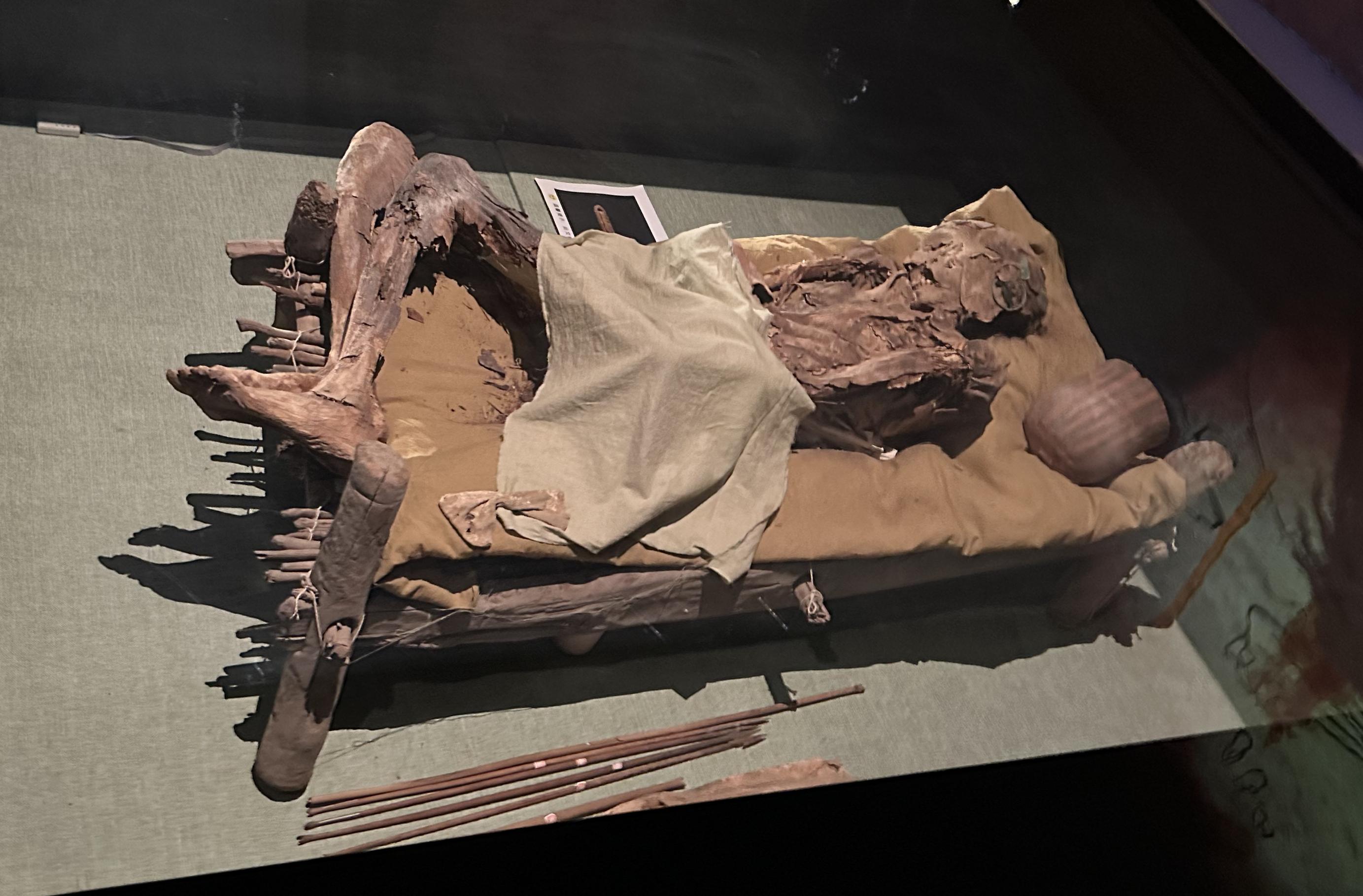
The Yanghai cemetery near Turpan, belonging to the distinctive Subeixi culture, constitutes one of the most spectacular Iron Age nomadic burial grounds discovered in Central Asia. Excavations have uncovered vertical pit tombs, some featuring platforms and elaborate side chambers, filled with extraordinary grave goods including painted pottery decorated with striking triangle motifs, finely crafted woodwork, bronze and iron weapons, stone and bone tools, sophisticated horse harnesses, and textiles made from leather, wool, silk, and remarkably even cotton.
Animal offerings of sheep, cattle, and horses emphasize the fundamentally pastoral nature of this society, supplemented by hunting activities and the cultivation of millet, barley, and wheat. Three Yanghai individuals analyzed in this study display mixed ancestry combining local Tarim-related lineages, steppe herder ancestry related to Afanasievo populations, and substantial genetic input from East Asian millet farmers. Both genetically and archaeologically, Yanghai appears to represent a classic frontier society where nomadic herders, settled farmers, and ancient desert populations achieved remarkable cultural and biological integration.
Several crucial Iron Age cemeteries are situated in the Balikun-Yiwu grassland belt of the eastern Tianshan, including Heigouliang, Hanqigou, and the nearby Shirenzigou site analyzed in earlier research. These archaeological sites mark seasonal settlements of pastoralist communities who moved their herds across high mountain valleys following ancient patterns of transhumance.
One Heigouliang individual, radiocarbon dated to approximately 2,360-2,330 years ago, and the Hanqigou burials fit precisely into an Iron Age Balikun-Yiwu genetic cluster, together with populations from Yanghai and Qigeman. Genetic analysis reveals that these grassland communities share several key characteristics: local Tarim-related ancestry comprising roughly five to thirty-one percent of their genetic makeup, western steppe herder ancestry most closely matching Afanasievo-related populations rather than later Andronovo groups, and substantial East Asian millet farmer ancestry ranging from twenty-two to forty-two percent.
Archaeological evidence perfectly complements this genetic picture: in precisely the locations where excavations reveal pastoral camps, sophisticated horse harnesses, painted pottery, and steppe-style goldwork, the genomic data demonstrates deep biological mixing of local desert populations, early steppe herders, and farmers connected to northern China's agricultural heartland.
Qigeman Cemetery, located near Turpan, consists of simple vertical earthen pit tombs that might appear unremarkable to casual observers. However, one individual dated to approximately 2,338-2,157 years ago matches the distinctive Balikun-Yiwu genetic profile identified throughout the region. Despite its modest appearance, this small tomb represents another crucial piece in the genetic puzzle demonstrating that the eastern Tianshan corridor formed a continuous cultural and biological zone throughout the Iron Age.
The research emphasizes that the Tianshan mountains did not constitute a uniform frontier region. The eastern and western sides of this massive range preserve distinctly different historical narratives.
At western Tianshan sites such as Tangbalesayi and Nileke, Iron Age burials reveal dramatically different genetic signatures. One Tangbalesayi individual, radiocarbon dated to approximately 2,344-2,158 years ago, and individuals from Nileke demonstrate high proportions of ancestry related to Middle and Late Bronze Age steppe cultures, particularly Andronovo populations that had spread extensively across western and southern Xinjiang. These individuals also carry the characteristic R1a1 Y-chromosome lineage common among Andronovo and related steppe groups, with little or no detectable East Asian ancestry in some cases.
This genetic pattern aligns perfectly with archaeological evidence: the western Tianshan and adjacent basins were strongly integrated into the Andronovo cultural sphere, characterized by distinctive metalworking traditions, burial customs, and pastoral practices.
In the eastern Tianshan, Iron Age populations carry steppe ancestry primarily from groups related to the earlier Afanasievo herders rather than the later Andronovo complex, at least until historical periods. Simultaneously, they demonstrate stronger and progressively increasing genetic connections to East Asian millet farmers. Iron Age eastern Tianshan individuals possess roughly 22-42 percent ancestry from groups tied to Yellow River farming communities. During historical periods spanning Han and Tang dynasties and beyond, this proportion increases to approximately 52-91 percent in several individuals, especially at sites containing clear Han Chinese cultural material.
Maternal and paternal lineages support this pattern: most eastern Tianshan individuals carry typical East Asian mitochondrial haplogroups such as Z4, M11, C4, and D4, along with Y-chromosome lineages common in East and Northeast Asia including O2a2, C2a, and Q1a1a. The mountain chain thus functioned as a significant barrier: Andronovo-related ancestry moved readily along the western slopes, while Afanasievo-related ancestry and Yellow River-connected farmers exerted stronger influence along the eastern flanks.
Archaeological discoveries in the Balikun-Yiwu grasslands demonstrate that the eastern Tianshan maintained active connections with Altai networks to the north. Sites including Heigouliang, Shirenzigou, and related locations have yielded gryphon-shaped gold pendants, animal-style ornaments, and sophisticated horse harnesses that closely match artistic traditions of the Pazyryk culture famous for its frozen burial mounds in the Altai Mountains.
The study uses these archaeological finds, combined with genetic signals of steppe-related ancestry, to argue that the eastern Tianshan functioned not merely as a link between China and Central Asia, but as part of a north-south mountain corridor extending into the Altai region.
When the Silk Road formally emerged during the Han dynasty, the eastern Tianshan corridor did not suddenly spring to life; instead, it intensified cultural and economic patterns that had developed over more than a millennium. The research traces this continuity into the historical era through several key cemetery sites.
The Asitana cemetery, located near the ancient city of Gaochang outside Turpan, spans Jin dynasty, Sixteen Kingdoms, and Tang periods. Its sloping shaft tombs and elaborate side-chamber graves contain rich assemblages including silk textiles, painted wooden coffins, ceramic figurines, bronze mirrors, and inscribed stone stelae that document the multicultural nature of Silk Road communities.
One Asitana individual dated to approximately 1,719-1,612 years ago carries a predominantly East Asian genetic profile closely matching populations from northern China, with detectable admixture from steppe-related groups. This genetic pattern provides concrete evidence of migrants from the north China heartland settling in frontier garrisons and urban centers along the Hexi-Tianshan route.
The Yingpan cemetery lies at the southern foot of the Kuruktag mountains in Yuli County, west of the famous ruins of Loulan. Its Eastern Han to Wei-Jin tombs include poplar wood coffins, carefully arranged grave goods, and gendered tool assemblages that reflect sophisticated social organization during the early Silk Road period.
One Yingpan individual dated to approximately 1,714-1,605 years ago shows a strong genetic affinity toward early steppe herder ancestry of the Afanasievo type rather than later Andronovo populations. This genetic analysis suggests that ancient steppe lineages persisted in this corner of Xinjiang well into the historical era, becoming integrated into new cultural fashions and political systems.
The Saensayi cemetery near Urumqi, distributed across stepped terraces at a valley mouth, spans from the Bronze Age through Han and Tang dynasties. Pottery, bronze implements, iron tools, stone and bone artifacts document centuries of continuous occupation. An individual dated to roughly 959-803 years ago carries ancestry primarily derived from ancient Northeast Asian populations and groups from the Baikal and Mongolian plateau regions, again demonstrating how the eastern Tianshan continuously attracted northern steppe peoples.
Sangeqiao, a Tang-period cemetery near Turpan, features both vertical pit and side-chamber tombs. The individual analyzed there clusters genetically with Iron Age eastern Tianshan groups, suggesting remarkable continuity: local mountain and desert populations, shaped by centuries of cultural contact, persisting into the medieval period even as imperial structures and religious systems transformed around them.
The Qinvfen site near Lianmuqin in Shanshan County provided another historically significant individual with characteristic eastern Tianshan ancestry. Combined with evidence from Asitana, Sangeqiao, and Yingpan, Qinvfen helps demonstrate that the Turpan-Shanshan region hosted remarkably diverse populations: partly local desert dwellers, partly connected to northern China, and partly linked to steppe and Tarim Basin traditions.
Across all archaeological sites examined, the research presents a consistent genetic portrait of the eastern Tianshan corridor characterized by three major ancestral components: persistent Tarim-related ancestry representing ancient local desert populations, substantial East Asian millet farmer ancestry that increased over time, and western steppe herder ancestry primarily of the Afanasievo type in the east and Andronovo type in the west.
The study suggests this complex mixture did not result from a single massive migration event, but developed through repeated waves of movement: pastoralist groups exploring mountain valleys, farmers advancing westward along the Hexi Corridor, and local populations maintaining their presence in oases and grasslands. By the Tang dynasty, when official prefectures, military garrisons, and protectorates dotted the region, the people of the eastern Tianshan already carried within their genes a profound history of movement connecting China, Inner Asia, and the vast Eurasian steppe in a remarkable testament to ancient human mobility and cultural exchange.
Original source article
https://doi.org/10.1093/molbev/msag057





Comments