Haplogroup Q1a2a1b

– 5 min read


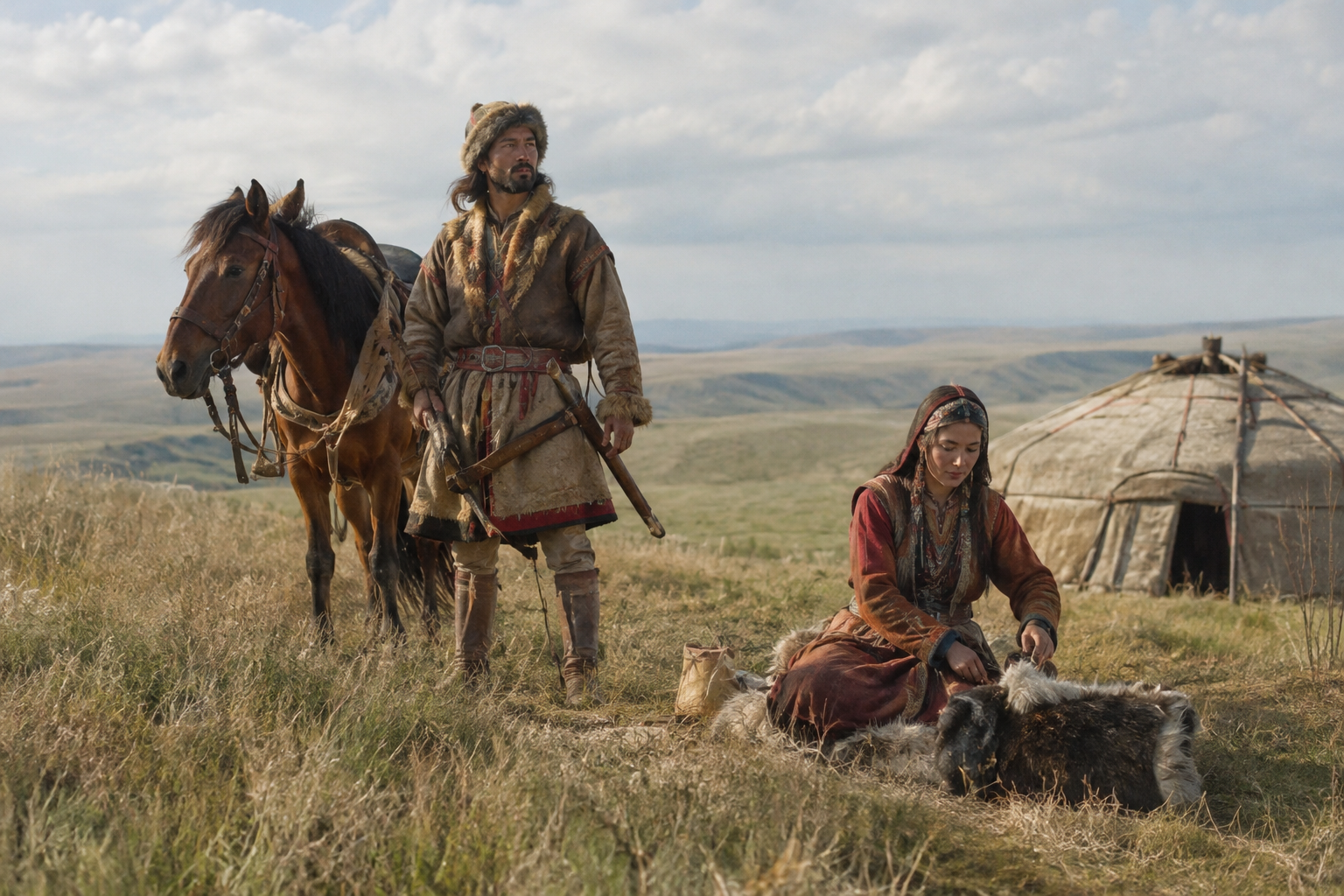
One of the more arresting clues for haplogroup Q1a2a1b in the ancient record comes from a man identified as I27890, dated to around 100 BC and associated with the Sarmatian horizon of the Eurasian Steppe. That is already enough to make him interesting. The Sarmatians sit at a historical crossroads: mounted pastoralists moving across the grasslands north of the Black and Caspian Seas, known from archaeology, ancient writers, and now increasingly from DNA.
What makes this sample especially valuable is not that it lets us tell some over-neat tale of a single people or a single migration. Quite the opposite. A Q-lineage appearing in a Sarmatian-era individual reminds us that steppe societies were often genetically varied, mobile, and entangled with populations far to the east as well as those of the western steppe. In that setting, a paternal line like Q1a2a1b is a real historical signal: not a badge of ethnicity, but evidence of how wide the human networks of the steppe could be.
The sample we have here is sparse in description but rich in context. I27890 is assigned to the Sarmatian horizon, a broad archaeological label covering communities of the Iron Age steppe usually linked to Iranian-speaking nomadic groups in Classical sources. Around 100 BC, this was a world of movement, raiding, alliance, exchange, and adaptation, stretching across an enormous corridor of grassland.
That matters for Y-DNA interpretation. A Y-chromosome lineage follows one direct paternal line only, so it never stands for the whole ancestry of an individual or the identity of an entire people. But when a branch like Q1a2a1b turns up in a Sarmatian-context male, it contributes to a broader picture in which steppe populations were not genetically uniform. They were historical coalitions, not clones.
A useful wider comparison for this world of mobility and mixture is MyTrueAncestry's discussion of frontier populations around the Black Sea and steppe zone:
Haplogroup Q is a large and geographically wide-ranging Y-DNA family with deep roots in northern Eurasia. Some of its branches became especially important in the peopling of the Americas; others appear across parts of Siberia, Inner Asia, and steppe-connected populations. That wider background is important, but it should not be lazily collapsed into the narrower branch discussed here. Q1a2a1b is not interchangeable with all of haplogroup Q, and the appearance of one branch in one Sarmatian-era man does not turn all Sarmatians into a single eastern-derived population.
What it does suggest is contact, incorporation, or ancestry streams reaching across the great trans-Eurasian zone. The Eurasian Steppe was never a wall. It was a conduit. Horses, herds, warfare, marriage, fosterage, and political expansion all helped move people as well as objects. In such a landscape, paternal lineages that today seem geographically far apart can appear together in ancient contexts that make perfect historical sense.
That larger pattern has become clearer as ancient DNA has expanded across Iron Age steppe contexts. A number of studies on Scythian and related populations have shown that steppe groups could combine western and eastern Eurasian ancestry in different proportions, depending on period and region. For readers interested in that broader background, see MyTrueAncestry's piece on elite steppe burials:
It is tempting to read ancient labels too literally. "Sarmatian" sounds tidy, as though archaeologists had uncovered a single bounded nation with one ancestry profile and one paternal signature. But ancient steppe confederations rarely behave so politely for modern categories. The term usually covers a spread of related but changing groups over time, tied together by lifeways, material culture, and broad historical traditions rather than by any single genetic formula.
That is where a sample like I27890 earns its keep. Even on limited evidence, he points toward the internal diversity of the Sarmatian world. Some Sarmatian-period men carried lineages more commonly associated with western steppe or European contexts; others show links reaching further east. Q1a2a1b belongs in that second conversation. It does not rewrite the identity of the entire horizon, but it makes the horizon itself more realistic.
Research collections associated with ancient Eurasian populations, including material linked through this ancient DNA resource, have been central to building that more complicated picture. The value lies less in any single glamorous label than in the cumulative pattern: steppe groups were repeatedly formed through mixture, movement, and local reassembly.
If you have Q1a2a1b today, the ancient steppe is worth paying attention to precisely because it was a zone of connection. From the Altai to the Pontic-Caspian region, Iron Age populations shared technologies, horse culture, burial customs in some areas, and long-distance political habits. Yet they were not uniform. Some communities leaned more toward western Eurasian ancestry, some showed stronger eastern components, and many were mixed in ways that refuse neat textbook maps.
That is why this Sarmatian-context finding is so suggestive. It sits in a historical period when mobile groups could absorb newcomers, recruit allies, or emerge from earlier mixed populations already shaped by centuries of contact. A Q1a2a1b lineage in that setting may reflect ancestry ultimately tied to deeper Inner Asian or north Eurasian networks, but the man himself belonged to a Sarmatian-era world on the western steppe. Ancient people, inconveniently and usefully, often embody more than one story at once.
For a parallel look at how mixed and regionally varied steppe-descended populations could become, the Khazar frontier article is a helpful companion:
For someone researching a present-day paternal line, the lesson of Q1a2a1b is not a grandiose claim of being "Sarmatian" in any simple sense. The more responsible insight is better than that. This lineage has a foothold in the ancient steppe record, and at least one known case places it in a Sarmatian-horizon individual around 100 BC. That is a real historical anchor.
At the same time, paternal ancestry is only one thread. A modern Q1a2a1b line might connect through later movements across Inner Asia, eastern Europe, or other steppe-linked regions rather than descending from any particular Sarmatian man or tribe. The point is not to force a single identity, but to recognise that this branch belongs to a world of long-distance connections across northern Eurasia.
That wider theme also appears in MyTrueAncestry's coverage of steppe and Inner Asian population history:
So the most distinctive thing we can presently say about Q1a2a1b from this evidence is that it appears in the archaeological world of the Sarmatian horizon, in the case of I27890 around 100 BC. That does not reduce the branch to one people, but it does place it in a historically important zone where east-west contacts were constant and consequential. For anyone carrying this haplogroup today, the ancient steppe is not background scenery. It is one of the places where your direct paternal line becomes visible in history.
Comments