Haplogroup O2a2b1a2a1a

– 5 min read


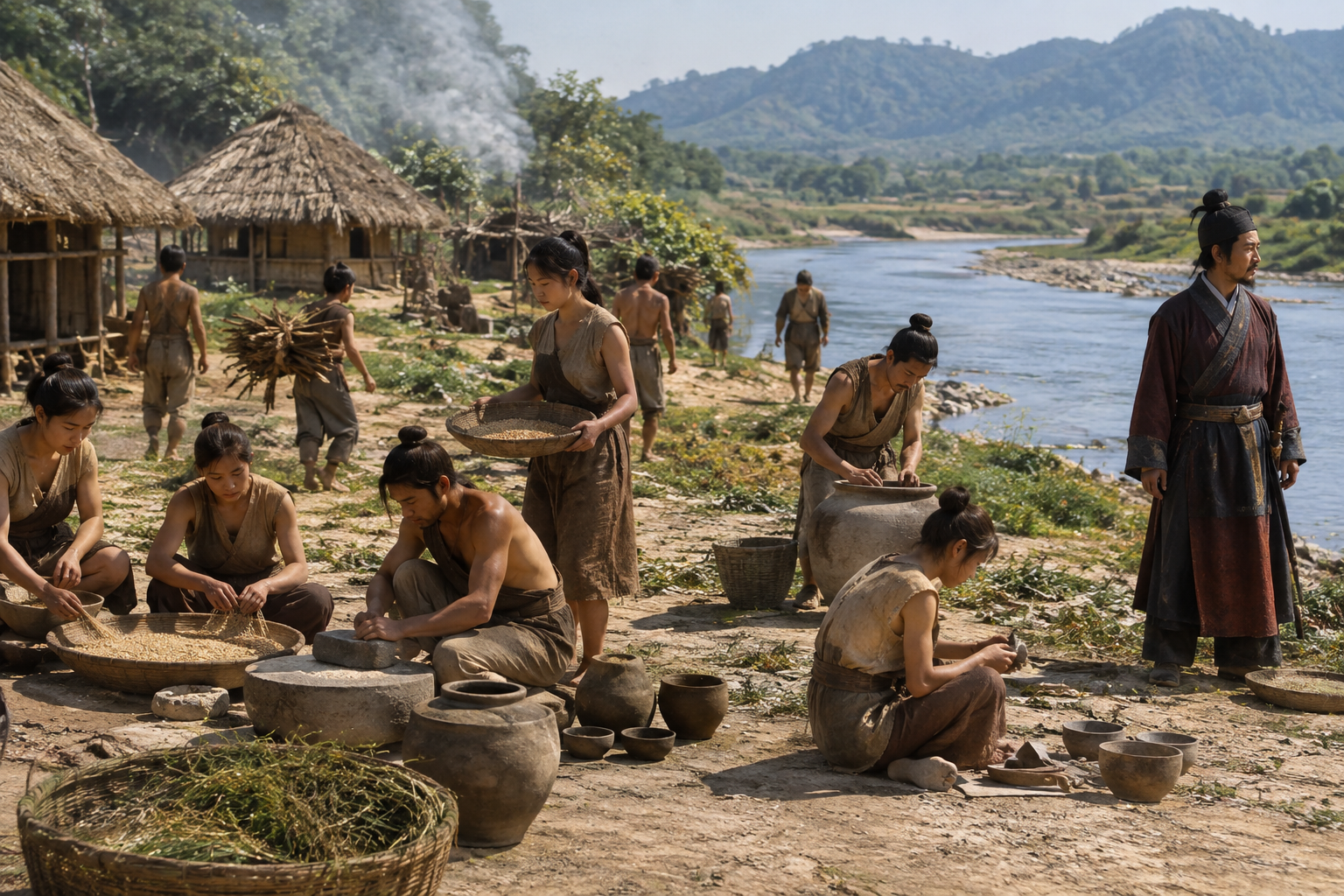
At Baligang, on the Tuan River in Henan, archaeologists and geneticists have a striking cluster rather than a single celebrity grave: a run of Late Neolithic male individuals, dated around 3000 BC, carrying the Y-DNA haplogroup O2a2b1a2a1a. The sample IDs alone tell the story of scale: BLG-M13-20, BLG-M167, BLG-M174, BLG-M224-3, BLG-M231, BLG-M76-2, BLG_M13-12, BLG_M13-25, BLG_M13-30, BLG_M13-4, BLG_M13-44, BLG_M13-51, BLG_M13-68, BLG_M13-7, BLG_M13-77, BLG_M13-8, BLG_M13-88, and BLG_M13-89. When the same paternal branch appears again and again at one site, it becomes more than a technical detail: it suggests that direct male-line continuity mattered in the life of this Neolithic community.
That makes O2a2b1a2a1a especially interesting. Y-DNA traces one narrow line of descent - father to son to son - rather than a person's whole ancestry, but in archaeology that narrow line can be revealing. Here, the evidence places this branch deep in the prehistoric Middle Yellow River world and then, much later, in southern China, where a Late Ming individual from Guangxi, NBT_1-1, shows that the lineage did not vanish with the Neolithic villages of Henan.
Baligang is important because repetition itself is evidence. One ancient Y chromosome can be intriguing; nearly twenty associated with the same haplogroup at one Late Neolithic site is something else entirely. It points to a durable paternal presence within a settled farming landscape in central China.
The Baligang dates, given here as around 3000 BC, place these men in the later Neolithic centuries when communities of the Middle Yellow River were already living in worlds shaped by agriculture, local traditions, and expanding social networks. We should not turn that immediately into a dynasty or a tribe. But it is entirely reasonable to say that O2a2b1a2a1a was established in this region early enough to be part of the human fabric from which later northern and central Chinese populations developed.
This matters because lineages often appear in ancient DNA as isolated dots on a map. Baligang is not a dot. It is a cluster, and clusters allow us to talk about continuity within a community rather than just the biography of one excavated man. A broader ancient DNA study of the Middle Yellow River world is directly relevant here, especially for understanding how local populations changed and endured over long periods: research on genomic history in the region.
Henan is not just another province in Chinese archaeology. It sits in one of the great heartlands of early northern Chinese settlement, farming, and state formation. That does not mean every Baligang male was an ancestor of later elites, still less that one haplogroup can stand in for a civilization. It does mean that finding O2a2b1a2a1a here gives this branch a serious time depth in one of East Asia's most historically important regions.
There is also a useful methodological point. The article haplogroup is O2a2b1a2a1a, a very specific subclade. In ancient DNA, the confidence with which a sample is assigned to such a fine branch can vary depending on preservation and sequencing resolution. So the safest reading is this: the Baligang sample set is reported in association with this lineage, and as a group it anchors the branch in Late Neolithic central China. That is already significant without inflating the claim.
In practical terms for family historians, Baligang tells us that this paternal line was not a late or recent arrival in the Chinese historical world. It was present in a settled Neolithic community long before bronze ritual centers, imperial bureaucracies, or written dynastic histories entered the picture.
The second major anchor is much later and much farther south: NBT_1-1, a Late Ming Dynasty individual from Baitaishan in Guangxi, dated around AD 1600. The contrast is the point. Instead of remaining a lineage visible only in one prehistoric inland community, O2a2b1a2a1a appears again in the far south of China many millennia later.
That does not prove a single uninterrupted local family line from Baligang to Guangxi. No serious archaeologist would claim that from two time points alone. What it does show is geographic durability. The branch appears in both central Neolithic and early modern southern contexts, which fits a larger picture in which paternal lines associated with East Asian populations spread, diversified, and were absorbed into very different regional societies over time.
Guangxi is especially interesting because southern China has long been a meeting ground of populations, languages, and regional traditions. A Late Ming individual carrying this lineage sits within a world shaped by imperial administration, local identities, internal migration, and older southern population histories. The ancient DNA evidence cannot reduce that complexity to one neat migration arrow, but it does demonstrate that this paternal branch had become part of southern China's historical population landscape by the end of the imperial late medieval period.
When so many men at one Neolithic site share the same Y-DNA branch, the obvious question is kinship. Some may indeed have been related through paternal lines, perhaps closely, perhaps more distantly. But without explicit kinship results attached here, the careful interpretation is social rather than genealogical: Baligang may have included a community in which one male lineage, or a set of closely related male lines within the same broader branch, was strongly represented.
That fits well with what ancient DNA has been showing in many parts of the world. Burial communities are often not random samples of whole populations. They can reflect household structure, descent groups, status, marriage patterns, and local traditions about who was buried where. In other words, the frequency of O2a2b1a2a1a at Baligang is meaningful precisely because it may tell us something about how that community was organized, not just where its distant ancestors once came from.
One relevant thread in MyTrueAncestry's broader coverage is how genetics can illuminate family structure in historical China without collapsing identity into a single line of descent.
O2 and its downstream branches are among the major paternal lineages in East and Southeast Asia, but that broad statement should not be confused with the much narrower branch discussed here. O2a2b1a2a1a is one twig on that larger tree. Its importance in this article comes not from modern frequency tables, which are not provided here, but from the fact that it is attested in ancient individuals from two very different Chinese settings.
The wider field of ancient East Asian Y-chromosome research has increasingly shown that paternal history was shaped by both inland and coastal developments, with some branches becoming prominent in agricultural expansions and others in regionally specific communities. That larger framework helps explain why a lineage seen in Neolithic Henan might later appear in Guangxi without requiring a simplistic one-step migration story. For readers wanting the broader background, MyTrueAncestry has also covered how ancient Y chromosomes illuminate East Asian paternal history more generally.
There is also a useful research trail for the Guangxi-side evidence in publicly referenced Chinese ancient DNA material connected with these burials, including this associated ancient DNA dataset entry. Even without over-interpreting it, the pairing of Henan and Guangxi is enough to make O2a2b1a2a1a a lineage of genuine archaeological interest.
For someone exploring O2a2b1a2a1a today, the strongest evidence-based takeaway is not a royal legend or a heroic migration tale. It is that this direct paternal line is already visible in a substantial Late Neolithic cluster at Baligang in Henan around 3000 BC, and it still appears in a documented human context in Guangxi during the Late Ming period. That combination suggests depth, endurance, and a place within the long population history of China, especially between the Middle Yellow River heartland and the southern provinces.

Comments