Haplogroup LT

– 5 min read


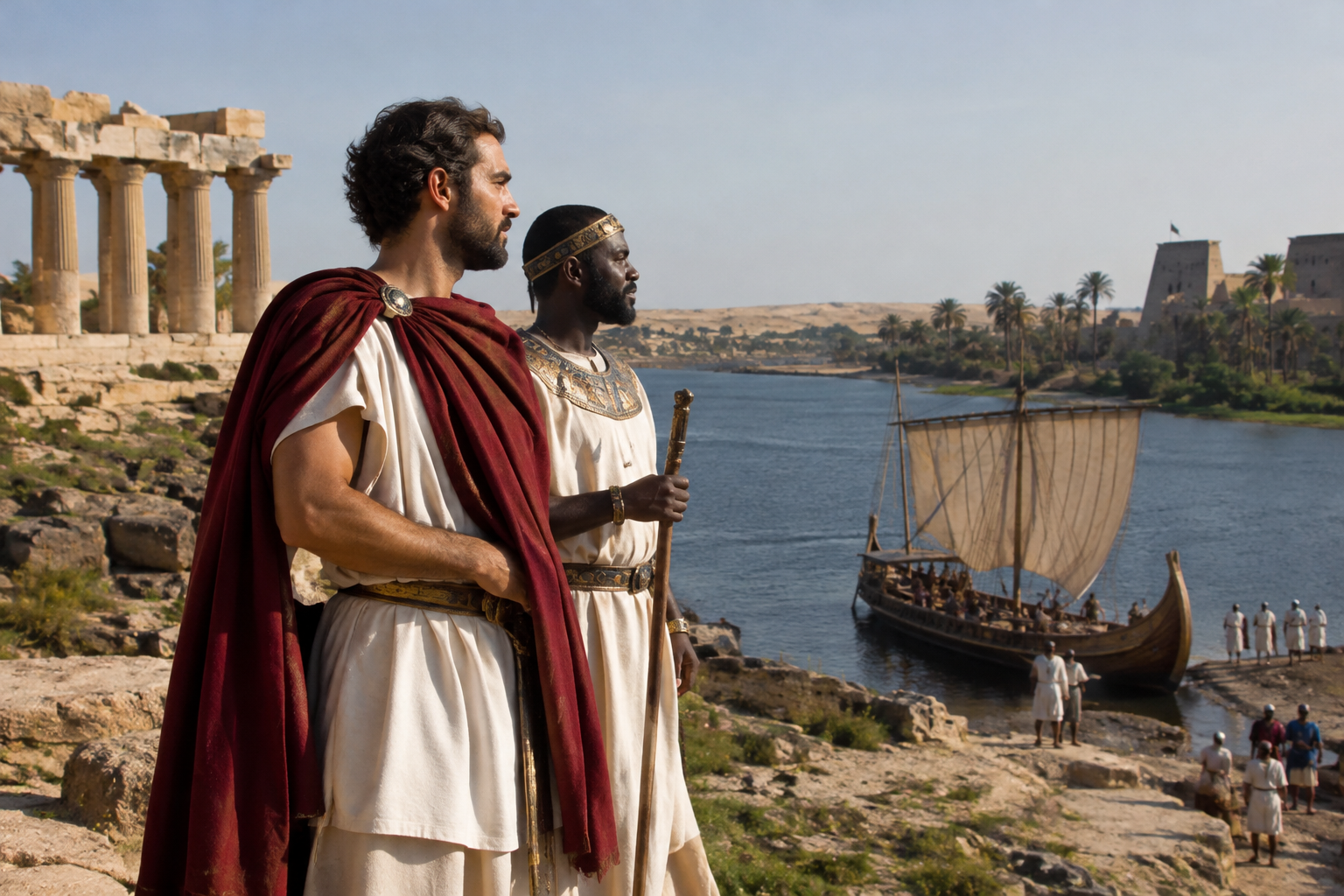
At Selinunte on the southwest coast of Sicily, one ancient man has become an unexpectedly useful guide to haplogroup LT. He is sample I19192, dated to around 536 BC, from the Manuzza area of the city and described as a Carthaginian-period individual from Italy-Sicily-Selinunte. That is already enough to make him interesting. Selinunte was a place where Greeks, Phoenician-Punic networks, and local Sicilian communities met, traded, fought, and lived in close proximity. A Y-chromosome assignment to LT in that setting is not a grand answer to Mediterranean history, but it is a vivid reminder that paternal lineages could appear in very mixed and mobile worlds.
LT is a broad Y-DNA branch rather than a fine terminal family signature. In other words, it tracks one direct paternal line only, not a person's whole ancestry, language, or cultural identity. What makes the evidence here worth pausing over is that the small set of ancient LT-linked men supplied for this article turns up in two very different historical settings: Punic Sicily in the first millennium BC, and medieval Nubia nearly 1,400 years later.
Selinunte is often introduced through warfare and destruction, but archaeology keeps showing that it was also part of a wider connected Mediterranean. By the later first millennium BC, western Sicily sat inside a crowded political landscape shaped by Greek colonies, indigenous Sicilian groups, and Phoenician-Punic expansion. A man like I19192, carrying the broad paternal lineage LT, belongs to that complicated human picture rather than to any simple ethnic box.
That matters because Y-DNA can tempt people into tidy labels. Yet a Carthaginian-period burial in Sicily does not let us declare that LT was a specifically "Carthaginian" lineage, still less that it marked a single people. What it does show is that this paternal branch was present in a cosmopolitan zone where ancestry from different shores of the Mediterranean could meet in one community, and sometimes in one cemetery.
A broader ancient DNA study of Sicily and neighboring regions has helped sharpen exactly this point: island histories are rarely insulated ones, and the western Mediterranean repeatedly drew in people from multiple backgrounds. For readers interested in that larger Sicilian setting, the MyTrueAncestry article on Paleogenomics of Ancient Italian Islands is a useful companion.
The Selinunte evidence also sits comfortably beside newer work on Punic and post-Punic populations that stresses diversity rather than uniformity. One of the more relevant research leads for this world is a genetic study of ancient Punic-associated populations, which speaks to the mixed origins and mobility of people in precisely these western Mediterranean settings. Even without pushing beyond what this one sample can prove, I19192 gives LT a clearly documented foothold in an archaeological landscape shaped by long-distance contact.
Because the haplogroup here is given simply as LT, caution is essential. LT is an upstream branch that today includes better-known descendant lines, but this article is about the level actually reported for the ancient individuals listed here. We should not silently upgrade these men into a narrower subclade, attach modern frequency maps to them as though nothing changed over time, or build a migration tale more precise than the evidence allows.
Still, broad branches can be historically useful. They help show where paternal diversity appears in the ancient record, especially in places better known from texts than from excavated genomes. In the case of Selinunte, LT contributes to the growing picture of Sicily as a zone of entanglement: not a neatly Greek east and Punic west, but a lived landscape full of movement, intermarriage, and local variation.
The second ancient man in this small LT dossier comes from a very different world. I19140 is dated to around AD 825 and comes from Kulubnarti in Makurian Nubia. By this date, we are in the medieval kingdom of Makuria along the Nile, a Christian Nubian polity with its own political traditions, regional networks, and social distinctions. The appearance of LT here is striking not because it proves a direct tie to Sicily, but because it shows the same broad paternal branch surfacing in a separate African context many centuries later.
Kulubnarti has become important in bioarchaeology because it offers unusually detailed evidence for life in medieval Nubia: health, diet, social inequality, and community structure. Genetic work connected to Nubian burials from the region has added another layer, showing that Nile Valley populations could carry lineages and ancestry components reflecting both local continuity and wider connections. In that framework, an LT assignment for I19140 is best read as one thread in a deeply interconnected Nile corridor, not as an isolated curiosity.
Research on Nubian ancient DNA, including work circulated at this study of medieval Nubian populations, has been especially valuable for moving discussion beyond old stereotypes of the region as marginal or static. Medieval Nubia was plugged into Red Sea, Nile, and northeastern African networks, and its cemeteries increasingly show that in biological as well as historical terms.
On paper, Selinunte in 536 BC and Kulubnarti in AD 825 look almost absurdly far apart. One belongs to the contested world of western Sicily in the age of Greek and Punic expansion; the other to a medieval Nubian kingdom on the Middle Nile. Yet that is precisely why this pairing is useful for thinking about LT. It warns us away from simplistic "homeland" stories built from present-day distributions alone.
Ancient DNA keeps doing this to historical common sense. It takes a lineage that might look abstract on a modern haplotree and pins it to real people in real places, often places that force us to think in terms of networks rather than nations. LT, in this evidence, is not the badge of one civilization. It appears instead in two settings where mobility, contact, and layered identities were part of ordinary history.
That wider lesson has echoes in several other MyTrueAncestry discussions of mixed historical populations. The article on Diverse Origins: Exploring the Genetic Legacy of the Ancient Punic People is particularly relevant to the Selinunte context, while Nubia's place in African population history makes a good companion to broader regional overviews.
It is worth lingering a little longer on Sicily, because it is one of those places where modern identity arguments can easily overrun the archaeology. A Y-line like LT in a Carthaginian-period individual from Selinunte does not settle debates about whether someone was "really" Phoenician, Greek, local Sicilian, or something else. Ancient communities did not arrange themselves according to modern genetic categories, and colonial zones were especially messy in practice.
But the sample does something better than settling labels: it gives us evidence of paternal diversity on the ground. In western Sicily, that matters enormously. The island's cemeteries and settlements were shaped by trade, settlement, war, enslavement, alliance, and family formation over generations. An ancient genome from Selinunte belongs to that granular human history.
Readers following the island's later story may also want to compare this with MyTrueAncestry's work on Medieval Sicily's Multi-Faith Genetic History, which shows that Sicily did not become simpler in later centuries. If anything, the island stayed true to form: multilingual, multi-faith, and genetically varied.
For someone discovering haplogroup LT today, the most responsible historical takeaway is not a single point of origin story but a pattern of presence in connected worlds. The ancient men I19192 at Selinunte and I19140 at Kulubnarti show LT turning up in societies shaped by exchange across seas and river corridors, and by the blending of local and incoming populations. That makes LT historically interesting not because it promises one famous ancestry, but because it sits comfortably inside some of the ancient world's busiest crossroads.

Comments