Haplogroup R1b1a2a
– 4 min read


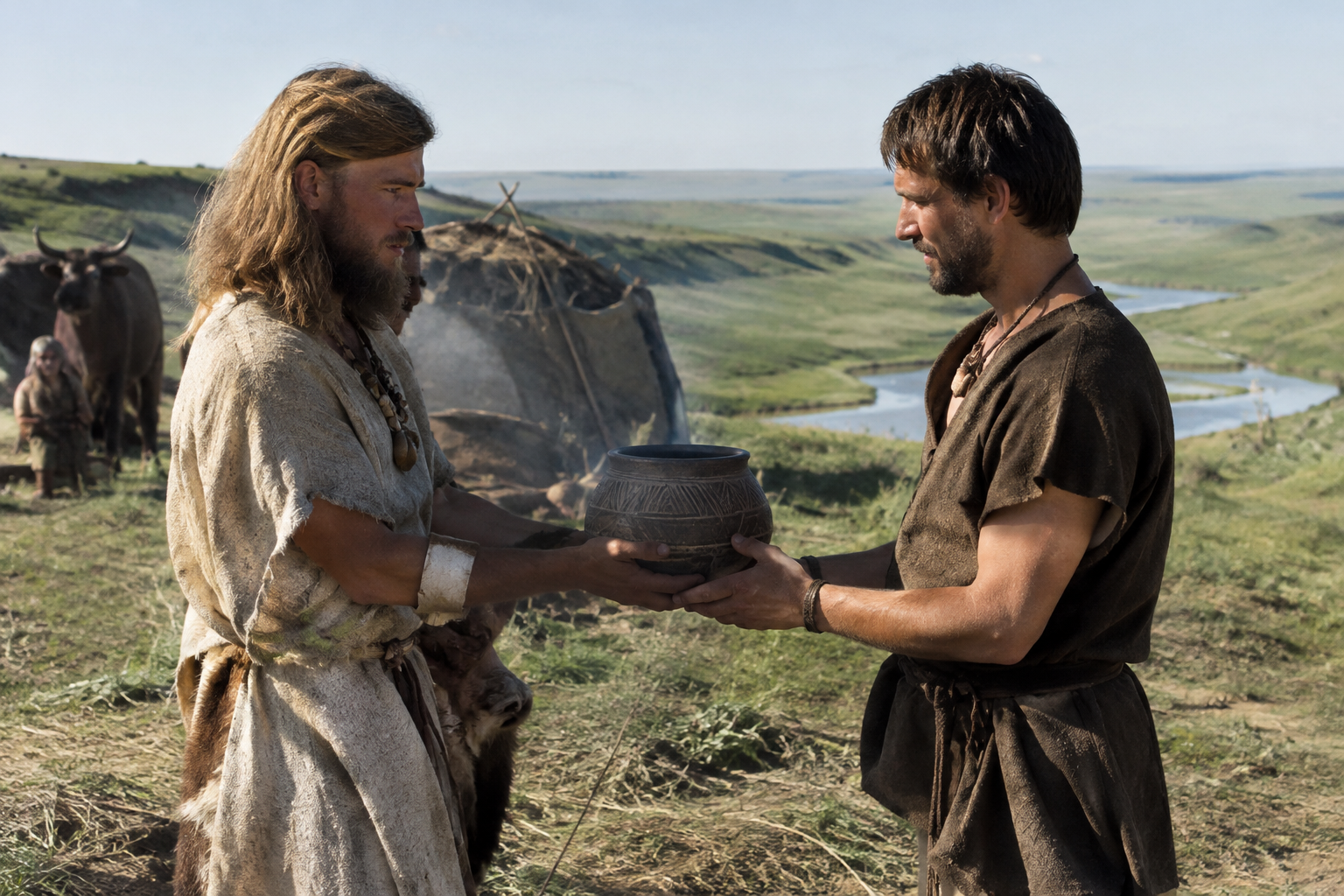
At Lopatino on the Sok River in Russia, one of the most discussed ancient burials in the genetics of Eurasia is sample I0443, dated here to around 2700 BC and associated with the Yamnaya horizon. He matters because he belongs to the broad paternal world from which much of later western Eurasian Y-DNA was reshaped, and because lineages connected with R1b1a2a appear again and again when archaeologists and geneticists trace the movement of steppe ancestry into Europe.
That does not mean one man "founded" half a continent, nor does a Y-chromosome tell us a person's whole ancestry. But Y-DNA does follow one direct male line, and in this case the line is historically revealing. The appearance of R1b-related males in steppe contexts and then in later Bronze Age central and western Europe is one of the clearest patterns in ancient DNA.
The Yamnaya world stretched across the Pontic-Caspian steppe in the late Copper Age and Early Bronze Age, linking mobile pastoral communities over a vast zone. Archaeology had long suggested that these were people of exceptional mobility, but ancient DNA turned that suspicion into something much firmer: many Yamnaya burials sampled so far show striking paternal concentration, especially within branches of R1b.
That is the real importance of I0443. He is not just an isolated ancient man from the steppe. He stands inside a larger demographic pattern in which particular male lines were disproportionately successful during the Bronze Age transition. A landmark ancient DNA study on steppe populations and their wider impact on Europe helped establish just how consequential these movements were for later European ancestry in the genetic record.
It is worth being precise here. R1b1a2a is a broad designation within the larger R1b family. Ancient Yamnaya males are often discussed in relation to downstream branches that later became widespread in Europe, but one must not collapse every R1b finding into the same exact subclade. What the Lopatino evidence does support is the deep connection between steppe male lines of this broader family and later Bronze Age expansions.
The second sample in this article, UNTA58_153, comes from Haunstetten in Germany and is dated here to about 1873 BC, in a Bell Beaker context. This is where the story becomes especially interesting. Bell Beaker archaeology is famous for its wide geographical spread, but genetics showed that in many parts of Europe it was not just a matter of pots, ornaments, or fashionable burial customs moving around. People moved too, and with them came a strong steppe-derived ancestry and new paternal lineages.
So when a Bell Beaker-associated man in southern Germany is linked with the branch discussed here, the significance is not simply that the same label appears twice. It is that we can place this paternal lineage in two very different settings: first in the steppe world that helped generate the demographic shift, and then in a central European archaeological culture deeply involved in the remaking of Bronze Age populations.
Research on Bell Beaker-period burials in southern Germany has been particularly valuable because it places genetics beside kinship and cemetery archaeology rather than treating DNA as a detached data point. An ancient DNA study examining these burials in depth offers that broader setting for understanding how such lineages sat within real communities in Bronze Age Bavaria.
Bell Beaker cemeteries across parts of western and central Europe have become central to discussions of R1b because they coincide with a major paternal turnover. Earlier Neolithic farmers in many regions often carried quite different Y-chromosome lineages. By the later third and early second millennium BC, however, R1b branches had become much more prominent in many areas connected with Beaker and post-Beaker populations.
That does not mean every Bell Beaker man carried R1b1a2a, still less that every modern man with this haplogroup descends from a single Beaker migration. What it does suggest is that this was the period in which parts of the wider R1b family achieved extraordinary social and demographic success across Europe. The Haunstetten sample belongs to that historical turning point.
Southern Germany is a particularly good place to watch this happen because it sits at a crossroads. It was connected westward to Beaker zones in the Rhine and beyond, eastward into central Europe, and southward toward Alpine corridors. A lineage found there is therefore not merely "German" in any narrow later national sense; it belongs to a Bronze Age landscape of movement, marriage, exchange, and local continuity mixed with substantial incoming ancestry.
On their own, I0443 and UNTA58_153 are just two men separated by centuries and by a considerable distance. Put together, they form a neat archaeological sequence. One stands in the Yamnaya steppe environment where R1b-associated male lines were already prominent; the other appears in a Bell Beaker setting in central Europe after steppe ancestry had spread far to the west.
This is exactly the sort of pattern that makes ancient DNA historically useful. It does not give us a heroic founder or a simple migration arrow on a map. Instead it shows how a paternal branch can be tracked through different archaeological worlds: from pastoral communities on the steppe to Bronze Age societies in Europe that were neither copies of Yamnaya nor untouched survivors of the earlier Neolithic.
Modern readers often want a haplogroup article to end with a tribe, a kingdom, or a surname. Ancient evidence is usually less tidy than that. R1b1a2a is best understood here as part of a broad paternal framework that became enormously important in Bronze Age Europe, especially in populations carrying substantial steppe ancestry. The exact downstream branches that later flourished in different regions are a more detailed question than these two records alone can answer.
That matters because archaeological labels and genetic labels are not the same thing. "Yamnaya" names a cultural horizon. "Bell Beaker" names another complex archaeological phenomenon. R1b1a2a is a paternal lineage label. The historical power of the evidence lies in seeing where they intersect without confusing one category for another.
Central Europe and language spread
The most distinctive thing about R1b1a2a in this article is not a claim to fame but a clear archaeological trajectory. With I0443 at Yamnaya Lopatino and UNTA58_153 at Bell Beaker Haunstetten, we can watch one branch of the wider R1b story move from the steppe background of the late third millennium BC into the transformed societies of Bronze Age Europe. If this haplogroup appears in your paternal line, the ancient evidence points most responsibly toward that big Bronze Age reshaping of Eurasian male ancestry rather than to any single later people, kingdom, or family.



Comments