Haplogroup C2a1a1b1b
– 5 min read


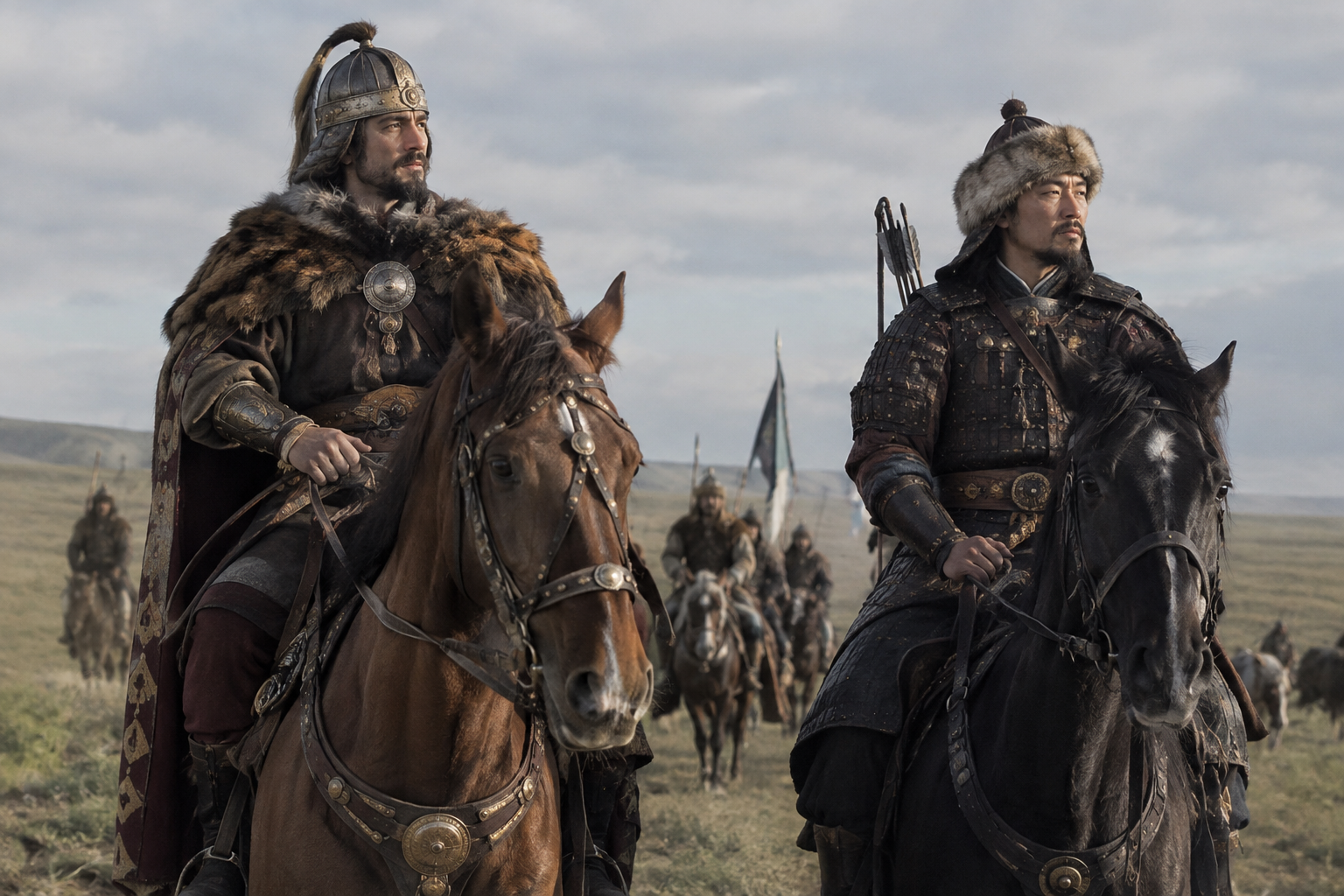
At Fajsz-Garadomb in Hungary, one buried man from around AD 650 stands out not because we can reconstruct his whole life in cinematic detail, but because the genetics place him inside a paternal line that is far more at home in the histories of Inner Asia than in older narratives of early medieval Europe. This individual, sample FGD-4, is identified here with Y-DNA haplogroup C2a1a1b1b and described as an Avar elite military leader.
That matters because C2 lineages are strongly associated with northern and eastern Eurasian populations, and this particular subclade points us toward the steppe world that linked Mongolia, Central Asia, and the Carpathian Basin. Y-DNA follows one direct male line only, not a person's total ancestry, but when a lineage like C2a1a1b1b turns up in well-dated archaeological contexts, it helps anchor historical movements that written sources often describe only from the outside.
The Avar period in the Carpathian Basin has long attracted argument. Byzantine writers described formidable mounted powers on the empire's frontier, while archaeologists have traced changing burial customs, political centres, and social hierarchies across what is now Hungary and its neighbours. Ancient DNA has added something especially useful here: it has shown that at least part of the Avar elite carried a distinctly East Asian genetic profile.
Sample FGD-4, from Fajsz-Garadomb and dated here to around AD 650, fits neatly into that wider picture. If this individual is correctly resolved to C2a1a1b1b, he represents not just "steppe ancestry" in a vague sense, but a sharply eastern paternal signature inside an early medieval elite context in Europe. That is exactly the kind of finding that stops us from flattening the Avars into a generic migration-period label.
An ancient DNA study of Avar-period elites, available here, helped establish how strong those Inner Asian connections could be in some high-status burials. The broader lesson is not that every Avar grave tells the same story, but that the ruling and military strata could include men whose paternal ancestry linked them to populations much farther east than the Danube frontier.
European Huns and Xiongnu Links
There is a temptation, when looking at a detailed Y-DNA label, to treat it as a ready-made ethnic badge. That would be a mistake. Still, some branches are historically more informative than others, and C2a1a1b1b is one of them. Within Eurasian archaeogenetics, C2 lineages repeatedly appear in regions tied to the eastern steppe, especially Mongolia and adjacent zones.
So when this branch appears in an Avar-period burial in Hungary, it strengthens the case that at least some Avar elite males were not merely culturally influenced by Inner Asia, but retained direct paternal roots there. That does not prove a single migration route for one family, nor does it turn one grave into the whole Avar population. What it does do is give the historical debate a hard biological edge.
It also helps explain why the Avar polity looked so unusual to its contemporaries. This was not simply a local European kingdom wearing steppe fashions. In at least some cases, the men buried with elite status really were connected, in their paternal descent, to the far eastern steppe world.
The second sample is separated from Fajsz-Garadomb by both geography and time, but that is precisely what makes it interesting. BAY001, a Late Medieval Mongol warrior from Bayan Khairkhan and dated here to around AD 1300, is also associated with haplogroup C2a1a1b1b. Now the lineage is no longer turning up at the western end of the steppe system; it appears in Mongolia itself, in a period shaped by the Mongol world empire and its aftermath.
This is a useful corrective to the habit of treating steppe history as if it moved in only one direction, westward into Europe. Lineages such as C2a1a1b1b make much more sense when we see the steppe as a connected zone with recurring centres of power in Mongolia and Inner Asia. The Avar-era Hungarian sample and the late medieval Mongolian sample are not evidence of a simple family chain across 650 years, but they do place the same paternal branch in two historically appropriate steppe-connected settings.
Research on medieval and earlier Mongolian populations, including supplementary material linked here, has helped frame how ancient DNA can track continuity and turnover across the steppe. For a haplogroup like C2a1a1b1b, that wider context matters: it is not just an isolated curiosity in one burial, but part of a paternal landscape deeply tied to Inner Asian history.
With only two ancient individuals listed here, caution is not a ceremonial extra; it is the whole method. FGD-4 and BAY001 do not show that all Avar leaders or all Mongol warriors belonged to C2a1a1b1b. They do not prove uninterrupted descent between the two men. And they certainly do not license romantic claims that everyone carrying this haplogroup today descends from a famous conqueror.
But they do something more historically grounded. They show this paternal branch in two places where we would expect eastern steppe-linked male lines to appear: among an Avar elite burial in the Carpathian Basin and in late medieval Mongolia. That combination gives C2a1a1b1b a very specific archaeological flavour. It is not merely "ancient Eurasian"; it is repeatedly at home in the political and military worlds of the steppe.
That is one reason archaeogenetics has changed the conversation. Older histories often had to infer origins from dress, weaponry, horse gear, or hostile outside descriptions. Genetics cannot replace those sources, but it can test them. In this case, the paternal evidence sits remarkably well with the idea that the Avar elite included men with genuine Inner Asian roots.
One of the most important things about the Eurasian steppe is that it repeatedly produced empires whose political reach far exceeded the size of their core homelands. The Avars in the Carpathian Basin and the Mongols in the thirteenth and fourteenth centuries were not the same polity, and should not be collapsed into one tradition. Yet both belonged to a long history of mobile confederations, cavalry warfare, and elite networks stretching across enormous distances.
Haplogroup C2a1a1b1b fits comfortably into that broad setting. Its appearance in an Avar-period grave in Hungary makes more sense when eastern steppe lineages are understood as part of real population movements and ruling groups, not as decorative add-ons to European history. Its appearance again in Mongolia in a later warrior burial reinforces that this was a living Inner Asian paternal line, not a one-off anomaly carried west and then lost from view.
For readers interested in how ancient Y-chromosomes illuminate East Asian paternal history more generally, the bigger picture is explored in related work on long-term regional patterns.
Ancient East Asian Y-Chromosomes
The most distinctive thing about C2a1a1b1b in the evidence here is not sheer antiquity, but historical placement. This branch appears in an Avar elite context in seventh-century Hungary and in a late medieval Mongolian warrior, giving it a credible archaeological association with the eastern steppe world and with the far-reaching political networks that world produced. If this is your paternal haplogroup, the ancient record does not hand you a named ancestor, but it does place your direct male line in a landscape shaped by mobility, military power, and Inner Asian connections across centuries.

Comments