Haplogroup R1b1a1b1a1a1c2a1d1
– 4 min read


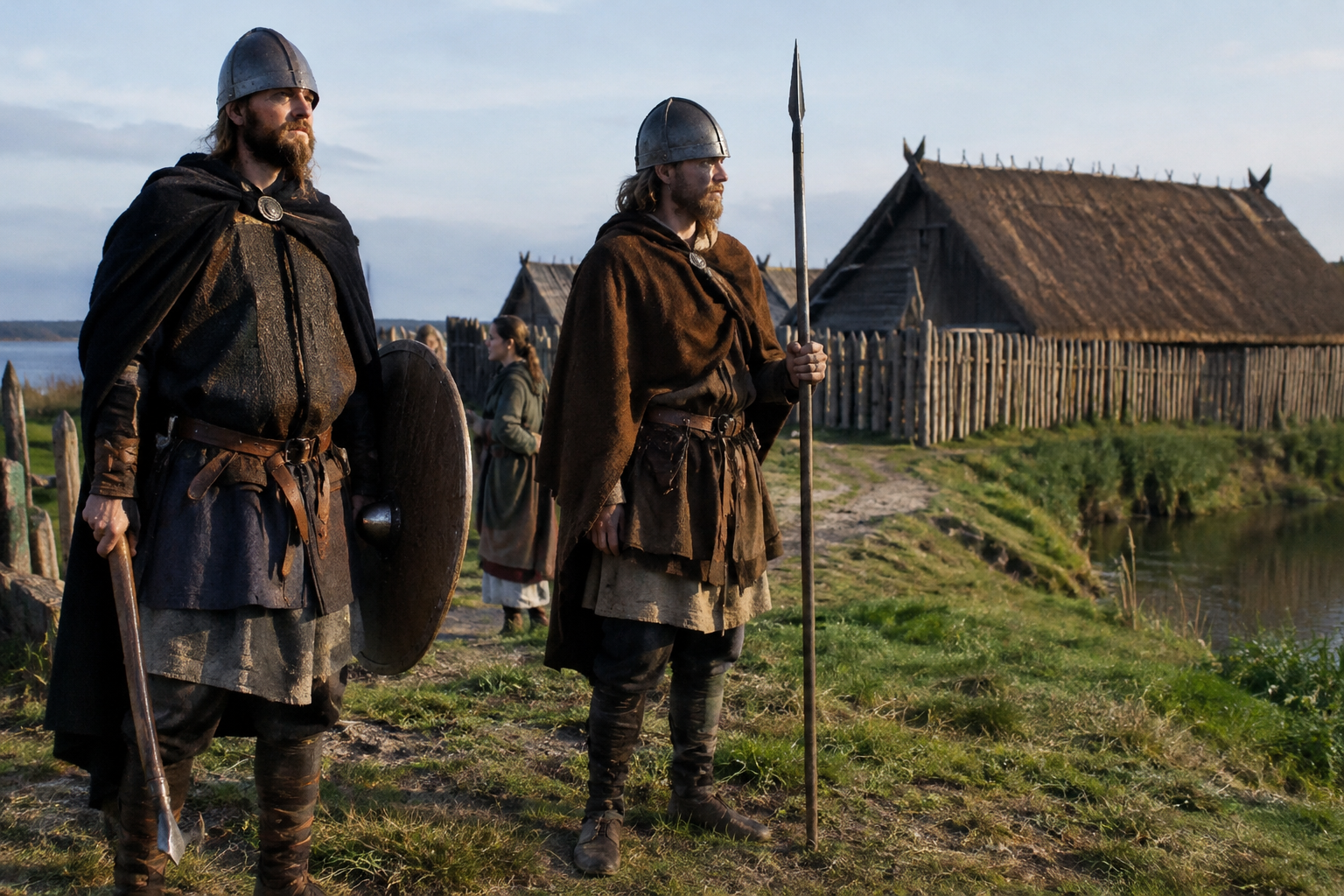
At Trelleborg in the Kingdom of Denmark, one Viking Age man dated to around AD 939 has been reported under the sample ID CGG105938. On its face, that is a very small scrap of evidence: one individual, one fortress world, one paternal line. Yet it becomes far more interesting when set beside another Danish male, VK313, from Rantzausminde Grav on Funen, dated to about AD 875. Together they place the Y-DNA haplogroup R1b1a1b1a1a1c2a1d1 in two closely related but archaeologically distinct corners of late first-millennium Denmark.
That matters because Y-DNA follows a direct paternal line only, not a person's whole ancestry, language, or identity. Even so, when the same narrow branch appears in more than one Viking Age Danish context, it offers a useful clue about how one male lineage was present within the wider Scandinavian world of fortresses, coastal settlements, and regional mobility.
The stronger opening point here is Trelleborg itself. The site name immediately evokes the ring fortresses associated with the late Viking Age in Denmark: planned earthworks, timber construction, and a highly organized political landscape often connected with the consolidation of royal power. Sample CGG105938, dated around AD 939, belongs in that historical moment, when Denmark was not merely a loose scattering of farms and ships but a kingdom being structured through labor, logistics, and defended nodes.
What we should not do is turn this man into a named warrior, officer, or aristocrat. The evidence provided does not support that. But it is still significant that a bearer of R1b1a1b1a1a1c2a1d1 appears in a Trelleborg-context individual, because it places this paternal branch within one of the best-known political and military landscapes of Viking Age Scandinavia.
An ancient DNA study connected with Viking Age Denmark and related burials has been circulated as a preprint at https://www.biorxiv.org/content/10.1101/2025.02.28.640770v1. Without overstating what can be extracted from a single reported lineage call, the broader value of such research is that it lets archaeology move beyond objects and monuments to ask who, biologically speaking, was actually present in these places.
The second sample, VK313 from Rantzausminde Grav on Funen, is dated slightly earlier, around AD 875. Funen was hardly peripheral in the Viking Age. It sat in the middle of the Danish archipelago, in a zone shaped by sea routes, local lordship, exchange, and the constant practical business of moving people across water.
Here again, restraint matters. We are not told of grave goods, kinship, or a precise social role, so none should be invented. But the pairing of VK313 on Funen with CGG105938 at Trelleborg suggests that this paternal branch was not confined to one isolated burial or one eccentric local family. It was present in at least two Danish settings within roughly the same broad historical horizon.
That pattern is modest, but not trivial. Ancient DNA often advances in exactly this way: not through one flamboyant revelation, but through repeated appearances that slowly show a lineage occupying real historical ground.
R1b1a1b1a1a1c2a1d1 is an extremely fine-grained branch name, deep inside the larger R1b family of Y-chromosome lineages. The wider R1b umbrella is common in much of western Europe today and appears in many ancient European contexts, but that does not mean every narrow descendant branch shares the same exact history. One of the easiest mistakes in public genetics is to take the broad fame of R1b and pin it directly onto a much more specific subclade without evidence.
So the safest reading is also the most useful one. For this article's branch, the evidence presented here places it in Viking Age Denmark through at least two men, one from Trelleborg and one from Funen. That is enough to say the lineage belonged within the male population of late first-millennium Denmark. It is not enough to map its entire prehistoric journey, assign it to a tribe, or claim it marked a single ruling dynasty.
There is a tendency, when looking at Viking Age DNA, to hunt immediately for famous raiders, kings, or expeditionary crews. But much of the real historical interest lies elsewhere: in the ordinary distribution of lineages across the Scandinavian heartland. A fortress-associated man from eastern Denmark and another from Funen hint at a paternal line that was part of the social fabric inside Denmark itself, not just an offshoot glimpsed abroad.
That is especially valuable because Viking Age history is often told through movement outward: to England, Ireland, Normandy, the Baltic, Iceland, and beyond. Yet those outward movements began in home regions where communities were already mixed, connected, and politically changing. A lineage like R1b1a1b1a1a1c2a1d1 becomes historically interesting not because it can be made glamorous, but because it helps populate that domestic Scandinavian background with real men from real archaeological settings.
A separate preprint linked to one of these sample sets is available at https://www.biorxiv.org/content/10.1101/703405v1. In the larger field of Viking Age archaeogenetics, such work has repeatedly shown that Scandinavia was neither biologically uniform nor historically simple. Local continuity, regional variation, and maritime mobility all have to be considered together.
The dates attached to VK313 and CGG105938 fall into an exceptionally busy period in Danish history. Around AD 875, Funen belonged to a sea-linked world of regional power. By around AD 939, the Trelleborg horizon speaks to more centralized planning and the sort of coordinated labor that only strong authority can mobilize.
That does not mean these two men were part of the same family line in any recent genealogical sense; many men can share a haplogroup branch while being separated by centuries or more on the paternal tree. But their presence in these settings does suggest that this branch participated in the transition from a decentralized Viking Age landscape to one increasingly shaped by royal infrastructure and territorial organization.
For someone who carries R1b1a1b1a1a1c2a1d1 today, the most responsible historical takeaway is quite specific. This branch is attested in Viking Age Denmark in at least two reported ancient males: VK313 from Rantzausminde Grav on Funen, around AD 875, and CGG105938 from Trelleborg, around AD 939. That does not make every present-day carrier "Viking" in any simple cultural sense, but it does place this paternal line inside the historical Danish world from which Viking Age society was built.
In other words, the value of the haplogroup is not that it hands you a saga hero. It gives you something quieter, and in some ways better: a documented paternal foothold in the lived archaeological landscape of Viking Age Denmark.

Comments