Haplogroup L

– 5 min read


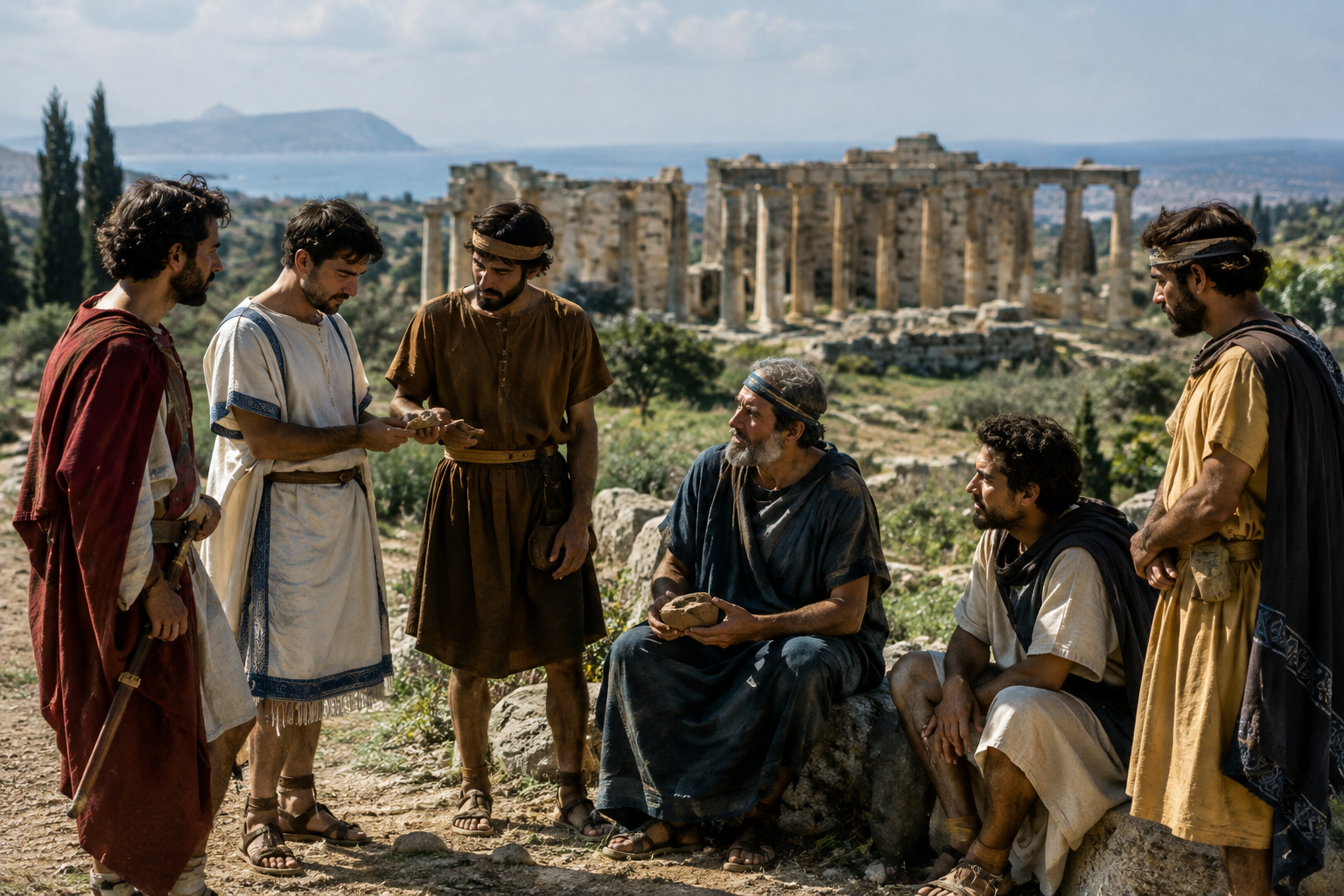
In Late Roman Cordoba, at Lucena's Cortijo Basilica del Coracho, one man dated to about AD 450 carried a Y-chromosome assigned to haplogroup L. He appears in the record as I37208, and that bare identifier is enough to make him interesting. In the western Roman world, haplogroup L is not the first paternal line most people expect to meet, yet here it is in southern Iberia at the edge of empire, in a period when Roman institutions were weakening but Mediterranean connections had hardly vanished.
That is the useful starting point for thinking about haplogroup L in antiquity. Y-DNA follows one direct paternal line only, not a person's whole ancestry, language, or identity. Even so, when the same broad lineage turns up in places such as southeastern Anatolia, the Aegean, Sicily, and Roman Spain, it offers a small but telling glimpse of how male lines could move through old corridors of settlement, colonization, trade, and empire.
The sample I37208 comes from a Late Roman context in the province of Cordoba, at Lucena's Cortijo Basilica del Coracho, around AD 450. That date matters. This was not the age of neat, self-contained local populations. Southern Hispania still belonged to a world of roads, ports, garrisons, estates, clergy, and merchants, even as political control shifted.
A man with haplogroup L in this setting does not prove a recent arrival from one particular eastern homeland, and it certainly does not turn late Roman Lucena into a colony of outsiders. What it does suggest is that paternal lines associated today more strongly with regions farther east had already become part of the population mix of Roman Iberia. That fits the larger picture explored in MyTrueAncestry's discussion of Roman Hispania's Lasting Genetic Legacy.
An ancient DNA study of Iberia and its later historical transformations has helped show just how connected the peninsula could be in Roman and post-Roman centuries, with people moving in from elsewhere in the Mediterranean and beyond rather than remaining within tidy regional boxes. For that broader context, see this research on population change in Iberia.
If Lucena gives us a western endpoint, the older eastern evidence is just as revealing. The sample I14734, dated around 550 BC, comes from Kuriki Hoyuk in Batman, in southeastern Anatolia. Another sample, I3225, dated around 450 BC, is identified as an ancient Dorian from Halikarnassos on the Aegean coast.
These two places sit in very different landscapes. Kuriki Hoyuk belongs to inland southeastern Anatolia, a zone long shaped by interaction between Mesopotamia, Anatolia, and the highlands to the east. Halikarnassos, by contrast, was one of the great coastal contact zones of the eastern Mediterranean, a place where Greek-speaking communities, Anatolian populations, imperial power, and maritime exchange all overlapped.
That matters for haplogroup L because it reminds us not to flatten its history into a single migration story. A paternal line found in both southeastern Anatolia and the Aegean coast in the first millennium BC may reflect much older population structures in western Asia as well as the ceaseless movement of men through military service, intermarriage, colonization, and commerce. Research on ancient Mediterranean population history has repeatedly shown that the Aegean and Anatolia were linked by far more than literary tradition alone; genetic evidence has become one more way of tracing those ties. A wider study of the region's ancient populations can be found here.
Two of the most intriguing L-associated individuals in this set come from Sicily: I20166, an ancient citizen of the Greek colony of Himera around 550 BC, and I21197 from Selinunte in western Sicily, dated around 176 BC. Sicily is exactly the sort of place where a haplogroup like L becomes historically interesting, because the island was never merely one thing.
Greek colonies in Sicily were not sealed ethnic capsules. They were communities planted in landscapes already occupied, then transformed by ongoing contact with other Greeks, indigenous Sicilians, Phoenician-Punic networks, and later larger imperial systems. To find haplogroup L in Himera and later at Selinunte is therefore not a curiosity detached from history; it sits perfectly within the island's reputation as one of the Mediterranean's great meeting grounds.
The chronological spread is important too. Himera belongs to the earlier age of Greek colonial expansion, while Selinunte in the second century BC belongs to a later world already shaped by warfare, conquest, and new political orders. The paternal line persists across changing regimes, suggesting not a single episode but the continuing presence of varied male ancestries within Sicilian communities.
That is very much in keeping with other work on the island and its neighbors. MyTrueAncestry readers interested in these island populations may also want to compare Genetic Diversity in Medieval Sicily and Medieval Sicily's Multi-Faith Genetic History, both of which show how deeply layered Sicilian population history remained long after the classical period.
With haplogroup L, caution is especially important because the label itself is broad. The evidence provided here does not give a securely documented fine-scale terminal subclade for these ancient men, so the responsible level is the parent haplogroup as reported. That means we should resist the temptation to assign a neat origin point, a named people, or a single route across the map.
Still, the pattern is historically meaningful. The ancient men listed here appear in southeastern Anatolia, the Aegean coast, Greek Sicily, Hellenistic Sicily, and Late Roman Spain. Those are not random dots. They are some of the most heavily connected zones of the eastern and central Mediterranean world, tied together over centuries by shipping lanes, armies, sanctuary networks, taxation systems, colonists, enslaved people, and ambitious families moving where opportunity or necessity took them.
In other words, haplogroup L in these contexts looks less like an isolated anomaly and more like a recurrent minority strand within populations shaped by long-distance contact. That does not make every carrier a migrant, but it does place the lineage within the very old human habit of moving around the Mediterranean and western Asia while leaving descendants far from any imagined point of origin.
If your Y-DNA falls within haplogroup L, these ancient cases suggest a past that is deeply entangled with the connected worlds of Anatolia and the Mediterranean. The clearest insight from the present evidence is not noble descent or membership in one famous ancient people. It is continuity of a paternal line across several major historical settings: Anatolian Iron Age communities, Greek colonial Sicily, Hellenistic western Sicily, and the late Roman far west in Iberia.
That is a modest conclusion, but a good one. Haplogroup L appears here not as a banner of one ethnicity, but as part of the male-line diversity carried through ports, colonies, cities, and provincial communities over many centuries.



Comments