Haplogroup N1a1a1a1a1a1a1

– 5 min read


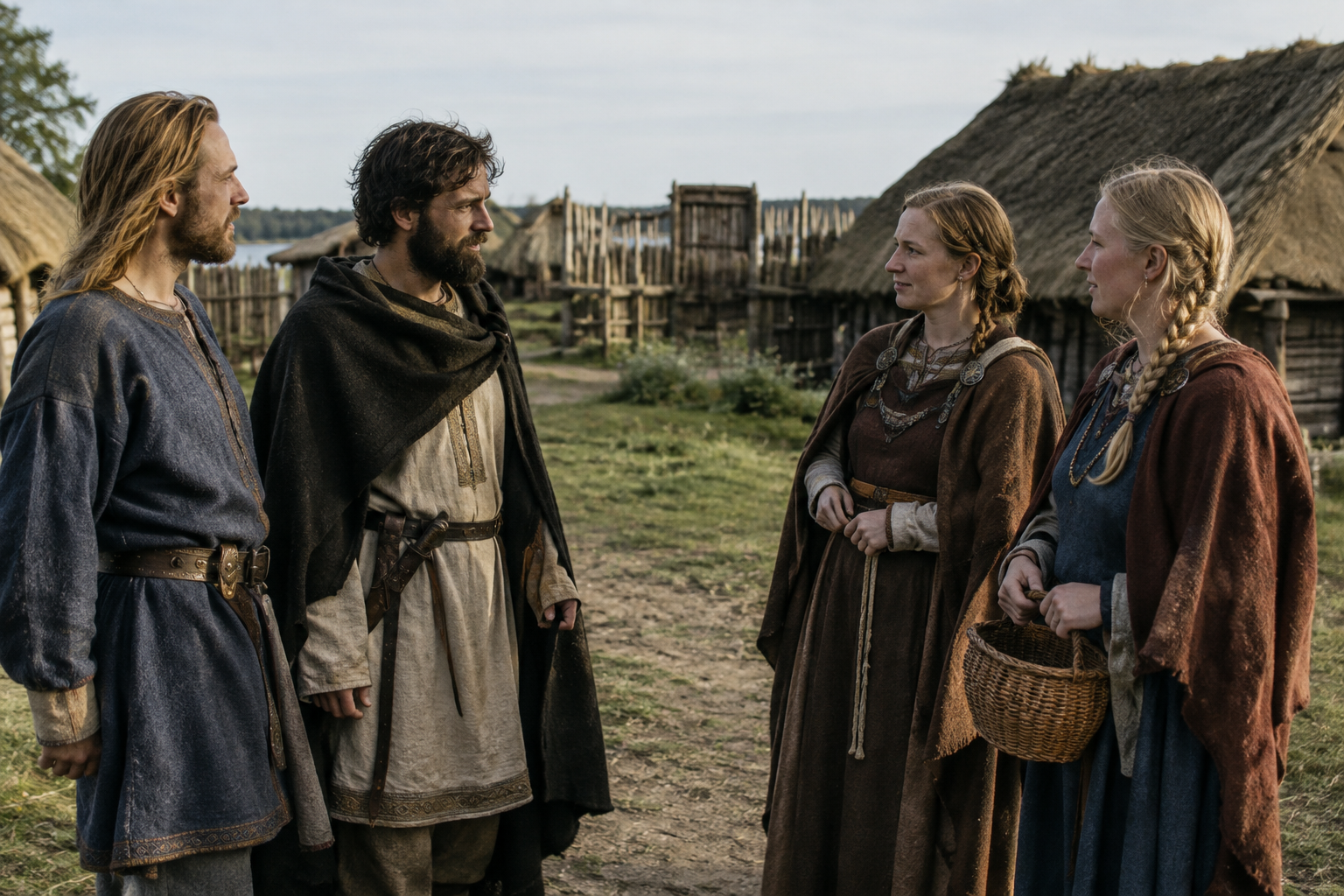
At Sandby borg on Oland, the violence of the fifth century was preserved with unusual bluntness. The ringfort is famous because its dead were left where they fell, creating a rare archaeological snapshot of a community struck in the Migration Period, around AD 475. Among the individuals recovered there are two entries tied to the Y-DNA branch N1a1a1a1a1a1a1: snb019 and snb019a, both from pre-Vendel Age Sweden.
That is what makes this haplogroup especially interesting here. N1a is a large northern Eurasian paternal lineage, but this very narrow branch is not something one should casually spread across every period and place where N appears. In the evidence at hand, it turns up in two quite different settings: a fifth-century Baltic island stronghold in Sweden, and early medieval graves at Velim-Velistak in Croatia. Because Y-DNA traces one direct male line only, it does not define the whole ancestry or identity of these men; what it does offer is a sharp little thread running through a much wider historical fabric.
Sandby borg has attracted so much attention because it is not simply a cemetery. It is a settlement-fortified enclosure whose inhabitants appear to have been killed and left unburied. That gives the site an immediacy archaeologists rarely get. Instead of a memorialized burial ground, we are looking at the remains of a catastrophe in place.
Within that context, snb019 and snb019a matter less as isolated labels than as proof that this paternal line was present on Oland in the later fifth century. The duplication of the identifier, with the "a" suffix, should not be overinterpreted as a separate historical drama; it is safest to treat them as closely related sample designations from the same site record rather than inventing a story around them.
The broader importance is regional. Oland sat in the Baltic world, linked to mainland Scandinavia and to maritime routes reaching far beyond it. A paternal lineage associated here with N1a1a1a1a1a1a1 reminds us that the Scandinavian past was not genetically uniform, and certainly not sealed off. Research on ancient Scandinavian populations, including the large ancient DNA study published in Cell, has helped show just how mixed and mobile these northern societies could be across long periods.
The temptation with a long haplogroup label is to treat it as a ready-made migration map. That is precisely what good archaeogenetics tries to resist. N1a1a1a1a1a1a1 is a highly specific downstream branch, while haplogroup N as a whole has a much deeper and broader history across northern Eurasia, especially in populations connected at different times with Uralic-speaking and northeastern European regions.
So the careful reading is this: these ancient men are reported in association with this narrow paternal branch, but the branch itself should not be made to carry the whole burden of language, ethnicity, or political identity. A man buried in early medieval Croatia and a man found in a fifth-century Swedish ringfort can share a paternal line without belonging to the same people in any simple historical sense.
Still, the pattern is suggestive. When a rare or tightly defined paternal branch appears in both Baltic Scandinavia and the western Balkans, it points us toward the kind of mobility that marked late antiquity and the early Middle Ages: military movement, frontier service, trade, marriage networks, and small-scale migration rather than a single dramatic folk migration with a neat arrow on a map.
The second cluster comes from Velim-Velistak in Croatia, where two early medieval individuals are listed with this branch: VEM003, dated around AD 750, and VEM032, dated around AD 775. The site belongs to a very different historical world from Sandby borg. We are no longer in a Migration Period Scandinavian stronghold, but in the early medieval eastern Adriatic zone, where post-Roman, Slavic, local Balkan, and wider Mediterranean connections all met.
That matters because Croatia in this period was not some isolated ethnic capsule. It was part of a frontier-rich landscape shaped by the collapse of Roman authority, the formation of new polities, and continuing contacts across the Adriatic and inland Balkans. The appearance of the same narrow Y-DNA branch in two men from Velim-Velistak suggests that this paternal line had become established, at least in some small local context, by the eighth century.
Just as important is what we cannot safely claim. Two individuals at one cemetery do not prove a ruling dynasty, a tribal founder, or a direct family link to the Swedish samples. They do, however, show continuity of presence within one early medieval burial population and make this haplogroup more than a one-off curiosity.
An ancient DNA project associated with these Croatian remains has also been deposited through the ENA research archive, which reflects the growing body of genomic work on the region's long-term population history. In this case, the key historical value lies in the combination of chronology and place: the branch is visible in a post-Roman Adriatic community roughly three centuries after its appearance in the Oland material.
Croatia's shifting paternal lineages
It is worth dwelling on how different these two settings are. Sandby borg is bound up with the crisis-ridden northern world after the Western Roman Empire's decline, when fortified sites, elite exchange, and local conflict shaped life around the Baltic. Velim-Velistak belongs to the early medieval Balkans, where new political formations emerged in territory once governed by Rome and contested by neighboring powers.
And yet a narrow paternal line appears in both. That does not mean there was a simple Swedish-to-Croatian migration of this haplogroup. It does mean that the male line behind N1a1a1a1a1a1a1 was part of the human traffic of northern and eastern Europe in the centuries between late antiquity and the early Middle Ages. In historical terms, this is exactly the sort of result ancient DNA is so good at producing: not a fairy-tale origin story, but a stubborn, specific signal that old populations were more connected than older nationalist histories liked to imagine.
For readers interested in that broader northern picture, Finland and the Baltic world offer useful parallels, especially where ancient DNA begins to show how eastern and northeastern connections became part of medieval population history.
Early medieval Finland and Baltic links
Many haplogroup articles end up sounding like atlases. This one is better read as a case study in scale. At the grand scale, N-related paternal ancestry belongs to a vast northern Eurasian story. At the fine scale, N1a1a1a1a1a1a1 appears here in a handful of identifiable men from two sharply different archaeological settings.
That combination is valuable for anyone researching a paternal line today. It suggests a branch with real early medieval depth in Europe, visible in both Scandinavia and Croatia, but not yet something that can be reduced to a single people, kingdom, or migration legend. If this is your haplogroup, the most defensible historical takeaway is not a claim to one famous tribe, but a connection to the mobile, entangled northern and eastern European worlds that linked the Baltic and the Balkans after Rome.
The clearest insight from the current evidence is modest but powerful. N1a1a1a1a1a1a1 is not just an abstract entry on a haplotree: it is present in the remains of men living in a fifth-century Swedish fort and an eighth-century Croatian community. That places this paternal branch inside real archaeological history, where violence, settlement, and regional change left bones as well as chronicles. For a modern tester, it is a reminder that the direct paternal line can preserve surprising links across distant corners of early Europe, even when the full historical path between them remains unfinished.






Comments