Haplogroup K+

– 4 min read


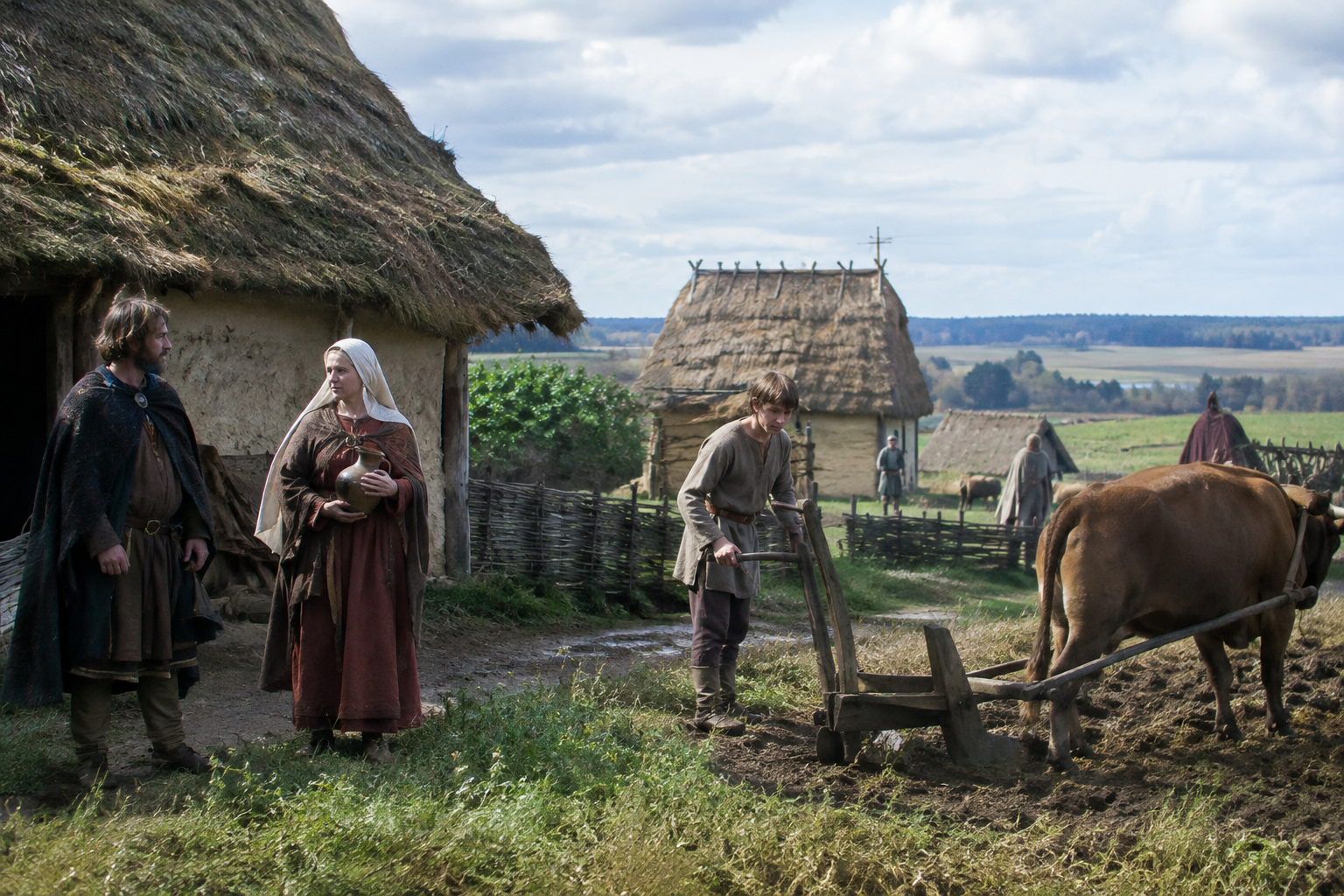
At Deersheim in Saxony-Anhalt, one early medieval burial has become especially intriguing for paternal-line research: sample DRH045, dated to around AD 500. That date places him in the unsettled generations after Roman power had faded in the West, when central Europe was being reshaped by new kingdoms, shifting military loyalties, and communities that were anything but isolated.
What makes DRH045 notable here is his reported association with the Y-DNA haplogroup K+. That is a very broad paternal designation rather than a fine-grained terminal subclade, and that distinction matters. Y-DNA traces one direct male line only, not a person's whole ancestry, language, or identity. Still, even a broad assignment can be historically useful when it appears in a well-dated archaeological setting.
By about AD 500, the region around Deersheim lay in a frontier zone of cultural blending. This was the age often called the Migration Period: not because whole peoples moved as single blocks, but because alliances, households, military retinues, and local communities were constantly being remade. A burial from this moment is valuable precisely because it sits at the meeting point between late Roman worlds and emerging early medieval ones.
DRH045 is therefore best understood not as a stand-alone curiosity, but as evidence from a population living through transition. Central Germany in this period was connected to wider movements across the Rhineland, the Elbe zone, and former Roman territories. Ancient DNA has been especially useful in showing that such communities often included people of mixed local and non-local origins, rather than neat ethnic packages marching across a map.
The label K+ can look deceptively simple. In Y-chromosome terms it refers to a very high-level branch in the paternal tree, one that sits far above many later and much more familiar downstream lineages. In other words, this is not the sort of assignment that allows us to pin DRH045 to a narrowly defined recent clan or historically named dynasty. It is a broad signal, and broad signals need careful handling.
That said, broad does not mean meaningless. When a male line survives in an excavated individual from a securely historical context, it gives us a fixed point: a man living in early medieval Germany, in a post-Roman landscape, whose direct paternal ancestry fell somewhere within that larger K-derived framework. For family historians today, that is often how ancient DNA is most valuable - not by offering a fairy-tale pedigree, but by anchoring a paternal line in a real human setting.
The caution is especially important because ancient samples are not always resolved to their deepest possible branch. Preservation, sequencing depth, and reporting standards can all limit precision. So for DRH045, the responsible approach is to discuss K+ as reported, and not to invent a more specific subclade that the evidence here does not supply.
If there is one large historical lesson from finds like DRH045, it is that early medieval Germany was not a sealed ancestral box. Archaeology has long shown exchange, mobility, and regional variation; genomics has sharpened that picture by demonstrating that burial communities could include very different maternal and paternal backgrounds. That does not abolish local continuity, but it does make simple origin stories much harder to sustain.
Research on early medieval populations in western and central Europe has repeatedly pointed to this mixture of continuity and movement. Some people were likely local descendants of earlier Roman-period or pre-Roman communities; others had family backgrounds tied to longer-distance mobility. The point is not that every grave marks a migrant, but that these cemeteries record societies in motion.
An ancient DNA project associated with these burials can be found at https://www.ebi.ac.uk/ena/browser/view/PRJEB81250. Even without overclaiming details from a single accession page, the broader research context supports a picture of early medieval Germany as a place where disease history, migration, and community formation can all intersect in the same cemetery record.
Single individuals are easy to underestimate. Yet one of the great strengths of archaeogenetics is that it lets us move between scales. A lone burial such as DRH045 will not define the whole Migration Period, but it can sharpen our sense of what kinds of male lines were present in a particular place and time. That is especially true for branches like K+, where ancient examples in well-described European early medieval contexts are not everyday headline material.
Saxony-Anhalt is also an especially useful setting because it sits in a region central to debates about post-Roman population history, the spread of Germanic languages, and the transformation of local societies after imperial collapse. A grave dated around AD 500 belongs to that conversation. Not because a haplogroup can solve the language question on its own - it cannot - but because it gives us one more point of evidence about the men who actually lived through the transition.
This is where genetics and archaeology are at their best when used together. The cemetery date tells us when. The site tells us where. The Y-chromosome tells us something narrow but concrete about one paternal line. And the historical landscape explains why that combination is more interesting than a bare haplogroup label on a screen.
For someone exploring a present-day paternal line, the most sensible value of this evidence is not prestige but perspective. DRH045 shows that a K+ associated male line was present in central Germany during the early medieval period, at a moment when identities were being rebuilt after Rome. That does not mean every modern K+ line descends from him, or from Germany, or from any one named people. But it does place this branch inside a documented archaeological world rather than leaving it entirely abstract.
That matters because haplogroups can otherwise seem oddly placeless. Ancient DNA restores place. In this case, the place is Deersheim; the time is around AD 500; the context is a society shaped by mobility, local continuity, and post-Roman change. For a broad paternal label like K+, that is already a meaningful historical foothold.
The clearest insight from haplogroup K+ here is not a sweeping migration saga, but something more disciplined and more useful: one direct male line linked to a real burial in Migration Period Germany. Sample DRH045 reminds us that paternal ancestry becomes most interesting when it is tied to excavated people, known places, and historically specific moments. If K+ appears in your own results, this early medieval burial from Deersheim offers a modest but genuine connection to the human landscape of post-Roman Europe.

Comments