Haplogroup J2a1a1b2a1b2

– 4 min read


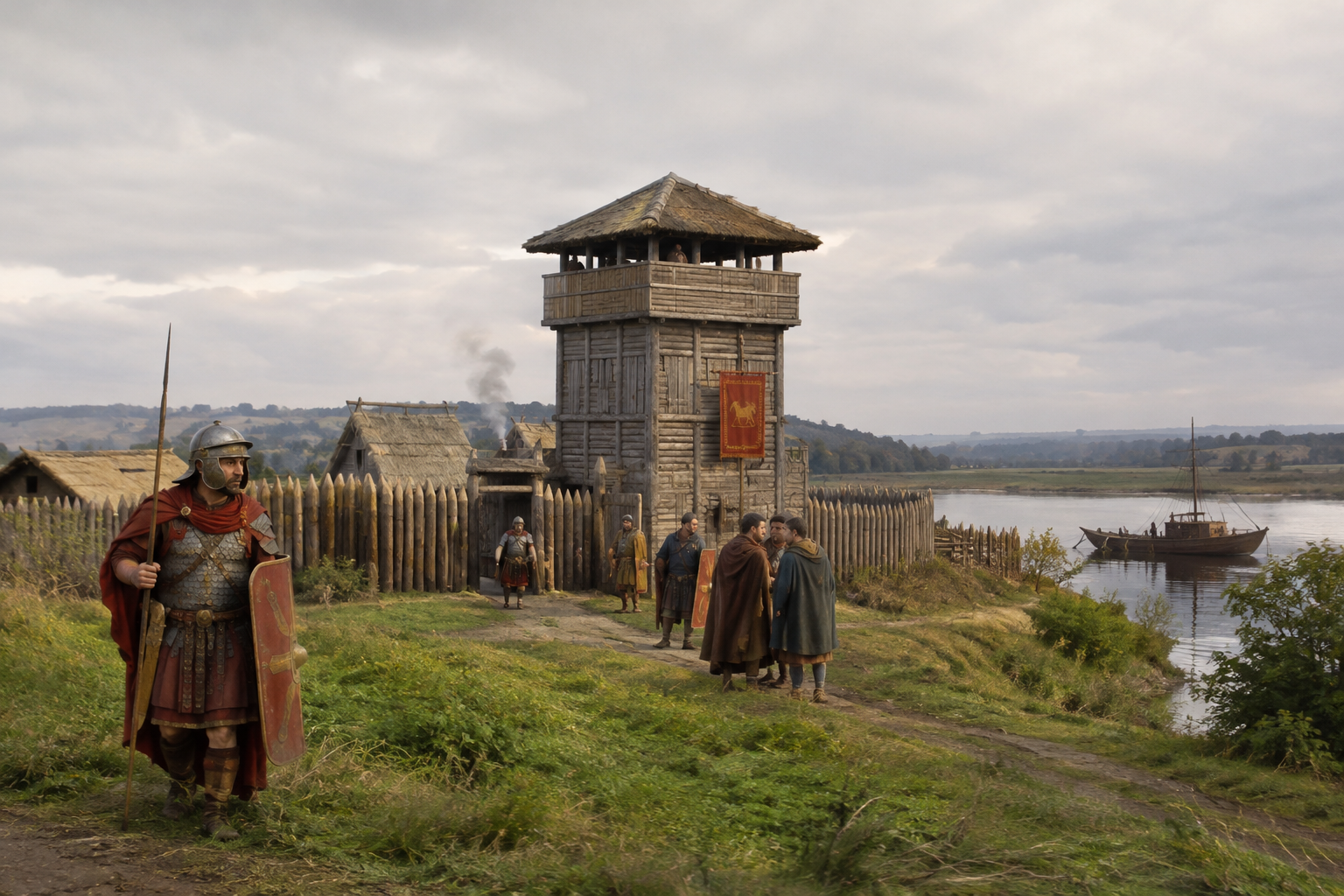
At Straubing-Azlburg on the Roman frontier in what is now Bavaria, one late antique burial has become unexpectedly useful for thinking about a very specific paternal line: J2a1a1b2a1b2. The individual identified as STRAZ_II_13, dated to around AD 400, comes from a borderland setting where the Roman world and the peoples beyond it were in constant contact. That alone makes him interesting. A Y-chromosome lineage often travels with men, families, military service, and migration, and a frontier cemetery is exactly where such histories tend to surface.
There is an important caution at the start. A Y-DNA haplogroup tracks one direct paternal line only, not a person's whole ancestry, language, or identity. But when a branch like J2a1a1b2a1b2 appears in a Late Roman frontier context in southern Germany, it raises a historically sharp question: how did a lineage more broadly associated within the wider J2 family with long histories in the Mediterranean and western Asia come to be part of life on the Danube edge of the empire?
Straubing, ancient Sorviodurum, sat in a strategic zone of the Roman Danube frontier. By about AD 400, this was not a neat line dividing "Romans" from "barbarians," but a busy and unstable region of soldiers, dependants, traders, local families, migrants, and people whose lives crossed political categories with ease. Burials from such places matter because they catch history at ground level, where imperial administration and personal ancestry meet.
The sample STRAZ_II_13 belongs to that world. Even with sparse sample-level detail, the context is substantial. A man carrying the paternal branch J2a1a1b2a1b2, or a very closely related reported assignment, was present in a cemetery tied to the late frontier community at Straubing-Azlburg. That does not tell us whether he thought of himself as Roman, provincial, immigrant, recruit, or something else entirely. It does tell us that this paternal line had reached - and was living within - one of the empire's most mixed zones.
An ancient DNA study of frontier populations published in Nature has drawn attention to just this kind of complexity: communities along the Roman-Germanic border were not genetically uniform blocs, but shifting mixtures shaped by mobility and local continuity alike. Straubing-Azlburg fits that larger pattern well.
The branch name here is very narrow: J2a1a1b2a1b2. That matters. It sits inside the much larger Y-DNA haplogroup J2, a paternal family with a deep and wide history across parts of the Near East, Anatolia, the Aegean, the Mediterranean, and later many other regions as well. But it would be careless to paste the whole history of J2 directly onto this one subclade without sample-specific evidence.
What we can say more safely is that lineages within the J2a world often appear in archaeological settings connected to the long, entangled histories of farming expansions, Bronze and Iron Age exchange, classical-era mobility, and imperial networks. In the Roman period especially, men and their paternal lines could move astonishing distances through army service, trade, slavery, administrative careers, marriage, and local resettlement. A late Roman grave in Bavaria is therefore not an anomaly to be explained away, but part of the larger human traffic of empire.
That traffic is one reason frontier cemeteries are so revealing. They test the old habit of imagining ancient populations as tidy ethnic packages. One Y-lineage may point toward eastern or southern connections in the distant paternal past, while the rest of a person's ancestry, language, culture, and everyday life were shaped locally on the frontier itself.
It is easy to picture the late Roman frontier as a crumbling military edge. In reality, places like Straubing were plugged into very large systems. The Danube was a transport corridor, a military artery, and a cultural hinge. Units were transferred, federate groups settled, goods circulated, and communities adapted to repeated political change.
That is the real historical setting in which STRAZ_II_13 should be understood. If a man with this paternal lineage was buried there around AD 400, his ancestry may reflect generations of movement before him, not one dramatic migration in his own lifetime. His paternal forebears might have entered central Europe through Roman channels, through pre-Roman connections, or through mixed provincial populations that already carried diverse lineages. With only one identified ancient individual here, the responsible point is not to choose a single route, but to recognize the frontier as the place where such routes converged.
Now, one sample is not a population. That is obvious, but worth keeping in proportion. Ancient DNA becomes powerful not because every grave is definitive, but because each securely placed individual can anchor a larger pattern. STRAZ_II_13 gives this haplogroup a documented foothold in a Late Roman frontier cemetery in Germany. That is already historically meaningful.
Archaeology has spent decades dismantling the old story that frontiers were simple lines separating fixed peoples. Genetics has sharpened that picture. Instead of sealed groups, we find communities composed through recruitment, marriage, local persistence, and repeated arrivals. A branch like J2a1a1b2a1b2 appearing in this context underlines exactly that point: the Roman frontier was not only defended; it was inhabited by people with varied paternal histories.
This broader theme also appears in other MyTrueAncestry discussions of the period, including work on mobility and mixed origins in late antique communities.
Mixed origins in Late Antiquity
For readers exploring this haplogroup today, the most sensible historical frame is not a single ethnic label but a chain of connected worlds. The wider J2a background has often been associated, at broad scale, with regions tied into the eastern Mediterranean and adjacent lands. The Roman Empire then amplified movement across those worlds, carrying people and paternal lines into provinces far from any supposed homeland.
That does not mean STRAZ_II_13 was a newcomer from the east, still less that every present-day carrier of J2a1a1b2a1b2 descends from one Roman-era migration. It means that by the time we meet this lineage archaeologically in late Roman Bavaria, it was already part of the complicated demographic fabric of Europe. That is a different, and better, story than a simplistic tale of origins.
For more on how ancient genomics is changing older ideas about peoples and language in central and northern Europe, one useful comparison is this discussion of population movement and cultural change.
The clearest insight from this evidence is modest but important. J2a1a1b2a1b2 is attested in the person of STRAZ_II_13 at Straubing-Azlburg, around AD 400, in a Late Roman frontier setting where ancestry, service, and settlement were deeply entangled. For anyone researching this paternal line, that does not offer a royal pedigree or a single migration legend. It offers something better grounded: a real ancient presence in one of Europe's great contact zones, where Roman and non-Roman histories were being lived together.
Comments