Haplogroup J1a2a1a2d2b2b2

– 5 min read


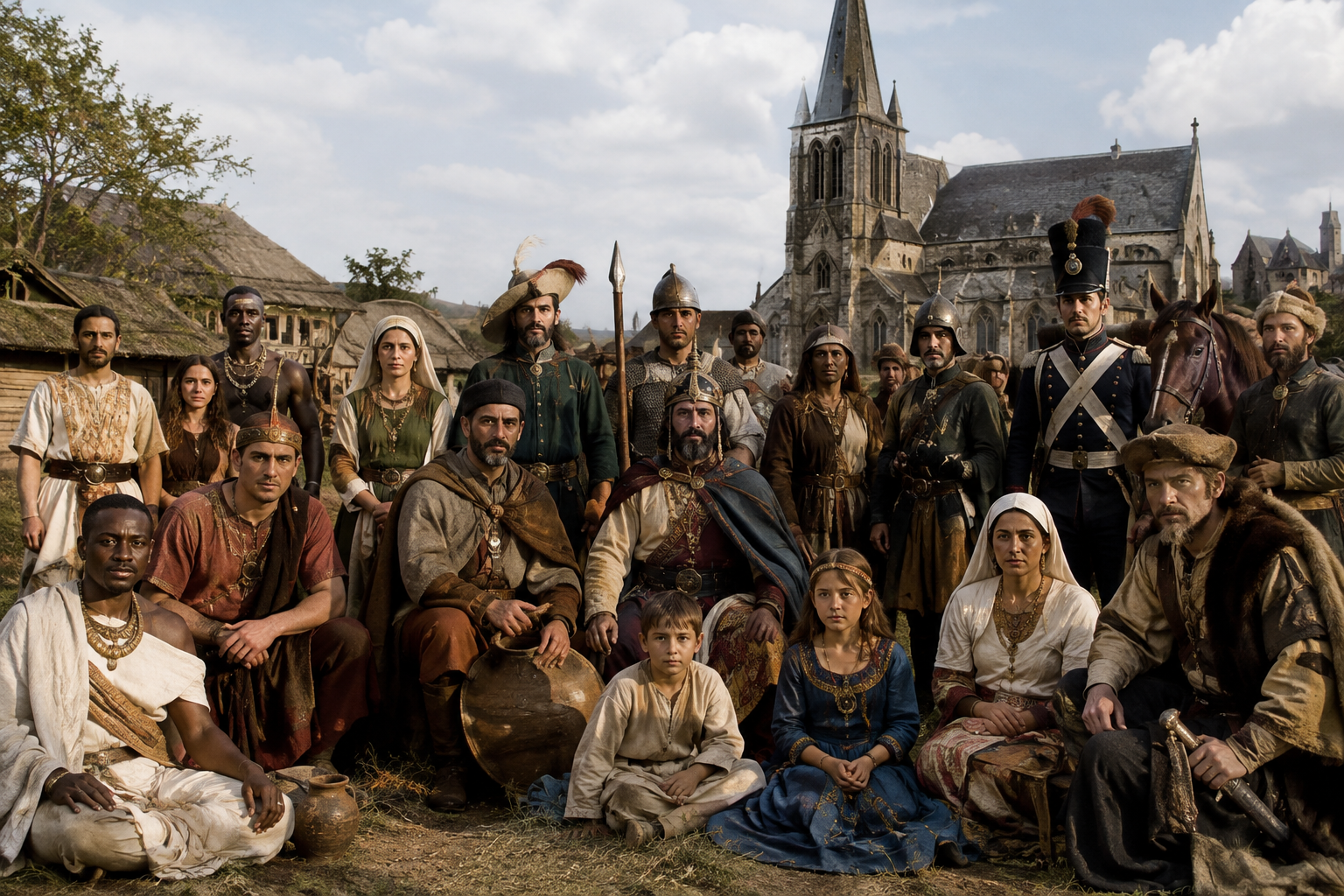
At Rakoczifalva in Hungary, a striking cluster of men dated to around AD 650 carries the paternal line J1a2a1a2d2b2b2. The site matters because it is not a lone curiosity. Instead, it gives us a small concentration of this lineage in one Migration Period landscape, with individuals such as RKF098, RKF110, RKF129, RKF147, RKF226, RKF124, RKF121, RKF182, RKF225, RKF192, RKF237, RKF117, RKF194, RKF053, RKF060, RKF062, RKF068, and RKF079, alongside Avar elite burials RKC009, RKC021, and RKC018.
That is the useful starting point for understanding J1a2a1a2d2b2b2. Y-DNA follows one direct paternal line only, not a person's whole ancestry, but when the same branch appears in several burials from the same place and period it becomes historically interesting. Here, the interest lies in how a lineage more often associated in broad terms with Southwest Asian and Near Eastern paternal history turns up in a very mixed early medieval setting in the Carpathian Basin.
The Rakoczifalva material belongs to a region that, in the 6th and 7th centuries, was anything but isolated. The Carpathian Basin after Rome was a frontier, a corridor, and a political prize. Avar power sat over communities with different local origins, different incoming ancestries, and different social roles. So when one paternal branch appears repeatedly there, the sensible conclusion is not that everyone belonged to one tribe or one family, but that this male line had found a durable place in that world.
The distinction between the general Migration Period burials and the specifically labelled Avar elite graves is important. RKC009, RKC021, and RKC018 show that this haplogroup was not confined to one social register in the cemetery record as presented here. It appears across a site complex linked with both broader community burials and higher-status Avar-age contexts, which suggests integration rather than a one-off arrival.
An ancient DNA study of medieval Hungary's elite has helped underline just how varied these populations could be, with steppe-linked, local European, and more southerly or easterly elements all meeting in the same political landscape. That wider picture is useful background for Rakoczifalva, even if any one paternal branch must be interpreted carefully within it. For readers interested in that setting, see Genomes of Medieval Hungary's Elite Reveal Conquest-Period Roots and Lasting Steppe Ancestry.
Another revealing case is I40570 from Aquae Calidae in Bulgaria, dated to around AD 350 and described as a Levantine outlier from a Gothic grave. That phrase is doing a lot of work. It tells us that the burial context was associated with a Gothic-period setting, while the individual's broader ancestry profile stood out from some of the others around him.
This is exactly the kind of evidence that prevents lazy equations between archaeology and ethnicity. A Gothic grave does not necessarily contain a man whose ancestors were all from the Baltic or the north; equally, carrying J1a2a1a2d2b2b2 does not make a person simply "Levantine" in any cultural sense. What it does show is that late antique communities around the Black Sea and Balkans could include men whose paternal and genome-wide backgrounds linked them to very different parts of the wider Roman and post-Roman world.
Research on late antique Bulgaria has emphasized that Gothic communities were genetically diverse rather than biologically uniform. That broader finding makes I40570 especially valuable as a reminder that the Migration Period was full of military service, client networks, intermarriage, and movement across imperial frontiers.
Mixed origins of Gothic communities
If Rakoczifalva shows concentration and Aquae Calidae shows mobility, the Bronze Age samples point further south and east. Among the older cases linked to this branch are I14762 from the Yamhad Kingdom in southeast Anatolia, dated around 1640 BC; ALA035 from Canaanite Alalakh, around 1685 BC; ALA018, an Amorite outlier child from Alalakh, around 1410 BC; and I16120 from Late Bronze Age Armenia at Dzori Gekh, around 1380 BC.
These are not all the same culture, and they should not be flattened into one story. But taken together they place this paternal line, or a close reported association with it, in the orbit of Bronze Age northern Syria, southeast Anatolia, the Levant, and the South Caucasus. That is a serious historical zone: palace states, trade routes, dynastic marriages, and armies moving between Mesopotamia, Anatolia, and the eastern Mediterranean.
Alalakh in particular has become one of the key ancient DNA sites for showing how connected Bronze Age societies were. A genetic study examining the ancient population there is available at https://www.science.org/doi/10.1126/science.abm4247. For J1a2a1a2d2b2b2, the relevance is not that every later European carrier came from one Bronze Age city, plainly not, but that the deeper archaeological trail for this paternal line points convincingly into the old interaction zone of the Near East.
One of the most suggestive western finds is I22119 from Tharros in Sardinia, dated to 269 BC and identified as Phoenician or Punic. Now that is a wonderfully Mediterranean setting for a lineage like this one. Tharros was part of a world tied together by ships, harbours, merchants, garrisons, and colonies stretching from the Levant to North Africa, Sicily, Sardinia, and Iberia.
This does not mean that the branch spread only through Phoenician expansion, nor that all Punic men carried anything like it. But a Punic-era Sardinian example fits very neatly with a paternal line that appears earlier in the Levantine and Anatolian record and later in Europe in contexts shaped by migration and empire. The western Mediterranean was one of the great transmission belts of antiquity.
Readers following Punic genetic history more broadly may want to compare this with Diverse Origins: Exploring the Genetic Legacy of the Ancient Punic People.
The branch does not vanish after antiquity. I20278 from Sant Julia de Ramis Les Goges in Girona, dated to AD 621, places it in early medieval Spain. That matters because 7th-century Iberia was another contact zone: late Roman traditions, Visigothic rule, Christian communities, and surviving Mediterranean links all overlapping. It is not hard to see why a paternal line with eastern Mediterranean depth might surface there.
Much later still, STR140, STR140a, and STR140d from St. Rombouts in Belgium, dated to AD 1561, show the lineage in a late medieval or early modern northwestern European urban church context. By then we are no longer looking at frontier warbands or Bronze Age palace networks, but at settled Christian Europe. The same paternal branch can therefore be tracked across radically different historical worlds without needing any romantic tale of a single unbroken elite descent.
Even YYY083A, a soldier of Napoleon's Grande Armée from the 1812 mass grave at Vilnius, reminds us how far such lineages could travel once they were embedded in European populations. Armies, after all, are the great accidental museums of ancestry.
What stands out about J1a2a1a2d2b2b2 is not a single kingdom or a single migration, but a pattern: Bronze Age appearances in the Near East, a Punic-era western Mediterranean case, late antique and early medieval examples in the Balkans, Hungary, and Spain, and later survival in western and central Europe. In other words, this is a paternal line that seems to belong especially well to worlds connected by trade, empire, military service, and long-range movement.
For someone researching this haplogroup today, the best-supported lesson is a sober one. Your direct paternal line may have deep roots in the Near Eastern and eastern Mediterranean sphere, but the ancient evidence we have shows that this branch was already moving through mixed societies long before the modern era. Its history is not narrow. It is mobile, urban, imperial, and repeatedly entangled with the great contact zones of Eurasian history.
Comments