Haplogroup J1a2a1a2d2b2b1

– 4 min read


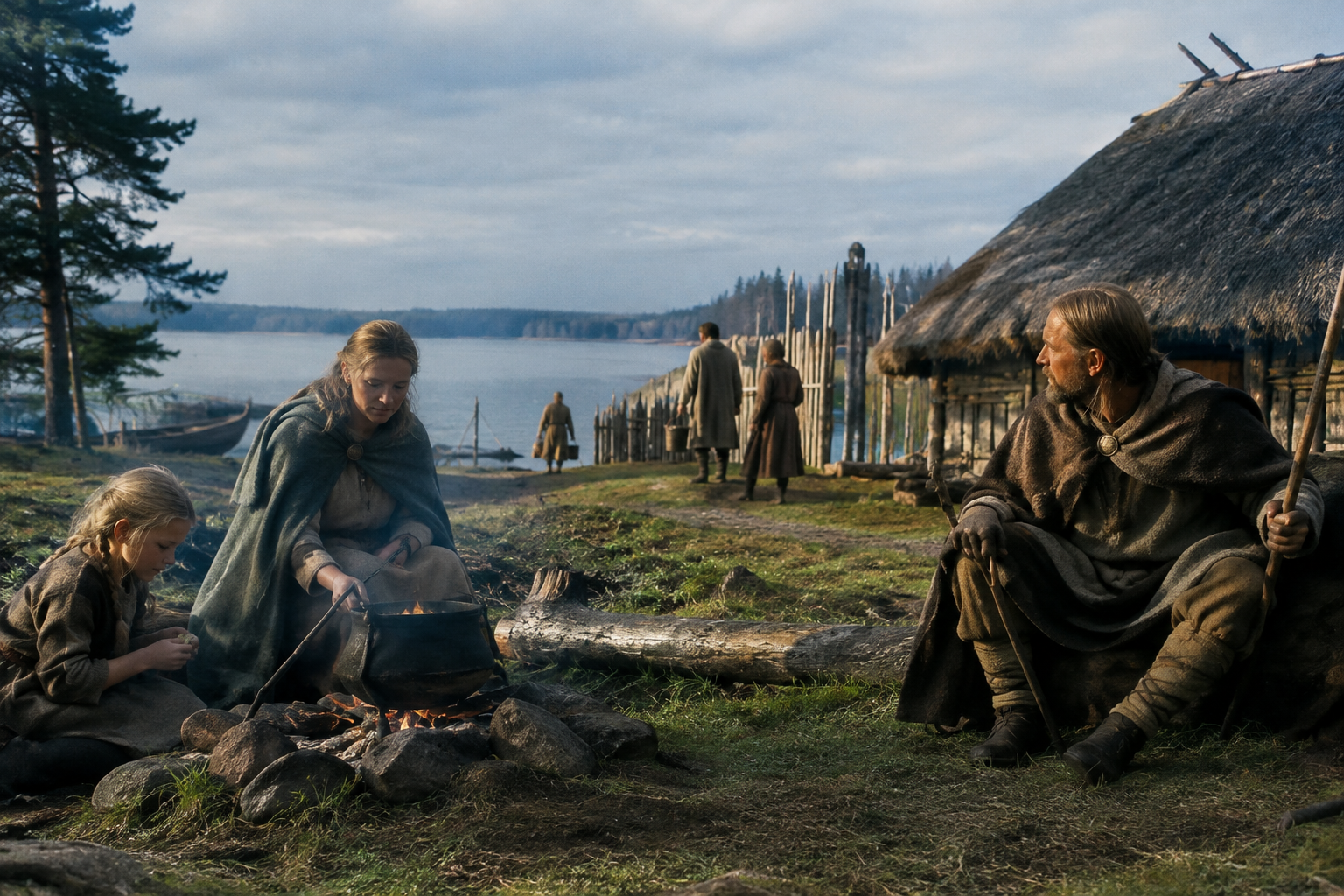
The most concrete clue here is a single man: VL7, dated to around AD 900 in what is now Latvia and classified as Baltic Late Iron Age. That is already enough to make this paternal line interesting. The Y-DNA branch highlighted here, J1a2a1a2d2b2b1, belongs within the wider J1 family, a lineage better known today from regions much farther to the south and southeast than the eastern Baltic.
So the immediate historical question is not whether one burial can stand for all of Latvia; it cannot. The real question is why a man carrying this direct paternal line appears in the eastern Baltic at the end of the first millennium, in a period when the Baltic coast sat inside a very busy world of exchange, raiding, migration, and local continuity.
VL7 comes from a landscape that was anything but isolated. Around AD 900, the eastern Baltic was connected to the wider Viking Age world through river routes, coastal travel, trade in raw materials and prestige goods, and shifting political networks. A man buried in Latvia at this date might be deeply local in culture, recently mobile, or descended from earlier newcomers whose paternal line had already been absorbed into Baltic society generations before.
That is why Y-DNA is useful, but only when handled carefully. It traces one direct male line only: father to father to father. It does not define a person's whole ancestry, language, or identity. In the case of VL7, it gives us a very specific paternal signal inside a much broader archaeological setting.
A research project on the Viking Age in Latvia, hosted by the University of Latvia, places this kind of evidence in its proper interdisciplinary frame, combining archaeology with scientific study rather than treating genetics as a story on its own: research on Viking Age Latvia.
The wider haplogroup J1 has a long and complex history across West Asia and neighboring regions. But that wider history should not be lazily pasted onto J1a2a1a2d2b2b1. A narrow subclade can have its own much more recent story, and with the evidence available here, the safest point is simply this: VL7 shows that a paternal line within this branch was present in Late Iron Age Latvia.
That matters because the Baltic in the ninth and tenth centuries was a contact zone. Goods and people moved along the Daugava and other major corridors toward the eastern European river systems, the Scandinavian world, and beyond. When an apparently unusual paternal lineage turns up in such a region, several explanations become historically plausible: direct migration, marriage networks, mercantile mobility, military retinues, or the long afterlife of older movements now archaeologically invisible at the individual level.
None of those possibilities needs embellishment. The interesting thing is precisely that the evidence does not point to a simple ethnic label. A burial in Latvia can be Baltic in archaeological period and location while still carrying a paternal line with a broader geographic story.
Popular history still sometimes imagines the Baltic edge of Europe as marginal. The archaeology says otherwise. Late Iron Age Latvia sat on important routes joining the Baltic Sea to inland eastern Europe, and those routes mattered to traders, warriors, craftsmen, and local elites. The result was not constant replacement of populations, but contact layered onto local communities.
That makes VL7 easier to understand. We do not need to picture some dramatic one-off arrival from a distant homeland. In fact, the more historically sensible picture is often the less theatrical one: a region in which lineages of varied origin could become part of local society over time, leaving only occasional glimpses in ancient DNA.
The broader lesson fits well with other early medieval studies from northern and central Europe, where burials increasingly show that mobility and ancestry did not always match neat cultural boxes.
Baltic connections in early medieval Finland
With only VL7 explicitly listed here, the article has to stay close to the ground. We can say that a man associated with J1a2a1a2d2b2b1 appears in Late Iron Age Latvia around AD 900. We can also say that this is exactly the sort of period when the eastern Baltic was tied into long-distance networks that make such a finding historically plausible.
What we should not do is inflate that into a claim about an entire tribe, a ruling dynasty, or the total paternal profile of medieval Latvia. One individual is evidence of presence, not dominance. Nor should we assume that the finest resolution of the modern article haplogroup was necessarily reported in exactly that form in the original archaeological study; ancient Y-DNA assignments are often revised as methods improve and comparative data grow.
That said, single individuals can still be historically valuable. Archaeology is full of cases where one burial opens a window onto a wider world. VL7 is useful not because he solves the history of J1 in the Baltic, but because he proves that this paternal thread had reached, or survived in, that region by the close of the first millennium.
Ancient genomics and language spread
For someone exploring this haplogroup today, the most responsible comparison is not with a romanticized saga map but with the real geography of movement around the Baltic Sea. Viking Age and Late Iron Age communities were linked by commerce, diplomacy, slavery, marriage, warfare, and seasonal travel. Paternal lines could move without entire populations moving with them.
That is especially important in places like Latvia, where local archaeological continuity coexisted with outside connections. A lineage such as J1a2a1a2d2b2b1 could have arrived recently in the centuries before VL7, or it could have been present longer and simply remain rare in the surviving record. Ancient DNA often reveals precisely this kind of mismatch between cultural landscape and paternal micro-history.
In that sense, VL7 belongs to a now familiar but still arresting pattern in archaeogenetics: early medieval Europe was not composed of sealed biological compartments. Even regions with strong local identities could include men whose direct paternal ancestry pointed to older and wider networks.
Mobility in the northern Black Sea world
The value of J1a2a1a2d2b2b1 in the ancient record, at least from the evidence here, lies in its specificity. VL7 is not a grand founding ancestor and not a shortcut to a single ethnic origin. He is something better for the historian: a firmly placed Late Iron Age individual from Latvia whose paternal line hints at connections beyond the obvious local frame. If you carry this haplogroup today, the strongest message is not a promise of one destination, but a reminder that direct male lines can travel far, settle quietly, and surface centuries later in places where the archaeology is already telling us to expect a connected world.



Comments