Haplogroup I2a1a2

– 6 min read


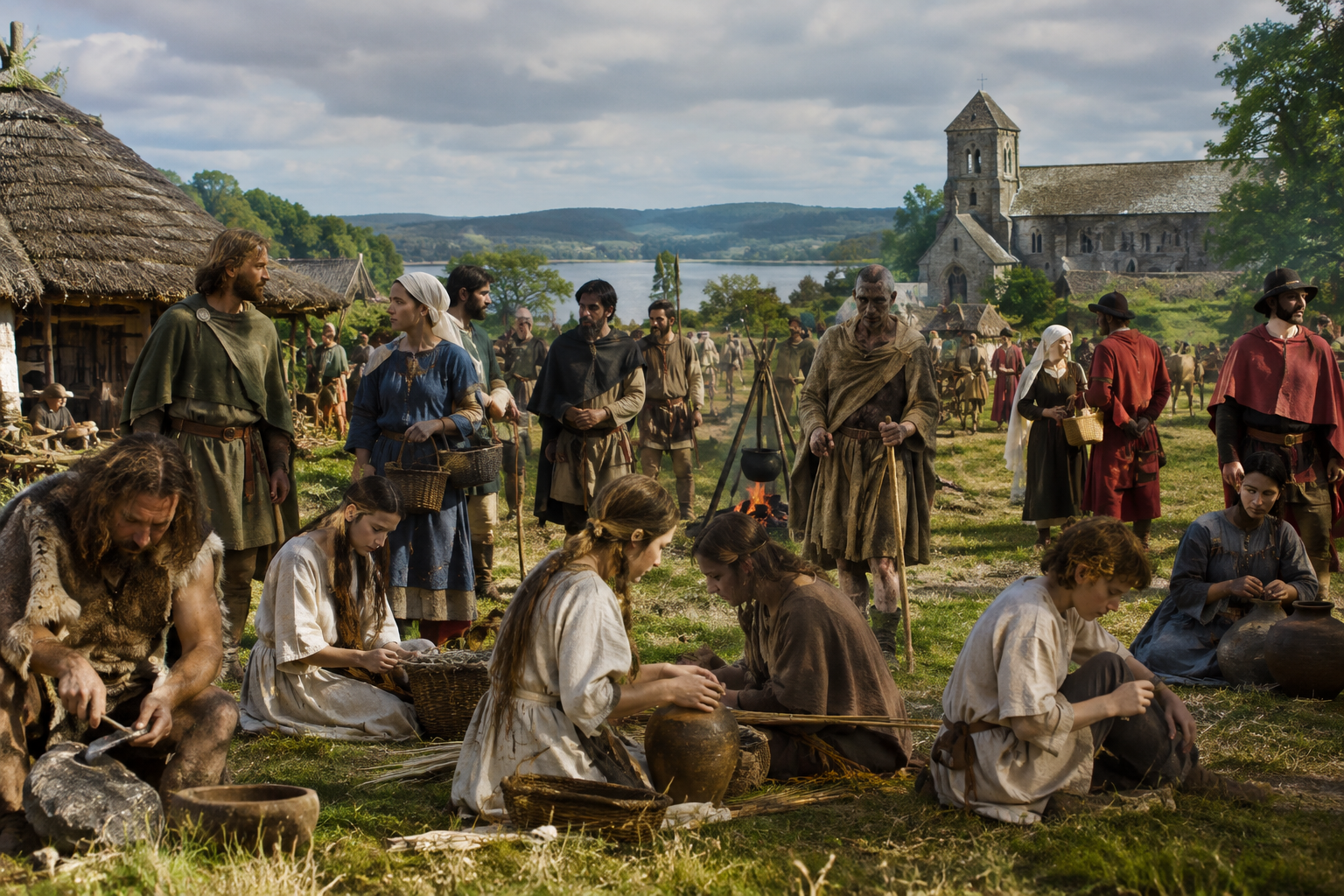
Some Y-DNA haplogroups arrive in the ancient DNA record with a bang: a royal tomb, a famous battle burial, a named dynasty. I2a1a2 is more interesting for almost the opposite reason. It keeps appearing across a very wide stretch of European time and geography: in Mesolithic and Neolithic contexts, in Atlantic-facing communities, in central and eastern Europe, and again in the medieval world. That makes it useful not as a badge of one people, but as a clue to long male-line persistence, movement, and survival.
As always, a small genetic health warning is in order. Y-DNA haplogroups trace only one line of ancestry: the direct paternal line from father to father to father. They do not describe a person's whole ancestry, culture, language, or identity. And with a subclade as specific as I2a1a2, it is especially important not to pour the entire history of broader haplogroup I or I2 straight into it without caution. Still, the ancient samples linked here let us watch one paternal lineage turn up in some very revealing places.
Within the wider Y-chromosome tree, I2a1a2 belongs to haplogroup I, one of the major paternal lineages associated with long-term European prehistory. Broadly speaking, lineages within I2 are often discussed in relation to ancient European hunter-gatherers, later interactions with incoming farmers, and regional continuity in different parts of the continent. But the story is not simple. By the Neolithic and Bronze Age, paternal lines that may once have been more regionally concentrated can turn up in communities shaped by farming, exchange, and migration.
That is exactly what makes I2a1a2 so historically attractive. In the supplied ancient DNA, it is not pinned to a single corner of Europe. It appears in Sweden, the Netherlands, Scotland, France, Iberia, Romania, Bohemia, Ireland, Poland, England, and Sardinia. That spread does not prove one uninterrupted male dynasty across millennia. What it does suggest is that this paternal branch, or closely related ones, remained part of the human landscape from the post-Mesolithic world into medieval society.
Learn How Ancient DNA Reconstructs the Past
One of the earliest and most striking appearances is I0011, from Neolithic Kanaljorden, Motala, Sweden, dated to 5710 BC. Motala is famous because it sits near the meeting point of water, ritual deposition, and early northern European communities. To find I2a1a2 here places this paternal line very early in the Scandinavian record. It is a reminder that such lineages were already embedded in the north long before written history, castles, or kingdoms.
Further southwest, the Dutch wetlands and coastal zones offer another important cluster. SWA002 and SWA004, both from Early Neolithic Netherlands Swifterbant dated to 4105 BC, and I12091 from Nieuwegein-het Klooster dated to 4150 BC, place the haplogroup in one of the most archaeologically interesting transition zones in Europe. Swifterbant communities are often discussed in the context of foragers, fishers, and early farmers meeting and mixing. Add I38448 from Schipluiden Harnaschpolder Grave 6 dated to 3520 BC, and the picture becomes even more suggestive: I2a1a2 was present not just in one fleeting moment, but across centuries in the lower Rhine and North Sea world.
Then there is Scotland, where the record becomes almost teasingly rich. I36006 and I36007 from Tulloch of Assery A dated to 3588 BC and 3506 BC, I36018 from Rattar East dated to 3497 BC, mid002 from Neolithic Scotland Orkney Rousay dated to 3497 BC, mid001 from the same region dated to 3233 BC, and I2637x from the Orkney Islands dated to 3200 BC all point toward repeated appearances in northern Britain. Add I19286 from Neolithic Scotland dated to 3160 BC and I2629 from Bronze Age Isbister, Orkney, Scotland dated to 2850 BC, and one begins to see not an isolated curiosity but a recurring paternal presence in monument-building and later prehistoric communities of the far north.
Explore Neolithic Tomb Kinship in Northern Scotland
France and the western mainland add still more depth. Samples such as ROS78 and ROS45 from Neolithic Rosheim, France dated to 4600 BC, I4303 and I4304 from Clos de Roque, Saint Maximin-la-Sainte-Baume, France dated to 4680 BC, and BERG157-7 from Neolithic Bergheim dated to 4100 BC show the lineage in early farming-era France. Later examples such as ROUQF from Grotte du Rouquet Moujan dated to 3050 BC and I13638 from Late Neolithic Belgium Grotte du Mont Falise dated to 2772 BC suggest that this branch, or closely related paternal lines, remained in circulation through changing cultural horizons.
Iberia is represented too, by por002 from Copper Age Iberia dated to 3100 BC and I10278 from Cova de la Guineu, Spain dated to 2950 BC. Again, this does not make I2a1a2 an "Iberian haplogroup" in any exclusive sense. It simply underlines how difficult it is to fence this lineage into one historical box.
When we move eastward, the story becomes even more interesting. I7137 from Bronze Age Romania Bodrogkeresztur Urziceni dated to 4050 BC and GAS004a and GAS004b from Bronze Age Romania Gambas Wietenberg Culture dated to 1631 BC show I2a1a2 in the Carpathian zone across a very long span. That is useful because the Balkans and Carpathian Basin were major crossroads: places where local continuity, steppe-related ancestry, and cultural turnover all interacted. A paternal line appearing there in both earlier and later prehistoric settings deserves attention.
The Iron Age sample I16092 from Hallstatt Louny, Northwest Bohemia dated to 500 BC pushes the lineage into the early Celtic world of central Europe. One must be careful here: a haplogroup is not a language, and one man in a Hallstatt context is not proof of a "Celtic haplogroup." But it does show that I2a1a2 was still present in a major Iron Age cultural sphere often associated with emerging elites, long-distance exchange, and the societies classical authors would later describe.
Read About Ancient DNA and Celtic Origins
The medieval appearances are perhaps the most evocative because they bring this paternal lineage into a world with names, dynasties, disease, and documentary history. KIL018 from Medieval Ireland Kilteasheen dated to 650 AD places I2a1a2 in early medieval Ireland, while MMW_H117_1 from a Medieval England Leprosy Victim, Winchester St Mary Magdalen dated to 1125 AD offers a very different sort of window: not kingship or glory, but the hard realities of disease, exclusion, and urban religious care in Norman England.
Then there is PCA0316 from the Medieval Piast Dynasty, Plonsk, Masovia dated to 1100 AD. This is the kind of sample that instantly tempts overstatement. Better to resist it. The sample shows that a man associated with the Piast medieval setting carried this paternal line, but that alone does not allow us to rewrite the entire paternal history of every Piast ruler. What it does do is connect I2a1a2 with one of the most important dynastic landscapes of medieval eastern Europe.
Finally, COR002 from Early Medieval Corona Moltana, Sardinia dated to 900 AD reminds us that even island societies were part of the same broad pattern of circulation and local continuity. By now, I2a1a2 looks less like a regional oddity and more like one of those durable European paternal threads that repeatedly surfaces wherever ancient DNA is sampled carefully enough.
Discover the Piast Genetic Story
The supplied noble family and castle field contains no usable family details here, so it would be irresponsible to invent baronial lineages, ancestral seats, or heraldic romances and pin them onto I2a1a2. That absence is actually a useful reminder of how genetics and history work together. Sometimes the ancient DNA is rich and the later genealogy thin; sometimes it is the other way round. The task is not to force a connection where none has been supplied, but to understand the kind of connection that might exist in principle.
If a later noble house emerged in regions like Orkney, Masovia, the lower Rhine, or the Carpathian Basin, that house would have occupied landscapes where paternal lines such as I2a1a2 had appeared long before charters and stone keeps. But geographical overlap is not genealogical proof. Castles preserve family memory; Y-DNA preserves one paternal line; ancient burials preserve a much deeper human background. The excitement lies in seeing those layers together without muddling them.
Explore Medieval Leprosy DNA in Europe
I2a1a2 is historically interesting because it refuses to stay tidy. It appears in early northern ritual contexts, in Neolithic farming and mixed economies, in Atlantic Britain, in Copper and Bronze Age western Europe, in the Carpathian world, in Iron Age Bohemia, and in medieval Ireland, England, Poland, and Sardinia. That pattern is precisely what ancient DNA is so good at uncovering. Written history usually begins late and unevenly. Genetics can show us that some paternal lines were already old, widespread, and socially mobile long before anyone wrote down a pedigree.
For MyTrueAncestry users, that is the real value of a haplogroup like I2a1a2. It may connect your direct paternal line, not to one simple tribal label, but to a much longer European story of continuity, adaptation, and movement. Ancient DNA comparisons cannot prove that you descend from I0011, PCA0316, or MMW_H117_1 in a documented genealogical sense. But they can place your paternal line in a landscape populated by real ancient individuals whose bones, burials, and genomes are changing how we understand the past.
Upload your DNA to MyTrueAncestry to explore whether your results show connections to ancient individuals, archaeological cultures, and historical populations linked to lineages like I2a1a2. It is a powerful way to see your ancestry in deeper time, while remembering that shared ancient DNA signals context and connection, not automatic proof of direct descent from any particular noble family or historical person.
Comments