Haplogroup I2a1a2

– 6 min read


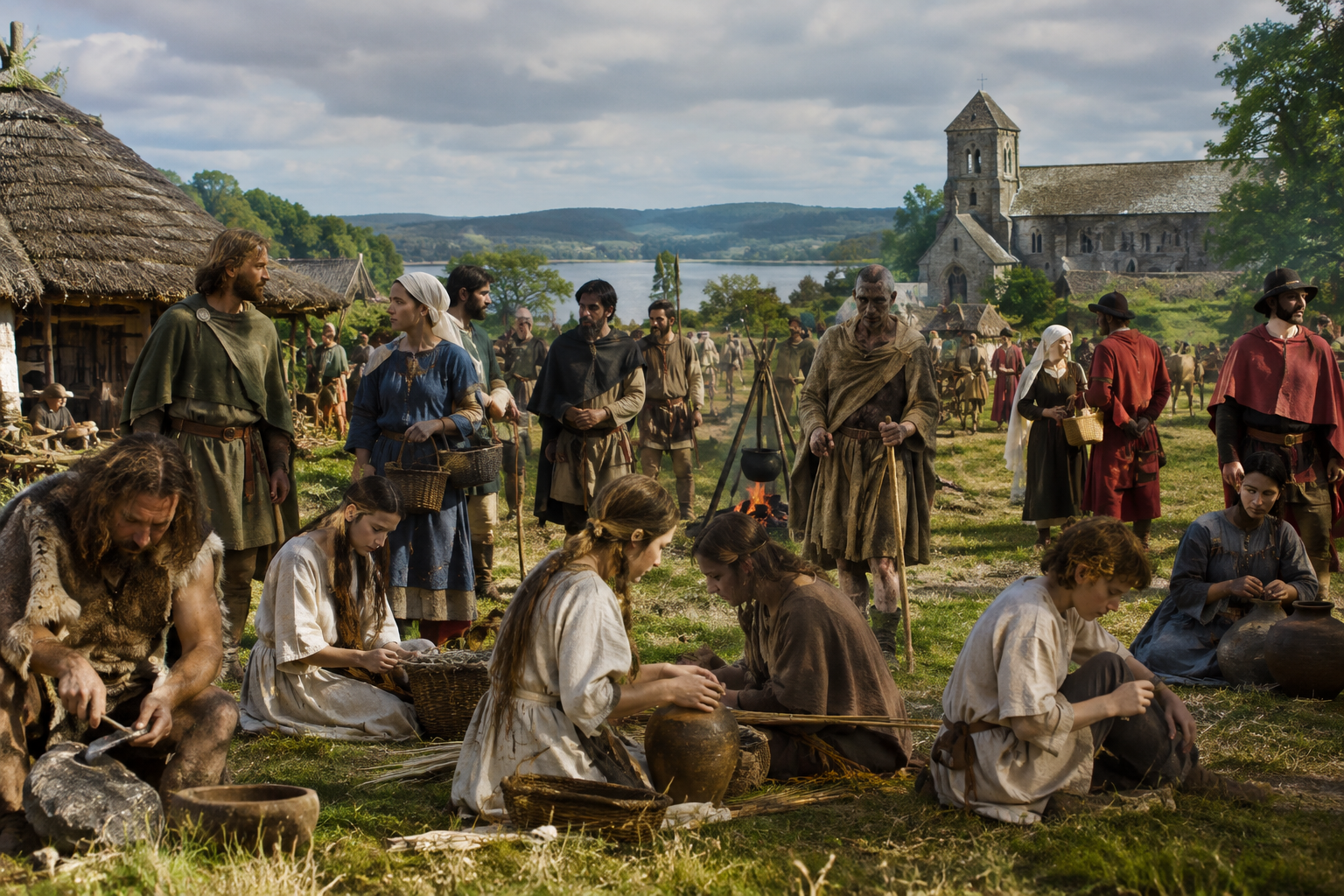
At St Mary Magdalen in Winchester, one excavated burial belongs to a man remembered less for rank than for disease. Sample MMW_H117_1, dated to around AD 1125, came from the medieval leprosarium attached to one of England's best known hospital cemeteries. That single Y-chromosome result, placed here under I2a1a2, is a useful way into the history of this paternal line, because it appears not in one neat "tribal" package, but in a long series of very different archaeological worlds.
That is the first important thing to say about I2a1a2. Y-DNA traces one direct paternal line only, not a whole identity or ethnicity. Yet when this branch turns up in ancient DNA, it does so again and again in places that matter for European prehistory and medieval history: Mesolithic and Neolithic Scandinavia, early farming communities around the North Sea, Neolithic and Bronze Age Britain, France and Iberia, Bronze Age Romania, and a few later medieval burials in England, Ireland, Poland, and Sardinia.
One of the oldest samples in this set is I0011 from Kanaljorden, Motala, Sweden, dated to about 5710 BC. Kanaljorden is famous because it belongs to a Mesolithic ritual context in central Sweden, a place that has become almost emblematic of how complicated northern European hunter-gatherer societies could be. In broad historical terms, a lineage associated here with I2a1a2 sits comfortably inside a much larger pattern in which early branches of haplogroup I were common among European foragers long before the great expansions of farming and later steppe ancestry.
That does not mean every later I2a1a2 man descended directly from this specific Swedish individual in any simple, traceable way. It does mean that the branch belongs to an old European paternal landscape that was already established millennia before written history. Research on the Baltic Sea region has been especially important for showing how strongly some hunter-gatherer lineages persisted in the north even as farming spread into Europe; one useful overview is linked here in an ancient DNA study of the Baltic Sea region.
By the fifth and fourth millennia BC, the same broad paternal branch appears in communities that were no longer Mesolithic foragers. The sample list includes SWA002 and SWA004 from Swifterbant in the Netherlands, both around 4105 BC, and I12091 from Nieuwegein-het Klooster, also linked to the Swifterbant world, around 4150 BC. These are important because the Swifterbant horizon sits in that awkward, fascinating zone between hunting, fishing, herding, and farming in the wetlands of the Low Countries.
In other words, I2a1a2 is not confined to one side of the old textbook divide between "foragers" and "farmers". It appears in exactly the sort of archaeological settings where those categories blur. The same is true farther west and north, with BLR001 from Baltrum in East Frisia around 3685 BC and I38448 from Schipluiden, Harnaschpolder Grave 6 in South Holland around 3520 BC. These finds suggest that some paternal lines rooted deep in European prehistory continued into coastal farming communities rather than being wholly replaced.
This is one reason I2a1a2 can be so interesting for family historians. It has the feel of continuity in regions where ancient populations were mixing, adapting, and changing lifeways rather than simply vanishing.
Mesolithic-Neolithic transition
The Scottish material is especially striking. Samples I36006 and I36007 from Tulloch of Assery A in Scotland date to about 3588 BC and 3506 BC. I36018 from Rattar East dates to about 3497 BC. Then there are the Orcadian examples: I2637x from the Orkney Islands around 3200 BC, mid001 from Rousay around 3233 BC, mid002 from the same island around 3497 BC, and I2629 from Isbister, Orkney around 2850 BC. Another Scottish Neolithic sample, I19286, is dated to roughly 3160 BC.
These are not all one family, and the presence of the same haplogroup label across several Scottish sites does not by itself prove a single local dynasty. But taken together, they do show that this paternal branch was established in northern Britain during the age of chambered tombs and early farming communities. Archaeology in northern Scotland has increasingly emphasized that tombs were not merely storage spaces for the dead; they were places where descent, land, and community memory were made visible. A recent archaeological discussion of those monuments can be found in this study of tomb-building and descent in Neolithic northern Scotland.
For I2a1a2, the Scottish evidence matters because it anchors the lineage in one of Europe's most intensively studied megalithic landscapes. Not as a romantic "clan marker" from time immemorial, but as a real paternal thread present among the builders and users of those early monument traditions.
The western European pattern is broad rather than isolated. In France, I2a1a2-associated samples include I4303 and I4304 from Clos de Roque, Saint-Maximin-la-Sainte-Baume around 4680 BC, ROS78 and ROS45 from Rosheim around 4600 BC, BERG157-7 from Bergheim around 4100 BC, Es97-1 from Escalles around 4050 BC, and later Neolithic individuals such as OBN004, OBN005, OBN011, and PEN003 around 3500 BC, plus ROUQF from Grotte du Rouquet Moujan around 3050 BC.
In Iberia, the picture includes por002 from Copper Age Iberia around 3100 BC and I10278 from Cova de la Guineu in Spain around 2950 BC. What this shows is not a tidy migration arrow, but a durable presence across western Neolithic and Copper Age communities. By the third millennium BC, men assigned to this branch or its close neighborhood were living in farming societies from southern France to Iberia and the Atlantic-facing north.
That spread fits a wider ancient DNA picture in which old European male lines survived unevenly through the Neolithic, sometimes in coastal zones and sometimes inside communities that had long adopted farming. It is a pattern of persistence, not stasis.
The lineage also appears east of the Alpine and North Sea zone. I7137 from Bodrogkeresztur, Urziceni in Romania is dated to around 4050 BC, while GAS004a and GAS004b from Gambas in Romania, associated with the Wietenberg Culture, are dated to about 1631 BC. That is a big chronological jump, and one should not smooth it over: these are very different societies. Still, the recurrence is useful because it shows the branch was not merely a far western or northern phenomenon.
Another later example is I16092 from Louny in northwest Bohemia, around 500 BC, placed in an Iron Age Hallstatt context. The Swiss samples MX188, MX190, MX191, and MX192 from Spreitenbach, dated between roughly 2660 BC and 2200 BC, add yet another setting in temperate Europe. Labels in older datasets can be untidy, and culture names do not automatically tell us language or identity. But they do underline a sensible conclusion: I2a1a2 participated in many local histories across prehistoric Europe, rather than belonging to a single short-lived expansion.
The medieval samples are fewer, but very evocative. Besides the Winchester leprosy burial MMW_H117_1, there is KIL018 from Kilteasheen, Ireland around AD 650, PCA0316 from Plonsk in Masovia around AD 1100 and associated with the medieval Piast Dynasty, and COR002 from Corona Moltana, Sardinia around AD 900.
These later appearances are worth handling carefully. A Y-line in a Piast-associated burial does not make the whole dynasty "an I2a1a2 dynasty", and a hospital burial in Winchester does not tell us where that man's paternal ancestors had lived a thousand years earlier. What it does show is that this branch endured into the documentary Middle Ages in very different corners of Europe: insular Atlantic, Slavic Poland, Mediterranean Sardinia, and southern England.
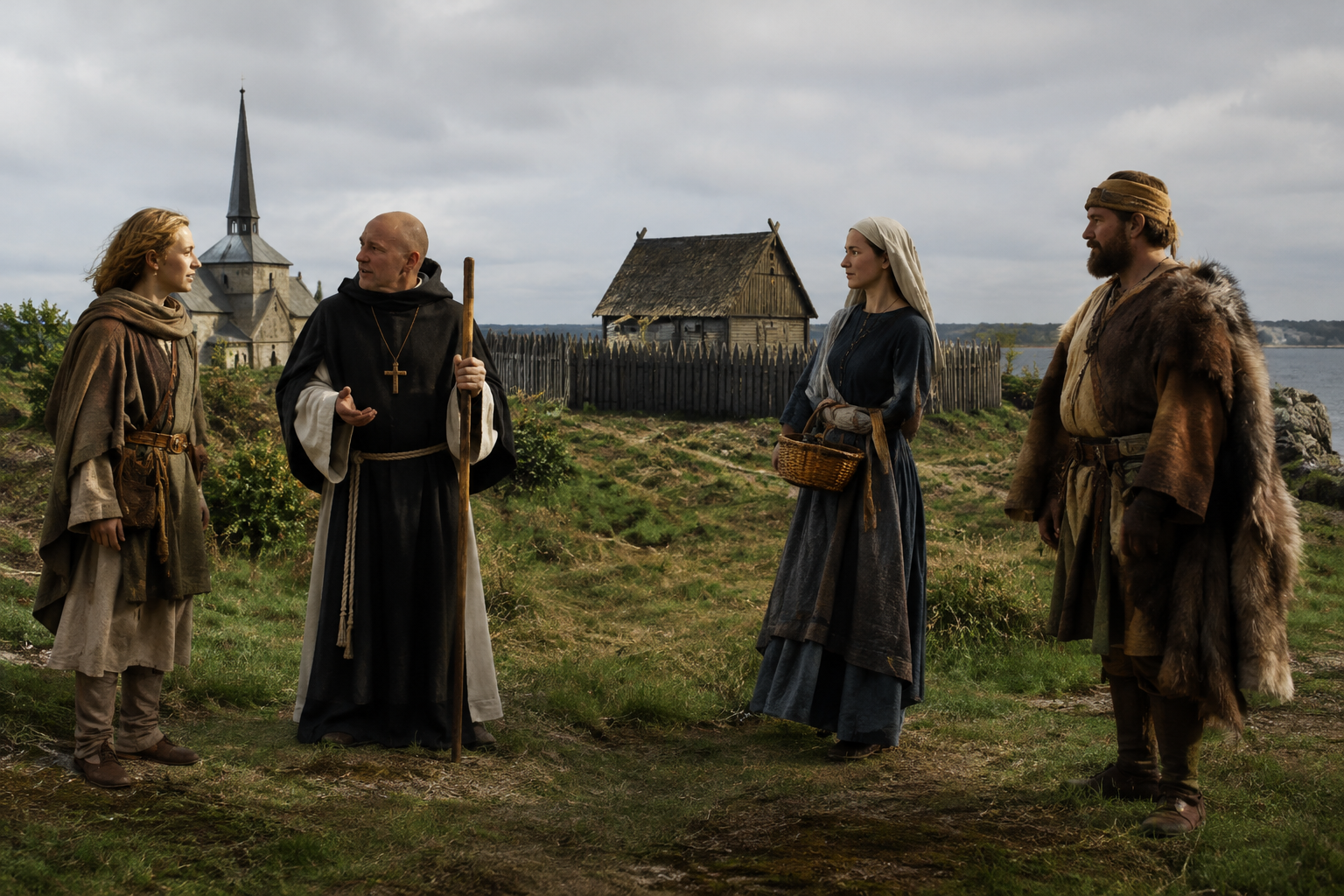
Winchester is perhaps the most humanly immediate of these cases. Medieval leprosaria were not merely places of exclusion; they were religious and social institutions with their own cemeteries and communities. In that setting, I2a1a2 is not an abstract marker on a phylogenetic tree. It belonged to a real man living in twelfth-century England, one of the many individuals whose DNA now lets us connect the intimate scale of a burial to the long scale of European population history.
If your paternal line falls under I2a1a2, the strongest message from these ancient samples is not a single homeland story but a deep and varied European one. This branch appears in hunter-gatherer Scandinavia, in early farming communities around the North Sea, in Neolithic tomb landscapes of Scotland, in western European farming societies, and in later medieval burials from England to Poland. That combination makes I2a1a2 a lineage of persistence: old in Europe, repeatedly absorbed into new cultures, and still visible whenever archaeology and ancient DNA manage to catch it in the act.
Comments