Haplogroup I2a1a1b1b~

– 5 min read


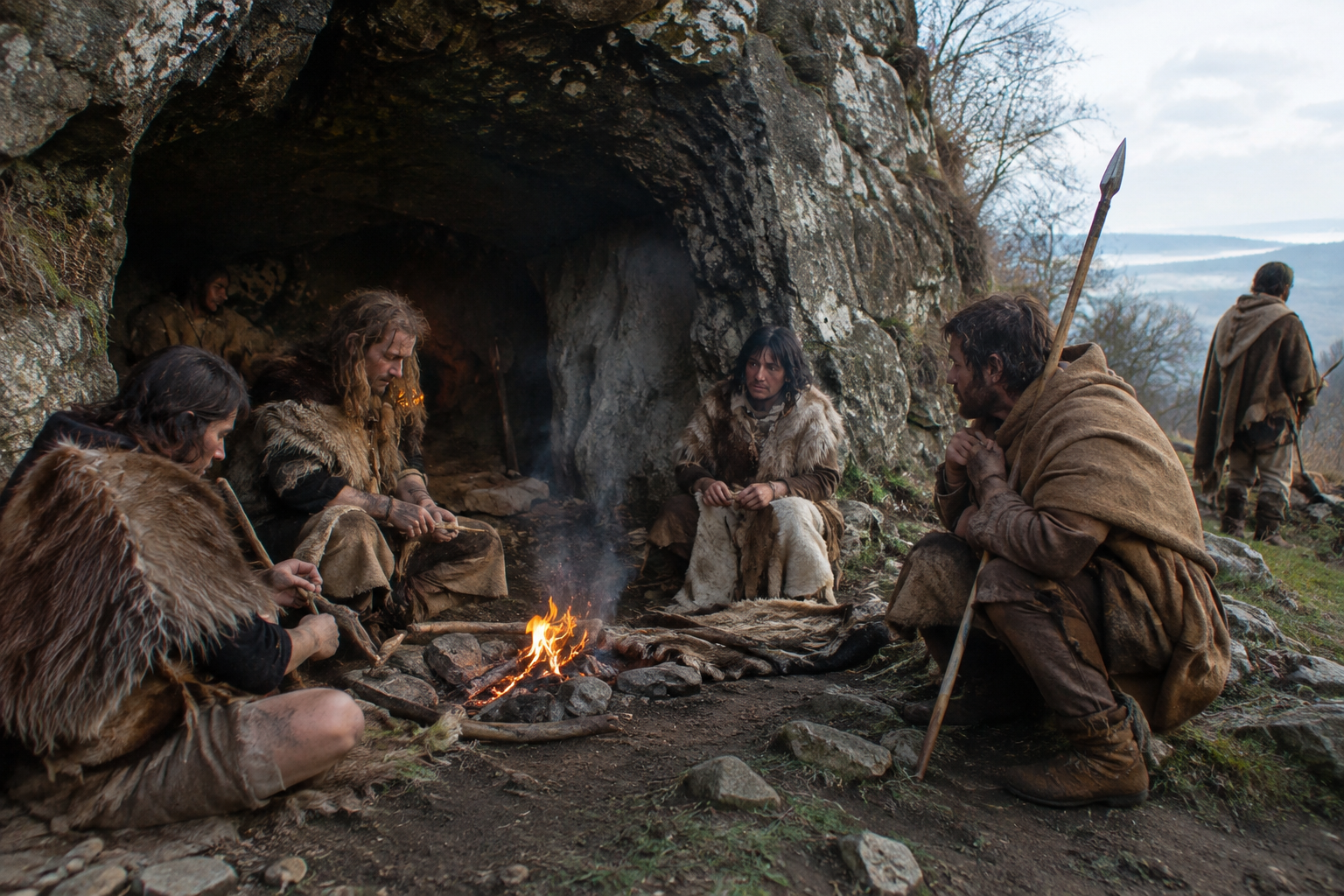
At Blatterhohle Cave in western Germany, one of the more intriguing Neolithic male lineages turns up in a very concrete form: sample I1565, dated to around 3724 BC. He is associated here with Y-DNA haplogroup I2a1a1b1b~, a branch within the broader I2 family that is often tied, at a high level, to long-established European paternal lines. What makes this case interesting is not some grandiose claim about a "people," but the setting itself: a cave site that has become important for understanding how foragers and farmers overlapped, mingled, and persisted in Neolithic Central Europe.
A second appearance comes much later, with sample I7197 from Prague-Jinonice in the present-day Czech Republic, dated to about 1950 BC. That gap of nearly two millennia matters. It suggests that whatever the deeper story of I2a1a1b1b~ may be, this was not simply a lineage frozen inside one Neolithic community. Instead, the evidence hints at a paternal line present in very different archaeological worlds: first in a Neolithic cave context in Germany, then in a Bronze Age community in Bohemia.
Blatterhohle is one of those sites that keeps appearing in discussions of Neolithic Europe because it complicates tidy textbook narratives. The usual shorthand says that farming spread, hunter-gatherers faded, and the story moved on. But sites like this have long suggested that the reality was messier. Human groups with different subsistence traditions could occupy the same broad region, and their biological histories did not always line up neatly with archaeological labels.
That makes I1565 especially useful for thinking about haplogroup I2a1a1b1b~. In broad terms, many I2 lineages are well known in European prehistoric contexts, especially among hunter-gatherer-associated males. But one has to be careful here: the article haplogroup is a narrow branch, and the presence of this sample does not mean every I2 lineage in Neolithic Europe belonged to I2a1a1b1b~, nor that this branch can be assigned a single simple cultural identity. What it does offer is a firm point on the map for this paternal line in later Neolithic western Germany.
Blatterhohle also belongs to a wider conversation about persistence and admixture in northern and central Europe during the Neolithic. For readers who want more on that larger transition, this related piece is useful:
Mesolithic-Neolithic Transition
An ancient DNA study that helped make this broader region so important is research on ancient genomes from the North European plain and surrounding areas. It is relevant not because it proves every detail of this exact branch, but because it established just how dynamic the interaction between incoming farmers and older local populations could be. That is precisely the sort of setting in which a lineage like I2a1a1b1b~ becomes historically interesting.
Y-DNA follows one direct paternal line only: father to son to son across generations. So haplogroup I2a1a1b1b~ is not a label for a whole population, language, or ethnicity. It is better understood as one thread running through much larger communities whose total ancestry was always more complex.
The tilde in the label matters too. It signals that we should be cautious about pretending to have a perfectly final terminal placement in every case. In ancient DNA work, especially with older or low-coverage material, a sample may be associated with a branch without resolving every downstream mutation. That means the safest historical reading is modest: this article concerns a paternal line reported in connection with I2a1a1b1b~, not a mythical clan whose movements can be mapped with absolute certainty.
The later sample, I7197, comes from Prague-Jinonice in the Czech lands and is dated to roughly 1950 BC, placing him in the Bronze Age. This is already a very different world from Neolithic Blatterhohle. By the early Bronze Age, Central Europe had seen major cultural and demographic change, including the long aftermath of the Steppe expansions, shifting burial customs, and the growth of more regionally distinct social landscapes.
That is why I7197 matters so much in a short sample list. He shows that a paternal line associated here with I2a1a1b1b~ did not vanish with the end of the Neolithic. It remained present in Central Europe into a period when many male lines were being reshuffled, expanded, or locally replaced. A single individual cannot stand for all Bronze Age Bohemia, of course, but he does show continuity of this lineage family across a long stretch of time.
Research on central European ancient populations continues to sharpen this picture. A more recent preprint on ancient genomic patterns in the region is relevant to the wider Bronze Age and post-Neolithic context in which such lineages are being re-evaluated, even where individual haplogroup assignments still require caution.
For a wider look at how Bronze Age and later Central European populations can show both continuity and change, this related article sits close to the same historical problem:
If we put these two samples side by side, a pattern begins to emerge. Both are from Central Europe, but from very different moments: one from a Neolithic cave context in Germany, the other from a Bronze Age setting near Prague. That does not prove a straight-line descent from one excavated man to the other, still less a single continuous tribe. But it does suggest that this branch, or a very near paternal cluster around it, had a durable place in the region's human landscape.
This fits a larger archaeological truth about Central Europe. It was never a sealed container. Communities there absorbed influences from the west, the north, the Danube corridor, and the steppe-facing east. In that sort of setting, some paternal lines disappeared, others surged, and some quietly persisted across cultural turnovers. I2a1a1b1b~ may belong to that last category in the present evidence: not dominant in the record we have here, but enduring.
Readers interested in how ancient genomics has been used to connect language history and population movement in northern and central Europe may also want this piece:
One tempting mistake would be to call I2a1a1b1b~ a purely "hunter-gatherer" lineage and leave it there. The Blatterhohle sample certainly makes that temptation understandable, because the broader I2 family has deep roots in European prehistory. But the Prague-Jinonice evidence shows why that shortcut is too simple. By the Bronze Age, any surviving paternal branch was living inside societies already transformed by centuries of mixture, mobility, and cultural change.
So the most responsible reading is not that this haplogroup belonged to one fixed way of life, but that it was carried through several different ones. In one era it appears in a Neolithic setting famous for the complex relationship between farmers and foragers; in another it appears in a Bronze Age community in Bohemia. That is a much more interesting historical result than any fantasy of ethnic purity.
For another angle on how prehistoric populations in the broader Rhine-Meuse and neighboring zones changed through time while retaining older ancestry in places, this article is particularly relevant:
On present evidence, haplogroup I2a1a1b1b~ points toward a paternal line with documented ancient appearances in Central Europe from the later Neolithic into the Bronze Age. The striking thing is not royal glamour or a sweeping migration legend, but durability: this branch shows up in settings separated by time, culture, and archaeological context. For someone exploring their paternal ancestry, that suggests a line which may connect to some of the older layers of European male ancestry while also having passed through the great social rearrangements of prehistoric Central Europe.

Comments