Haplogroup I2a1a1a1a1a
– 5 min read


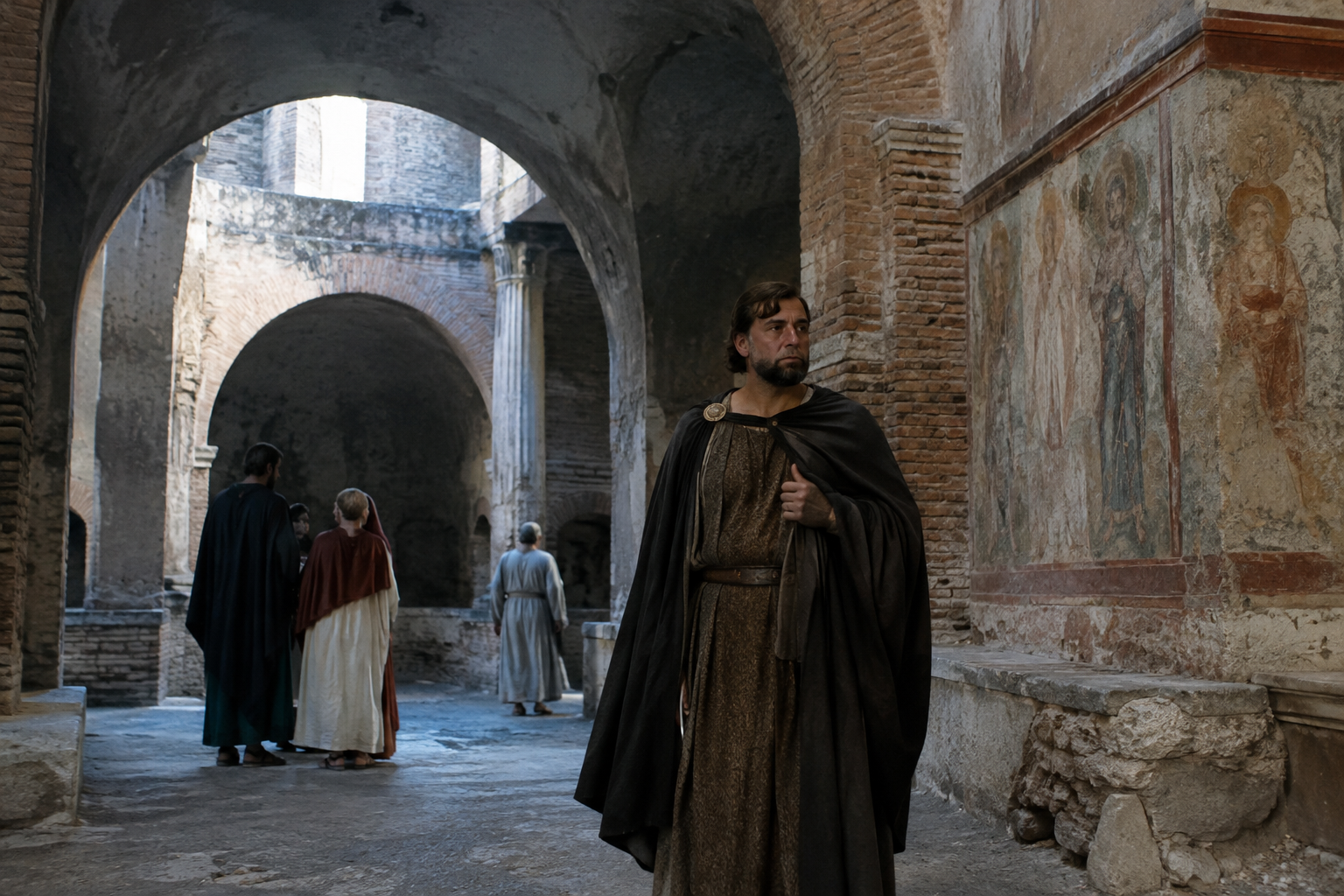
One of the more intriguing traces of haplogroup I2a1a1a1a1a turns up in late antique Rome itself: sample R104, a man dated to around AD 500 from Crypta Balbi. That date matters. This was not the high noon of the empire, with its marble certainties and swaggering inscriptions, but a city living through political fracture, new rulers, shifting populations, and the long afterlife of Roman institutions.
That makes R104 interesting for a simple reason. A Y-DNA lineage found in Rome at this moment is not merely a marker on a family tree; it is part of the evidence for who was actually living in the city as the western Roman world became something else. In this case, the reported paternal line is associated with I2a1a1a1a1a, a very specific branch within the wider I2 family. Y-DNA traces one direct paternal line only, not the total ancestry or identity of a person, but even that single line can be revealing when placed in the right archaeological setting.
Crypta Balbi is one of those wonderfully Roman sites where the layers do the talking. Built over and around an ancient urban complex in central Rome, it preserves the city not as a museum piece but as a working organism that kept changing after imperial power weakened in the West. By around AD 500, Rome was still enormously important, but it was no longer the old imperial capital in the classical sense. It had become a place where continuity and disruption sat side by side.
Sample R104 belongs to that world. The label "Late Roman Outlier" is itself suggestive. It points to an individual whose genetic profile stood out from surrounding comparisons, reminding us that late antique Rome was not a sealed population. People arrived there through military service, trade, administration, church networks, and the broad human movement that accompanied the end of Roman rule in the West.
A major ancient DNA study on the city of Rome and its changing population across time can be found here: https://science.sciencemag.org/content/366/6466/708. Even without forcing R104 into too neat a story, the larger lesson is plain enough: Rome in late antiquity was genetically mixed, historically complicated, and still plugged into a much wider world.
The haplogroup name looks forbidding, but the important thing is the scale. I2a1a1a1a1a is a narrow twig on a much older European paternal tree. The wider I haplogroups are deeply rooted in Europe, with I2 branches appearing in a range of prehistoric and later European contexts. But one must be careful here: the ancient depth of I2 as a whole does not automatically tell us the exact history of this particular sub-branch.
That distinction matters especially in a city like Rome. Finding a man carrying a branch of I2 in around AD 500 does not let us declare him "native Roman," "barbarian," "Gothic," "Balkan," or anything similarly tidy on the basis of Y-DNA alone. It tells us that one paternal line, ultimately part of an old European family of lineages, was present in a late antique urban population that was already the product of centuries of migration and mixture.
And that, in its way, is more interesting than a simplistic label. History is full of people who refuse to sit obediently inside our categories. R104 appears in a Rome that had known centuries of movement from across Italy, the Mediterranean, and beyond. His lineage belongs to that untidy human reality.
When the evidence is sparse, the temptation is to overstate it. Better to do the opposite and ask what one securely placed sample can genuinely add. In this case, R104 helps anchor I2a1a1a1a1a in a documented archaeological context: urban Rome in the generations after the collapse of western imperial rule.
That is useful because late antique cities are often discussed in terms of texts and politics rather than actual bodies. Emperors vanish, bishops rise, armies march, kingdoms appear in the written record. Yet the DNA asks a blunter question: who was buried there? A man from Crypta Balbi gives us one hard point of contact between the grand historical narrative and the lived population of the city.
There is also a wider implication. Late antique Italy was not genetically frozen after the Roman Empire. Several MyTrueAncestry features have explored how populations in Roman and early medieval Italy changed from place to place, sometimes preserving continuity and sometimes showing fresh inputs. That broader backdrop helps make sense of why an "outlier" at Rome is historically meaningful rather than anomalous in some dramatic sense.
By AD 500, Italy had already lived through civil wars, imperial division, military recruitment from many regions, and the establishment of post-Roman political power. Rome itself remained symbolically immense, but socially it was a city of survivors, newcomers, clerics, artisans, administrators, laborers, and families with very different backgrounds. Ancient DNA keeps underlining this point across the former empire: political labels rarely map neatly onto biological ancestry.
That is why the word "outlier" deserves a little attention. In genetics it often means a person is somewhat distinct relative to surrounding sampled groups, not that he was a historical oddity in everyday life. Cities are full of such people. In fact, great cities depend on them. Late Roman and early medieval urban centers gathered human diversity in a way that countryside samples sometimes do not.
Seen in that light, R104 fits a broader Mediterranean pattern. The Roman world moved people constantly, and the post-Roman world did not suddenly stop. If anything, the fifth and sixth centuries brought new kinds of mobility layered onto old Roman routes. A paternal lineage like I2a1a1a1a1a appearing in Rome at this date belongs to that mobile, entangled world.
Although this article rests on one ancient individual, the wider historical frame is not hard to see. Haplogroups within the broader I2 family recur in many parts of Europe across long spans of time. That does not allow us to write a direct, uninterrupted biography of I2a1a1a1a1a from prehistory to late antiquity, but it does place the lineage inside an unmistakably European paternal landscape.
What makes the Roman evidence distinctive is not antiquity alone, but setting. A lineage found in a village cemetery tells one kind of story; the same kind of lineage found in a dense urban site at the hinge of antiquity and the early Middle Ages tells another. Rome around AD 500 was still a magnet, still a prize, still a memory-machine for empire. Anyone buried there was part of a city that remained globally connected by the standards of its time.
For readers interested in how ancient genomics is reshaping our understanding of migration and language in early medieval Europe, this related piece offers a broader comparative frame.
Germanic Languages and Genomics
The most useful thing we can say about haplogroup I2a1a1a1a1a here is also the most concrete: it is represented by a man, R104, living in or connected to Rome around AD 500, at a time when the city was being remade by the end of empire and the persistence of urban life. That does not turn the haplogroup into a badge of any single people. What it does show is that this paternal branch belonged to the mixed human landscape of late antique Europe, and specifically to one of its most historically charged cities.
For someone researching this paternal line today, that is a respectable and rather compelling clue. Your Y-DNA does not tell the whole story of your ancestry, but in this case it does point toward a branch that appears in the archaeological record of a real man buried in post-imperial Rome, where history was changing fast and people kept moving anyway.
Comments