Haplogroup I2a

– 5 min read


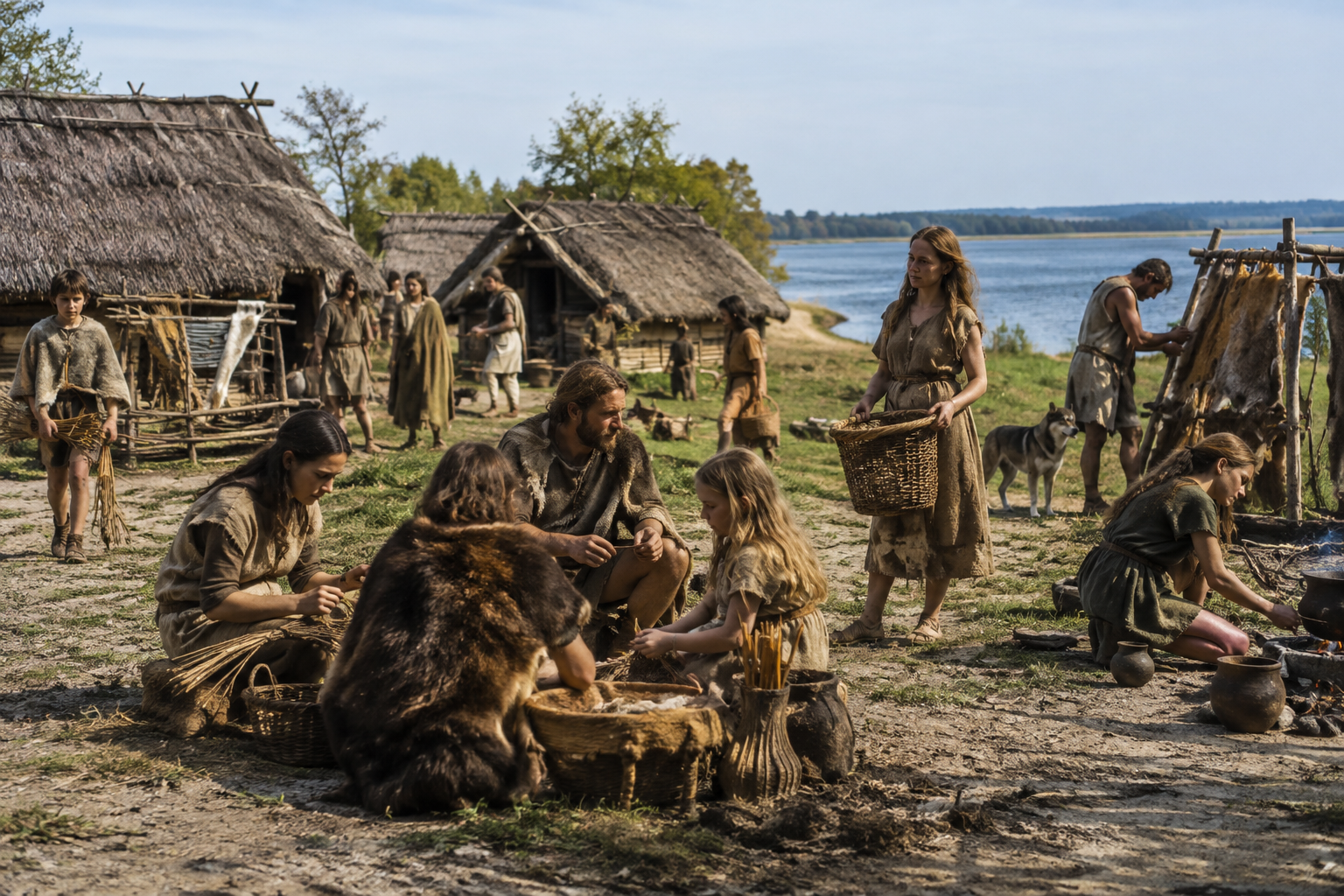
At Vasilevka in Ukraine, one of the oldest men in this set of evidence, sample NEO492, is dated to about 8705 BC. That is an arresting place to begin, because it shows haplogroup I2a attached not to a late historical dynasty or a neatly documented kingdom, but to the deep world of post-Ice Age foragers living along the rivers and open landscapes of eastern Europe. In other words, this is a paternal line that appears in the record long before castles, nations, or even farming villages had taken hold across most of the continent.
That early appearance matters. Y-DNA traces one direct paternal line only, not a person's whole ancestry, but it can still be extraordinarily revealing when the same lineage turns up again and again in ancient burials. In the case of I2a, the pattern in these samples is striking: eastern European hunter-gatherers, Baltic and Scandinavian foragers, then later Neolithic and Bronze Age communities from Germany to Denmark, Britain, Iberia, and even Sardinia. The story is not of a single people marching across a map. It is the survival and reshaping of an old European male line across huge cultural change.
The Ukrainian and adjacent Russian material is the backbone of this article. Alongside Vasilevka's very early NEO492, there are later samples from Lysa Gora (NEO265, NEO270, around 3585 BC), Volnensky Dnieper (NEO302, NEO304, NEO305, around 4728 BC), Vovnigi I and Vovnigi II (NEO552, NEO502, NEO524, NEO528), and Voloshskoe (NEO522). Taken together, they show I2a recurring across the North Pontic and Dnieper region over millennia.
This is important because the North Pontic zone was not some isolated backwater. It was one of the great contact regions of prehistoric Europe, linking forest, steppe, and river routes. A genetic study of this wider region, published in Nature, has emphasized just how dynamic these populations were between the sixth and third millennia BC. The I2a results fit that broader picture rather well: old forager-associated paternal lines remained present even as communities shifted, mixed, and adopted new ways of life.
It is tempting to turn a lineage like I2a into a shorthand for "the original Europeans", but archaeology is always less tidy than that. These burials belong to different sites and probably to different local communities over a very long timespan. What they show, more soberly and more interestingly, is continuity of one paternal branch within a landscape that was repeatedly being reorganized by ecology, exchange, and later by the spread of farming.
If Ukraine gives us depth, the Russian forest zone gives us density. At Sakhtish II, several individuals reported here as I2a-associated, NEO178, NEO188, NEO195, and NEO197, are dated to about 3318 BC. Nearby in this broader eastern European sphere are NEO175 from Ksizovo around 3300 BC and the older NEO204 and NEO212 from Golubaya Krinitsa, around 5278 BC.
What makes this cluster so useful is repetition. One sample can always be an outlier. Several related site finds across the forest and forest-steppe belt suggest that I2a was not a stray survival but part of the ordinary paternal landscape in some hunter-gatherer and post-hunter-gatherer groups of northeastern Europe. That does not mean every man there belonged to I2a, nor that all such men were close kin. It means this branch was durable.
The Sakhtysh material is especially evocative because it belongs to a world often overshadowed by the later, louder story of steppe expansions. Yet before and during those transformations, communities in the forest zone had their own deep histories. MyTrueAncestry readers who want a closer look at that context may enjoy the site-focused piece below.
Nowhere in this sample set is the persistence of I2a through major cultural change clearer than in Scandinavia, especially Denmark. The lineage appears in very early individuals such as NEO254 from Koelbjerg, Odense around 8515 BC, NEO91 from Groftemark, Sjælland around 7184 BC, NEO19 from Rønsten around 6222 BC, and NEO587 and NEO589 from Mesolithic Sjælland. It continues into later Neolithic contexts at Bygholm Norremark (NEO564), Døjringe Bog (NEO566), Pandebjerg (NEO595), Tysmose (NEO790), and other Danish sites.
This is exactly the sort of pattern that has made Denmark central to debates about how farming spread into northern Europe. An ancient DNA study examining Denmark's Mesolithic-Neolithic transition, available at Nature, has helped underline that the shift to farming was not simply a matter of ideas drifting northward. It involved real population change, but also local complexity, survivals, and mixtures. I2a sits right inside that debate because it is so often associated with pre-farming or forager-derived paternal backgrounds, yet it does not disappear the moment agriculture arrives.
Southern Sweden tells a similar story. The very early NEO18 from Hanaskede around 7925 BC and NEO27 from Hindby Mosse around 7743 BC point to Mesolithic depth, while later NEO39 from the same general site area, around 3124 BC, shows that this paternal branch remained part of the human landscape long after new economies and identities had taken shape.
One should be careful here. I2a is the article haplogroup, but not every ancient report resolves to the same fine sub-branch, and the cultural labels around these individuals changed dramatically over time. Even so, the larger point holds: in southern Scandinavia, I2a is part of the long continuity between forager Europe and the later societies that absorbed, replaced, or reworked those populations.
By the fourth and third millennia BC, I2a is no longer confined to obvious forager settings. Sample LEU028 from Leubingen, Germany, around 3500 BC, places the lineage in Neolithic central Europe. In Britain and the North Atlantic, it appears in the Banks Chambered Tomb, Orkney with NEO625, NEO626, NEO627, and NEO717, and in Hetty Pegler's Tump with NEO847. These are not minor locations in archaeological memory. They belong to the megalithic and tomb-building worlds of Atlantic Europe.
That does not prove a single Atlantic "I2a people". What it does show is that this paternal line moved successfully into communities whose architecture, burial monuments, and social lives looked utterly different from the earlier riverine forager cemeteries of Ukraine. Old male lines could be carried forward into very new social settings.
Iberia adds another useful dimension. NEO632 and NEO631 from Gruta do Caldeirão in Portugal, around 5397 BC and 5185 BC, and NEO648 from El Toral III in northern Spain, around 4570 BC, show I2a in the western Neolithic as well. Later Iberian and Mediterranean survivals, including NEO609 from Bronze Age Portugal and R11828 from Late Bronze Age Sant Imbenia, Sardinia, suggest that the branch remained part of the paternal patchwork rather than vanishing after the earliest farmer phases.
The ancient record here makes one thing very plain. I2a is one of the old surviving paternal threads of Europe, visible first among Mesolithic and early Neolithic men from eastern Europe and Scandinavia, and later carried into farming, megalithic, and Bronze Age societies across a broad expanse of the continent. That breadth is precisely why it is historically interesting: not because it points to one tribe or one ethnicity, but because it endured while Europe itself kept changing.
For someone researching an I2a paternal line today, the responsible takeaway is depth, not a single label. Your direct male line may connect to one of Europe's long-lived indigenous branches, especially those that persisted through the meeting of foragers and farmers. The ancient samples do not give a ready-made family tree, but they do place I2a firmly inside some of the oldest documented male histories in Europe.
Comments