Haplogroup I1a3b2

– 5 min read


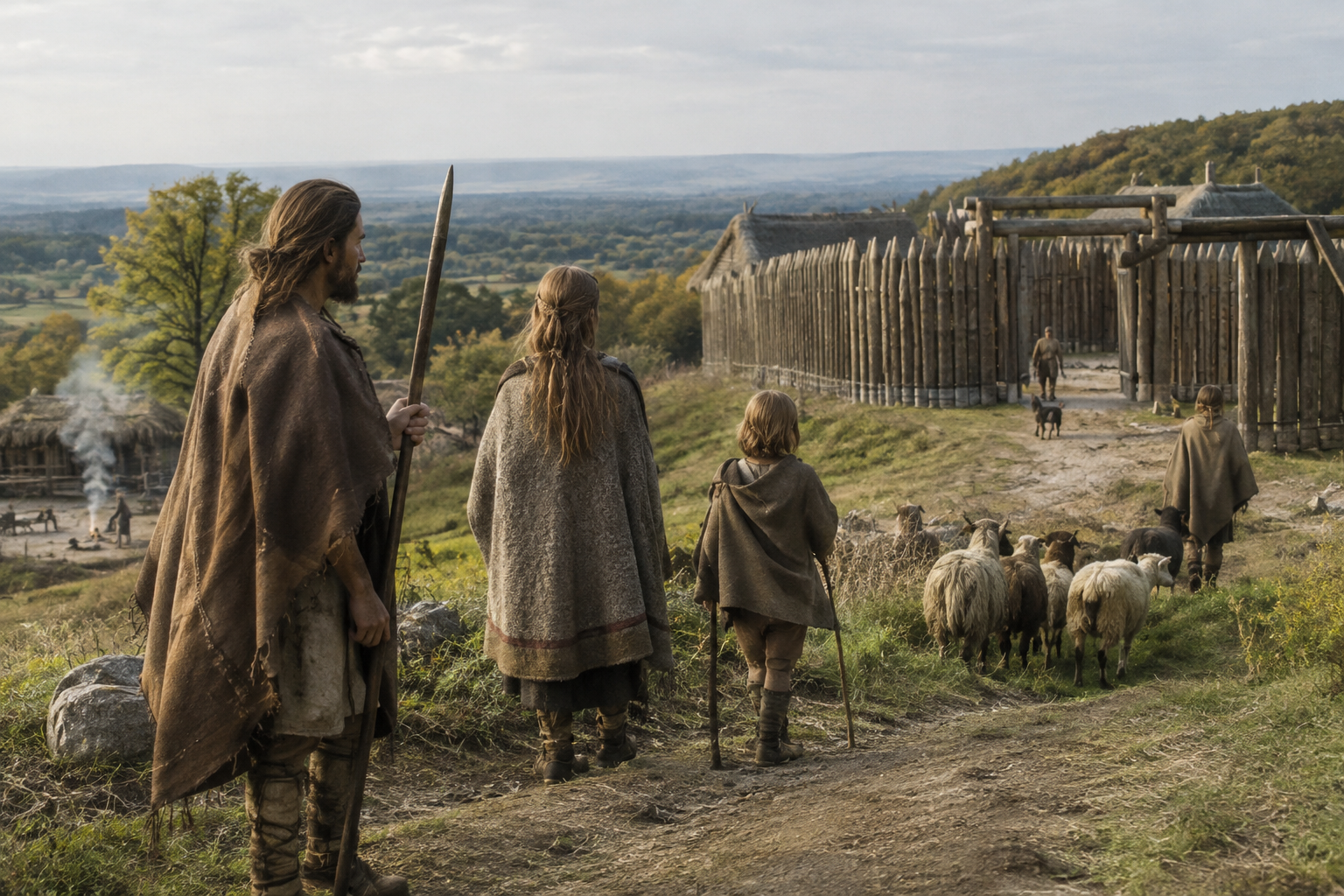
At Kuckenburg hillfort in Saxony-Anhalt, one Late Bronze Age man has become unexpectedly important for anyone interested in Y-DNA haplogroup I1a3b2. He is known in the record as KUC023, dated to around 800 BC, and he comes from a fortified settlement world that belonged to the closing centuries of the Bronze Age in central Europe. That matters because a single ancient Y-chromosome result, when it is securely placed in time and place, can pin a living paternal lineage to a real historical landscape rather than to a vague map of modern frequencies.
In this case, the landscape is not Viking Age Scandinavia, not medieval saga country, but inland Germany in the era of hillforts, metalworking networks, and regional power centers. Haplogroup I1 is a well-known northern European paternal lineage, but I1a3b2 is a much narrower branch, and it should not simply be treated as interchangeable with the whole of I1. What KUC023 gives us is a concrete sign that men associated with this branch, or with a very close paternal line leading into it, were present in Late Bronze Age central Europe.
Kuckenburg is one of those places that reminds us how misleading the word "prehistoric" can be. It sounds primitive; in reality, these were complex communities with defenses, long-distance contacts, and social organization substantial enough to leave behind major fortified sites. By around 800 BC, the region that is now Saxony-Anhalt stood within a lively central European zone shaped by exchange, mobility, and local continuity.
KUC023 belongs to that setting. We are not entitled to invent his rank, his occupation, or the contents of his grave if those details are not securely provided. But the context itself is valuable: this was a man from a defended Late Bronze Age community in Germany, not an isolated wanderer pulled from a historical vacuum.
That point fits well with broader research on central European populations in this period. A MyTrueAncestry article on Late Bronze Age Central Europe explores exactly this larger pattern: populations could show cultural change without implying total demographic replacement.
Late Bronze Age Central Europe
Y-DNA tracks one line only: father to son, to son, to son. It is therefore unusually good at telling us about a specific paternal inheritance, but it is not a shorthand for someone's whole ancestry, language, or identity. KUC023 may carry a lineage associated here with I1a3b2, yet that does not mean every man around him shared it, nor that this subclade by itself defines a people.
Still, there is a reason I1 attracts attention. In broad terms, I1 has long been associated with northern Europe and especially with later Germanic-speaking regions. That is the broad frame only. A narrow label such as I1a3b2 has to be handled much more carefully, because the history of a specific twig on the tree can be more local, more recent, or simply less well resolved than the parent branch.
So the safest reading is also the most interesting one: by the Late Bronze Age, a paternal line connected to this branch was already present in central Europe, in a fortified settlement zone well before the Roman period and long before medieval genealogies begin to speak.
One of the awkward habits of popular history is to take much later names - Saxons, Goths, Franks, Swabians - and throw them backwards across the Bronze Age as if the labels were permanent. KUC023 is a useful antidote to that. Around 800 BC, we are dealing with communities that archaeologists can place in time and material culture, but not with securely named historical tribes from written sources.
That distinction matters for genetics. If a branch later appears among populations speaking Germanic languages, that does not let us stamp every earlier carrier as "Germanic" in the linguistic or ethnic sense. What we can say is that central Europe already contained paternal lines later visible in the historical north-central European world.
This is where genetic work on the wider region becomes useful. Research linked through the ancient DNA project associated with these remains helps place such individuals into broader regional population history, even when the most responsible interpretation remains modest at the level of the single grave.
For readers interested in how genetics has been used to think about language dispersals in northern Europe, MyTrueAncestry also has a relevant piece on the spread of Germanic languages. It does not prove the identity of KUC023, but it gives the larger historical problem into which finds like his now fit.
There is no need to drag in a noble house or a castle merely for glamour, and in this case the evidence is stronger without that sort of embroidery. KUC023 matters precisely because he is not wrapped in medieval legend. He is an ancient man anchored to a real archaeological site and a defensible period in Late Bronze Age Germany.
Hillfort communities are particularly revealing because they sit at the intersection of local rootedness and broader networks. Fortification suggests organized labor and social coordination; Bronze Age exchange systems suggest that people, materials, and ideas moved across wide areas. A paternal lineage found in such a setting may represent continuity within the region, mobility into it, or both - but always within a concrete archaeological framework.
That broader German story continues into later centuries, when ancient DNA begins to illuminate movement, disease, and regional variation in early medieval populations. The chronology is much later than KUC023, but it is useful for seeing how dynamic central Europe remained.
For many testers, the instinct is to jump straight from an I1 branch to Scandinavia. Sometimes that may eventually be part of the story, but ancient DNA keeps warning us against oversimplified maps. Late Bronze Age central Europe was not a passive corridor waiting for northern peoples to appear; it was already full of established communities with their own deep histories.
That is why KUC023 is such a useful marker. He suggests that the paternal background behind I1a3b2 was already embedded in continental Europe before the Iron Age classical world took shape. If later branches of I1 became especially visible in Scandinavian and Germanic-speaking contexts, some of their deeper roots or early expansions may still have involved central European populations like those around Kuckenburg.
Comparable caution is visible in MyTrueAncestry's article on the population history of the Rhineland, which shows how regional histories in Germany are often more mixed, layered, and locally continuous than older migration-only models allowed.
If your paternal line falls under I1a3b2, KUC023 offers a valuable anchor: a man from a Late Bronze Age hillfort community in what is now Germany, living around 800 BC. That does not give you a named tribe, a royal pedigree, or a simple migration arrow. What it does give is something better grounded: evidence that this paternal lineage, or a very close ancestral branch, was already part of the human landscape of fortified central Europe well before the historical periods that usually dominate family imagination.



Comments