Haplogroup I1a1b1a1e2c
– 5 min read


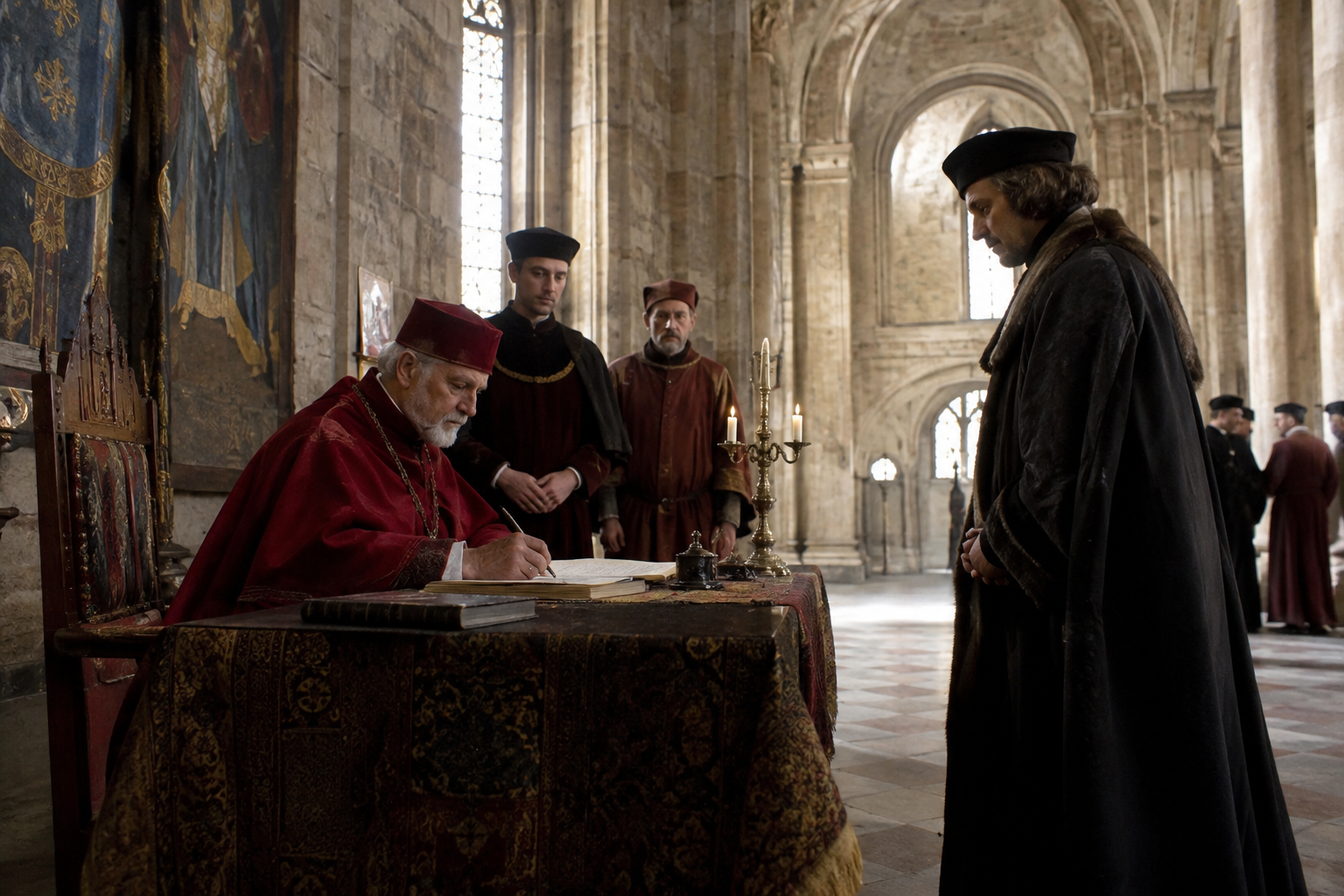
In 1429 AD, a man identified as R1286 was buried at the Cancelleria Basilica in Rome. On its own, that may sound like a neat archival footnote. But when a late medieval burial in the heart of papal Rome is associated with the Y-DNA haplogroup I1a1b1a1e2c, it opens a rather larger historical question: how did a paternal line usually discussed in northern European contexts come to appear in one of the great urban and ecclesiastical centers of late medieval Italy?
That is the interesting thing about Y-DNA. It follows one direct paternal line only, not a person's whole ancestry, language, or identity. But that narrow line can still be historically revealing. In the case of I1a1b1a1e2c, the most useful starting point is not a grand migration myth, but this single documented man in Rome, living in a city that had been drawing clerics, merchants, soldiers, pilgrims, and administrators from across Europe for centuries.
The sample we have here is sparely described: Late Medieval Cancelleria Basilica, 1429 AD, R1286. That means the evidence must be handled carefully. We should not invent a rank, an occupation, a cause of death, or a family history. Yet even with modest data, the context matters. A burial in Rome during the fifteenth century belongs to a world of intense movement, where the city functioned not simply as an Italian center but as a European crossroads.
For someone carrying I1a1b1a1e2c, that setting is historically plausible and genuinely interesting. The branch sits within the broader I1 family, a Y-chromosome lineage long associated with northern parts of Europe in both modern and ancient discussions. That does not mean every man in this subclade was "Germanic," still less that R1286 can be assigned a language or ethnicity from Y-DNA alone. It does mean that his paternal line fits well with the well-documented movement of northern and central European men into Italy across the Roman, post-Roman, and medieval centuries.
A broad ancient DNA study of populations connected to migrations and transformations across Europe, published in Science, helped establish just how mobile and mixed late antique and medieval populations could be. That wider lesson is useful here even if it does not by itself tell us the biography of R1286.
I1a1b1a1e2c is a very specific terminal-style label, but readers should resist the temptation to load the entire history of haplogroup I1 onto this exact twig. The parent lineage I1 has a deeper and broader story than any one sub-branch. A man assigned to I1a1b1a1e2c is not automatically a Viking, a Lombard, a Goth, or a medieval German merchant simply because those groups sometimes carried branches within I1.
Still, the broad historical backdrop is worth sketching. Across the first millennium AD and after, paternal lines within I1 appear in regions shaped by Scandinavian, North Sea, and continental northern European population histories. In southern Europe, such lineages can turn up through many kinds of movement: military service, church careers, trade, dynastic mobility, urban settlement, or earlier migration-period settlement that later disappeared into local society.
So the right way to read R1286 is modestly but not timidly. He is evidence that one paternal line within the I1 family was present in late medieval Rome. He is not proof that Rome had a "northern colony," nor that one medieval burial can stand for the city as a whole.
Late medieval Rome was not an isolated Italian town preserving some pure local past. It was a city repeatedly refashioned by empire, pilgrimage, papal government, and international patronage. Men arrived from the Holy Roman Empire, from the Italian peninsula, from Iberia, from the Balkans, and beyond. A paternal lineage that may have had stronger roots farther north could easily appear there without any need for melodrama.
This is exactly where genetics becomes most useful when paired with history rather than made to replace it. The Y chromosome marks one line of descent, while the city around R1286 was full of mixed households, multi-regional marriages, and institutions whose personnel came from many lands. In other words, his Y-DNA may point toward one paternal origin stream, while the rest of his ancestry and his lived identity may have been thoroughly shaped by medieval Rome.
That larger pattern of post-Roman and early medieval movement is easier to understand when set beside work on the Rhineland and adjacent zones, where ancient DNA has shown shifting mixtures rather than tidy ethnic blocks.
There is a slightly old-fashioned habit of treating Italy as though its medieval population history should be read only through Roman continuity. But archaeology has long shown that Italy was also a landing place, a frontier, and a meeting ground. Goths, Lombards, Franks, imperial officials, mercenaries, bishops, pilgrims, and merchants all passed through or settled at different times. Ancient DNA has steadily reinforced that picture of layered continuity and incoming diversity.
For that reason, an I1-derived paternal branch in a late medieval Roman burial should not be read as an anomaly requiring a heroic saga. It is better understood as one thread in a dense urban tapestry of movement. Research on early medieval Germany and frontier regions has also emphasized long-distance mobility, including individuals whose lives crossed cultural and geographic boundaries in ways older historical models often missed.
Migration in early medieval Germany
That does not mean R1286 himself had recently migrated from the north. He may have belonged to a family long established in Italy, with only the paternal line preserving a deeper geographic signal. Or he may have been part of a more recent stream of movement into Rome. With the evidence currently in hand, both remain possible.
Because broader I1 lineages are often discussed alongside the spread of Germanic-speaking populations, it is tempting to jump straight from haplogroup to language. That is too simple. Language spreads through households, patronage, conquest, trade, prestige, and everyday accommodation; Y-DNA traces only one male line. A man with I1a1b1a1e2c in fifteenth-century Rome may have spoken Italian, Latin in ecclesiastical settings, German, or something else entirely. The genetic result does not decide the matter.
But the comparison is still useful at the population level. Studies exploring the spread of Germanic languages through ancient genomics have shown that migration and language history can intersect, while also refusing to line up neatly in one-to-one fashion. That is a valuable caution for anyone tracing this haplogroup today: paternal ancestry can preserve evidence of old movements long after language and culture have changed.
The most responsible historical insight from this evidence is not a claim of famous descent or a single fixed homeland. It is something subtler and, in truth, more interesting. I1a1b1a1e2c, as represented here by R1286 of the Cancelleria Basilica, shows how a paternal line with wider northern European associations could be fully part of life in late medieval Rome. That is the real historical lesson: lineages move, cities absorb them, and identities become local long before the DNA stops remembering older connections.
For MyTrueAncestry users, that means this haplogroup may point toward a paternal history tied to the wider movements of northern and central Europeans, but its documented appearance in Rome is a reminder not to think in straight lines. Your direct male line may have passed through courts, ports, bishoprics, market towns, or frontier zones that written family memory never preserved.
Comments